
Inverted nipples occur when one or both nipples turn inward instead of projecting outward from the breast. They may be present from birth, develop during puberty, or appear later in adulthood. While longstanding nipple inversion is often a normal anatomical variation, newly developed inversion can sometimes indicate an underlying breast condition that needs medical evaluation.
The causes of inverted nipples vary from naturally short milk ducts and tight supporting tissue to changes associated with inflammation, scarring or other breast conditions. Understanding the difference between congenital and acquired nipple inversion can help you recognise when reassurance may be sufficient and when professional assessment is important.
At Pink Apple Aesthetics, Bangalore, individuals considering inverted nipple correction should first understand the possible cause of the condition before deciding whether treatment is appropriate.
What Causes Inverted Nipples?
The most common explanations for inverted nipples involve differences in breast development or the structures that support the nipple. In some individuals, the nipple is pulled inward by short milk ducts or tight fibrous tissue beneath it. In others, inversion develops because of changes in the breast over time.
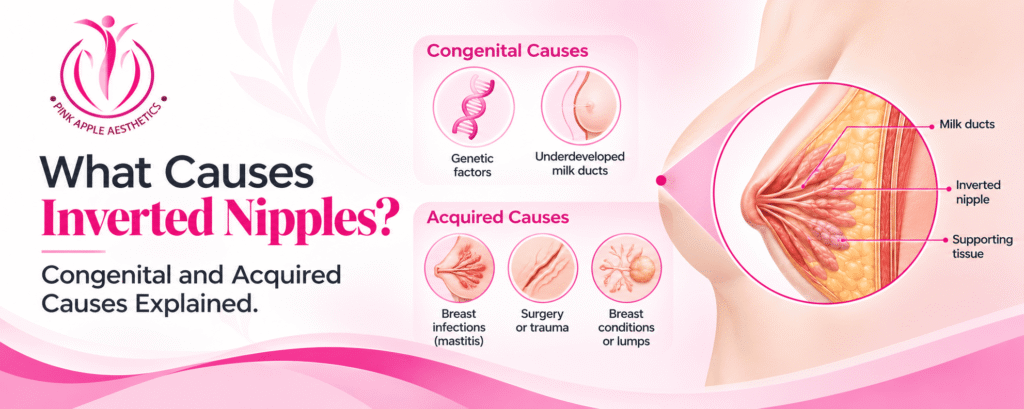
The main causes can be divided into two categories:
- Congenital nipple inversion: Present from birth or noticed during breast development.
- Acquired nipple inversion: Develops later in life, particularly when the nipple previously projected outward or its appearance changes noticeably.
This distinction is important because congenital inversion is often harmless, whereas new or unexplained inversion may require investigation.
1. Congenital Causes of Inverted Nipples
Congenital nipple inversion is a common anatomical variation. It occurs when the nipple and surrounding supporting structures develop in a way that causes the nipple to sit inward.
Developmental differences in breast anatomy
During breast development, the nipple, milk ducts and surrounding connective tissue form as part of the breast’s normal anatomical structures.
In some individuals, these structures do not provide enough outward support for the nipple to project normally. The nipple may therefore remain flat or turn inward.
Congenital inversion can affect one breast or both breasts. It may become more noticeable during puberty as the breasts develop.
If the appearance has remained stable and there are no associated symptoms, congenital inversion is often not a medical concern.
Short or tight milk ducts
Milk ducts carry breast milk towards the nipple. When these ducts are relatively short or tight, they can exert an inward pull on the nipple.
This is one of the structural factors associated with congenital nipple inversion.
The degree of tethering varies. Some nipples can be brought outward relatively easily, while others retract immediately or remain inverted.
Ductal tethering is also important when considering surgery because releasing these structures may improve projection but can affect breastfeeding, depending on the technique.
Tight connective or fibrous tissue
Connective tissue supports the nipple and helps maintain its position. If the tissue beneath the nipple is tight or restrictive, it can pull the nipple inward.
The combination of tight connective tissue, ductal shortening and individual anatomical differences determines how pronounced the inversion may be.
The precise cause cannot always be identified from appearance alone. A clinical examination can help determine the likely anatomical factors.
Family or inherited anatomical tendencies
Breast and nipple anatomy can vary between family members. Some people may notice similar nipple characteristics among relatives.
However, family history alone does not establish the cause of nipple inversion, and there is no need to assume that an inherited condition is responsible without an assessment.
2. Acquired Causes of Inverted Nipples
Acquired nipple inversion develops after the nipple has previously projected outward or when its appearance changes later in life.
Possible causes include changes in breast tissue, inflammation, scarring and certain underlying breast conditions.
Breast ageing and tissue changes
Breast tissue, skin elasticity and supporting structures change with age. These changes can alter the shape and position of the breast and nipple.
However, ageing should not automatically be considered the explanation for a newly inverted nipple.
If nipple position changes noticeably in adulthood, especially on one side, a healthcare professional should assess the change to identify any underlying cause.
Pregnancy and breastfeeding-related changes
Pregnancy and breastfeeding can cause changes in breast size, tissue composition, skin elasticity and nipple appearance.
Some individuals notice changes in nipple projection during these periods. Breastfeeding-related inflammation or scarring may also contribute to changes in the surrounding tissue.
Persistent or newly acquired inversion should be evaluated when appropriate, particularly if it is associated with pain, a breast lump, unusual discharge or other changes.
Breast infection and inflammation
Breast inflammation or infection can affect the tissues around the nipple and may lead to changes in its appearance.
Symptoms can include:
- Breast pain or tenderness.
- Redness or warmth.
- Swelling.
- Fever or feeling unwell.
- A painful area or lump.
Inflammation can sometimes cause tissue changes that pull the nipple inward. A healthcare professional should evaluate suspected infection because treatment depends on the underlying cause.
Persistent inflammation or nipple inversion that does not resolve also requires further assessment.
Scar tissue after breast surgery or injury
Previous breast surgery, an injury or tissue damage can lead to scar formation. Scar tissue may tighten and pull the nipple inward.
The likelihood of this occurring depends on the location and extent of the scar, the procedure performed and individual healing.
If inversion develops following breast surgery, inform your treating surgeon. An assessment can help distinguish expected healing changes from complications or other conditions.
Duct ectasia and other benign breast conditions
Mammary duct ectasia occurs when a milk duct widens and its walls become inflamed or thickened. It can cause nipple discharge, tenderness or nipple retraction in some individuals.
Other benign breast conditions can also affect the tissues surrounding the nipple.
Although these conditions are not necessarily cancerous, persistent symptoms or newly developed inversion should be assessed rather than assumed to be harmless.
Breast cancer
Breast cancer is an important, though not the only, possible cause of acquired nipple inversion.
A tumour or other disease-related tissue change may pull the nipple inward or alter the surrounding breast tissue. This is particularly concerning when the change is new, persistent or affects only one breast.
Possible warning signs include:
- A new breast lump or area of thickening.
- New nipple inversion or retraction.
- Bloody or unexplained nipple discharge.
- Skin dimpling or puckering.
- Persistent redness, thickening or changes around the nipple.
- A new change in breast shape or size.
These symptoms do not automatically mean that cancer is present. However, they warrant prompt medical evaluation.
Do not assume that newly inverted nipples are a cosmetic concern until an underlying breast condition has been assessed.
3. Why Does One Nipple Turn Inward Suddenly?
A nipple that becomes inverted suddenly or over a relatively short period deserves particular attention, especially if the change affects only one breast.
Possible explanations include inflammation, duct-related changes, scar tissue or an underlying breast condition. The cause cannot be reliably determined from the appearance of the nipple alone.
Arrange a prompt appointment with a qualified healthcare professional if you notice:
- A nipple that was previously outward-projecting but has become inverted.
- A new change affecting only one nipple.
- A breast lump, unusual discharge or skin changes.
- Persistent breast pain or swelling accompanying the change.
If there is fever, significant redness, warmth or rapidly worsening pain, seek urgent medical assessment because an infection or other acute condition may require timely treatment.
A clinician may recommend a breast examination and, depending on your age, symptoms and findings, diagnostic imaging or other investigations.
4. Can Hormonal Changes Cause Inverted Nipples?
Hormonal changes can affect breast tissue and nipple appearance, particularly during puberty, pregnancy and breastfeeding.
However, hormones alone should not automatically be assumed to cause persistent nipple inversion.
Structural factors such as short milk ducts and tight connective tissue may play a more direct role in longstanding inversion. When inversion appears newly in adulthood, assessment is important to identify or rule out other causes.
5. Are Inverted Nipples Always a Medical Problem?
No. Inverted nipples that have been present since birth or puberty and have remained unchanged are often a normal anatomical variation.
Some individuals experience no discomfort or functional difficulties. Others may have concerns about appearance, self-confidence, hygiene or breastfeeding.
Treatment is not automatically necessary simply because the nipple is inverted.
The important consideration is whether the condition is longstanding and stable or represents a new change. Any new, unexplained inversion should be evaluated before cosmetic treatment is considered.
6. How Do Doctors Identify the Cause of Inverted Nipples?
The evaluation depends on whether the inversion is congenital, longstanding or newly acquired.
A healthcare professional may consider:
Medical history: When the inversion began, whether it affects one or both breasts, and whether there have been recent changes.
Breast examination: Assessment of the nipple, areola and surrounding breast tissue, including any lump, tenderness, discharge or skin change.
Imaging: Ultrasound, mammography or other investigations may be recommended according to the patient’s age, symptoms and examination findings.
Further assessment: If the examination or imaging identifies a suspicious abnormality, additional investigations may be necessary.
Not every person with longstanding congenital inversion needs imaging or extensive investigation. The appropriate approach depends on the clinical circumstances.
6. What Treatment Is Available for Inverted Nipples?
Treatment should be based on the cause rather than appearance alone.
Observation
If the inversion is longstanding, stable and not associated with concerning symptoms, treatment may not be necessary.
Treatment of the underlying cause
When inversion is associated with infection, inflammation, scarring or another breast condition, the underlying problem should be evaluated and managed first.
Non-surgical approaches
Selected nipple eversion devices may help some individuals, depending on the degree of inversion and the underlying anatomy. Results vary, and these approaches may not provide lasting correction.
Inverted nipple correction surgery
Surgery may be considered for individuals who want to improve nipple projection and whose anatomy is suitable for correction.
The procedure may involve releasing tight tissue or modifying the supporting structures beneath the nipple. The approach depends on the severity of inversion, the cause and the patient’s goals.
Potential effects on breastfeeding, nipple sensation, scarring and recurrence should be discussed before surgery.
Important: Cosmetic correction should not replace medical evaluation of newly developed or unexplained nipple inversion.
8. When Should You Consider Inverted Nipple Correction?
If your nipples have been inverted for many years and there are no concerning symptoms, you may choose to seek a consultation for personal or cosmetic reasons.
Before proceeding, a qualified plastic surgeon can assess the degree of inversion, discuss treatment options and explain the expected benefits and risks.
If the inversion is new, however, the priority is medical evaluation to identify the cause before considering a cosmetic procedure.
People planning future pregnancies or breastfeeding should also discuss whether a proposed technique preserves the milk ducts and what this means for future breastfeeding.
Inverted Nipple Assessment and Correction at Pink Apple Aesthetics, Bangalore
Individuals concerned about longstanding inverted nipples can seek a consultation to understand their anatomy and available options.
At Pink Apple Aesthetics, Bangalore, an appropriate treatment discussion should consider the history of the inversion, clinical findings, individual expectations and any plans for future breastfeeding.
Depending on the assessment, the appropriate recommendation may be observation, a non-surgical option or surgical correction. A new or unexplained change in nipple appearance should first receive appropriate medical evaluation.
Considering treatment for longstanding inverted nipples? Contact Pink Apple Aesthetics to enquire about a consultation and learn which options may be suitable for you.
[Book a Consultation with Pink Apple Aesthetics]
Frequently Asked Questions About the Causes of Inverted Nipples
1. What is the most common cause of inverted nipples
Longstanding nipple inversion is often associated with developmental differences in breast anatomy, including short milk ducts or tight connective tissue that pulls the nipple inward. The exact cause varies between individuals.
2. Can inverted nipples develop later in life?
Yes. Acquired nipple inversion can develop because of inflammation, duct-related changes, scarring, previous surgery or an underlying breast condition. New inversion should be medically assessed.
3. Are inverted nipples hereditary?
Similar nipple characteristics may occur among family members, but family history alone does not establish the cause. Inverted nipples can result from several anatomical factors.
4. Why has one of my nipples suddenly turned inward?
Possible causes include inflammation, duct-related changes, scar tissue and underlying breast conditions. Because sudden or newly acquired inversion can occasionally indicate a serious problem, arrange a prompt medical assessment, particularly if there is a lump, discharge or skin change.
5. Can breastfeeding cause inverted nipples?
Pregnancy and breastfeeding can alter breast tissue and nipple appearance. Inflammation, scarring and other changes may contribute to inversion in some individuals. Persistent or new changes should be evaluated when appropriate.
6. Can breast cancer cause inverted nipples?
Yes. Breast cancer can sometimes cause new nipple retraction, although many other conditions can also cause it. A newly inverted nipple, especially on one side or with a lump, bloody discharge or skin changes, requires prompt medical evaluation.
7. Can inverted nipples be corrected without surgery?
Some individuals may benefit from selected eversion devices or other non-surgical approaches. Effectiveness depends on the degree of inversion and its cause. Significant structural tethering may require a different approach if correction is desired.
8. Does every person with inverted nipples need treatment?
No. Stable, longstanding inversion is often a normal anatomical variation. Treatment is a personal decision when there are no concerning symptoms, while newly acquired inversion should be evaluated first.
9. Can inverted nipples affect breastfeeding?
They can sometimes make latching more difficult, although many people with inverted nipples can breastfeed successfully. The degree of inversion, the baby’s latch and other factors influence feeding. Surgical correction may affect milk ducts, so breastfeeding plans should be discussed before treatment.
10. Which doctor should I consult for newly inverted nipples?
A qualified healthcare professional, such as a breast specialist or an appropriate primary care clinician, can evaluate new inversion and arrange further investigations if needed. A plastic surgeon may be consulted for longstanding inversion once relevant medical concerns have been assessed.
Conclusion
The causes of inverted nipples range from congenital differences in breast development to acquired changes involving inflammation, ductal conditions, scar tissue or, occasionally, breast cancer.
Longstanding, stable inversion is often harmless. Newly developed inversion, particularly when it affects one breast or occurs alongside a lump, unusual discharge or skin changes, requires prompt medical evaluation.
Understanding the underlying cause is the first step towards making an informed decision about treatment. Depending on the circumstances, management may involve observation, treatment of an underlying condition or elective inverted nipple correction.
For individuals considering correction of longstanding inverted nipples, a consultation at Pink Apple Aesthetics, Bangalore, can help clarify the available options and the factors to consider before proceeding.


