Facelift Surgery in Bangalore
At Pink Apple Aesthetics, Jayanagar, facelift surgery (rhytidectomy) is performed by Dr. Pinky Devi Ayyappan, MCh (Plastic Surgery) — a board-certified plastic and reconstructive surgeon with over 12 years of experience, trained in facial aesthetic surgery at internationally recognised centres in Seoul, Belgium, and Italy.
What Is Facelift Surgery (Rhytidectomy)?
Facelift surgery — medically known as rhytidectomy — is a surgical procedure that addresses the visible signs of facial ageing by lifting and repositioning the deeper structural layers of the face, tightening the underlying muscles, and removing or redistributing excess skin. The result is a face that looks naturally rested and years younger — not pulled, distorted, or ‘done’.
Modern facelift surgery is a significant advancement from older techniques that simply tightened the skin. Today’s gold-standard procedures work at the level of the SMAS — the Superficial Musculoaponeurotic System — a layer of muscle and fibrous tissue that lies beneath the skin and provides the face with its structural support. By repositioning the SMAS rather than just tugging at the skin, contemporary facelifts produce results that move naturally, heal well, and last considerably longer.
A facelift can effectively address:
- Jowls — the loss of jawline definition caused by skin and fat descending along the lower face.
- Deep nasolabial folds — the grooves running from the nose to the corners of the mouth that deepen with age.
- Sagging cheeks and midface descent — as the fat pads of the cheeks migrate downward over decades.
- Loose skin along the jaw and neck — including the early formation of a 'turkey neck' or neck bands.
- Loss of overall facial contour — the general softening of the facial outline that comes with age-related tissue laxity.

A facelift does not address forehead lines, crow’s feet, the appearance of the eyelids, or skin texture. These are often addressed with complementary procedures — Dr. Pinky will discuss the full picture during your consultation.
Facelift Before & After Results
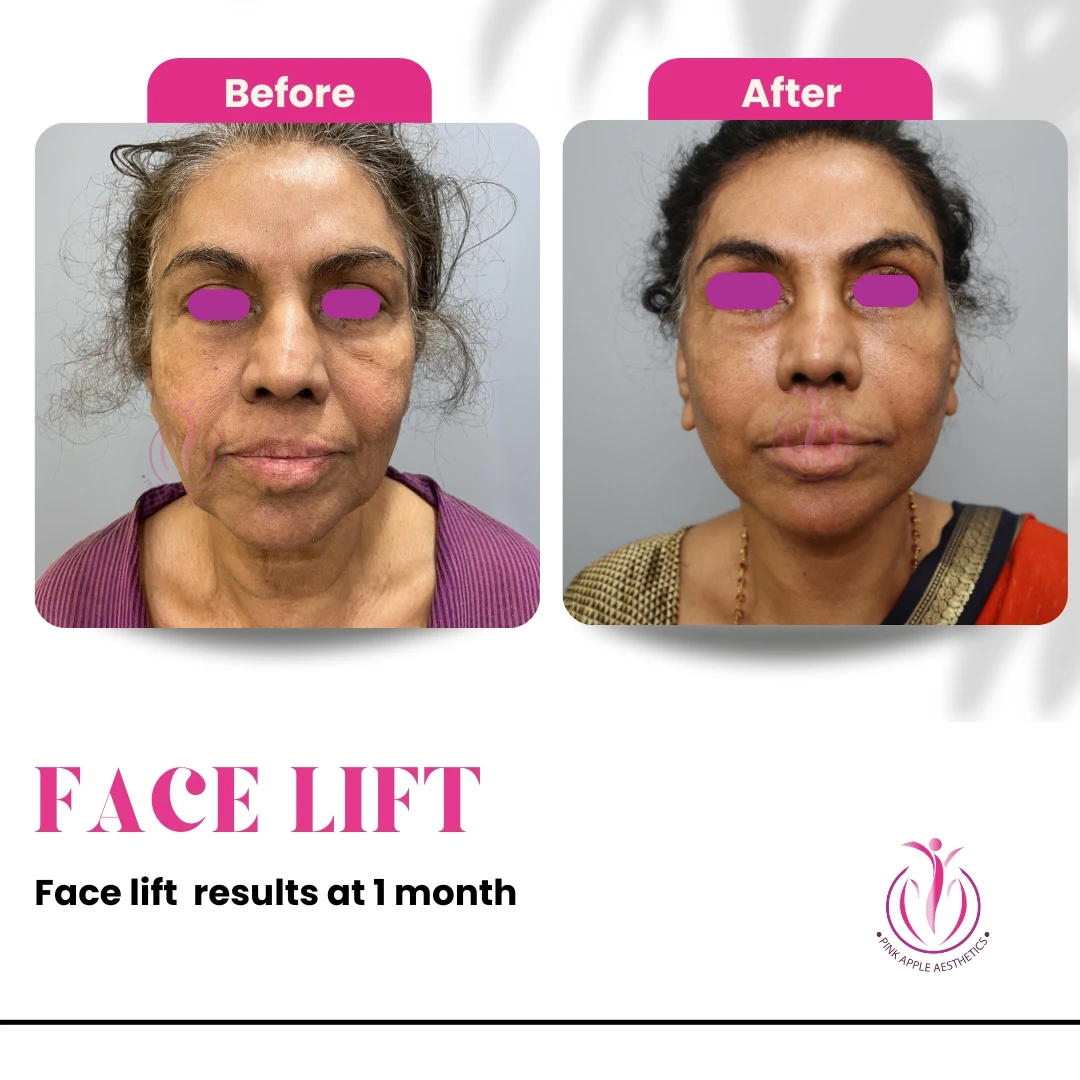


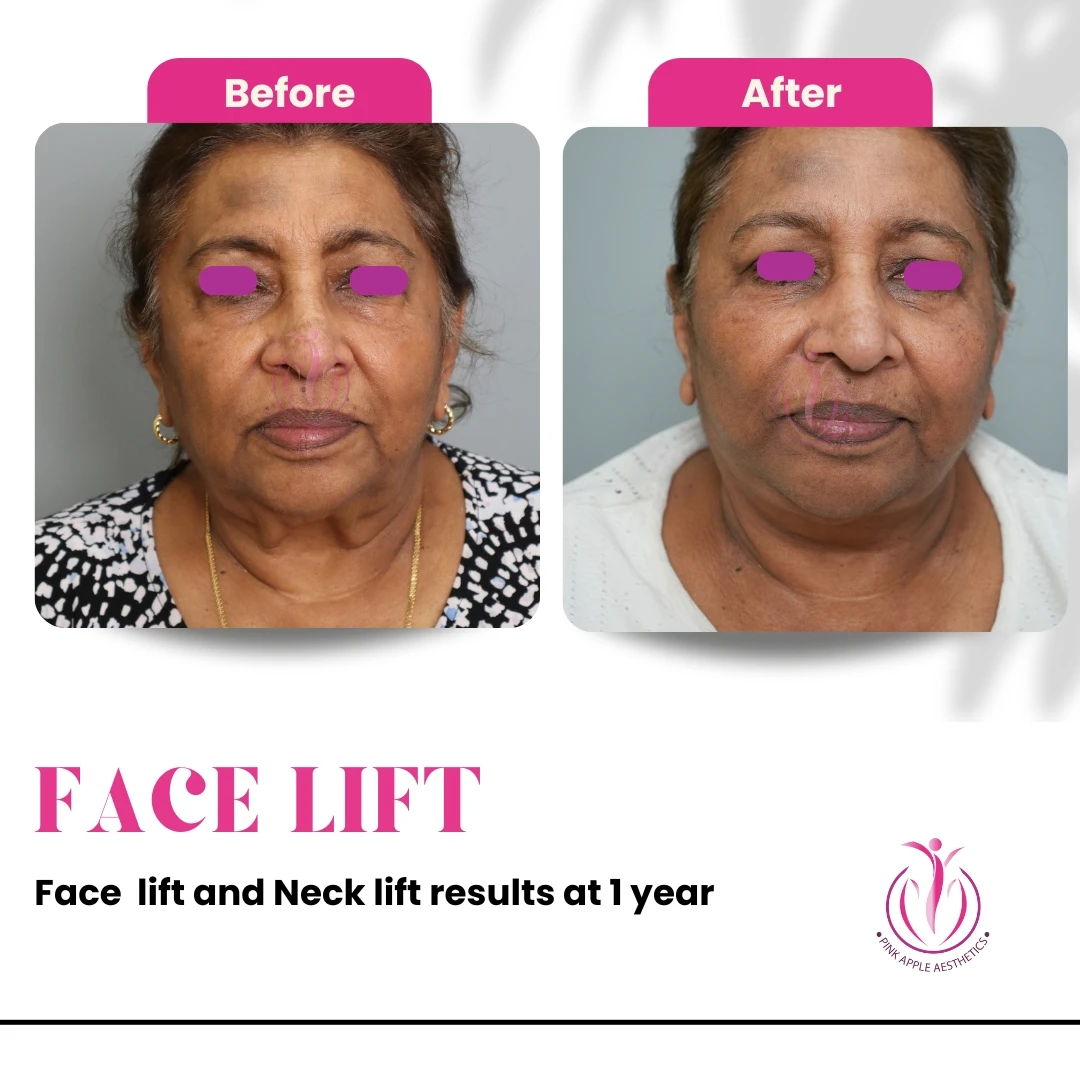
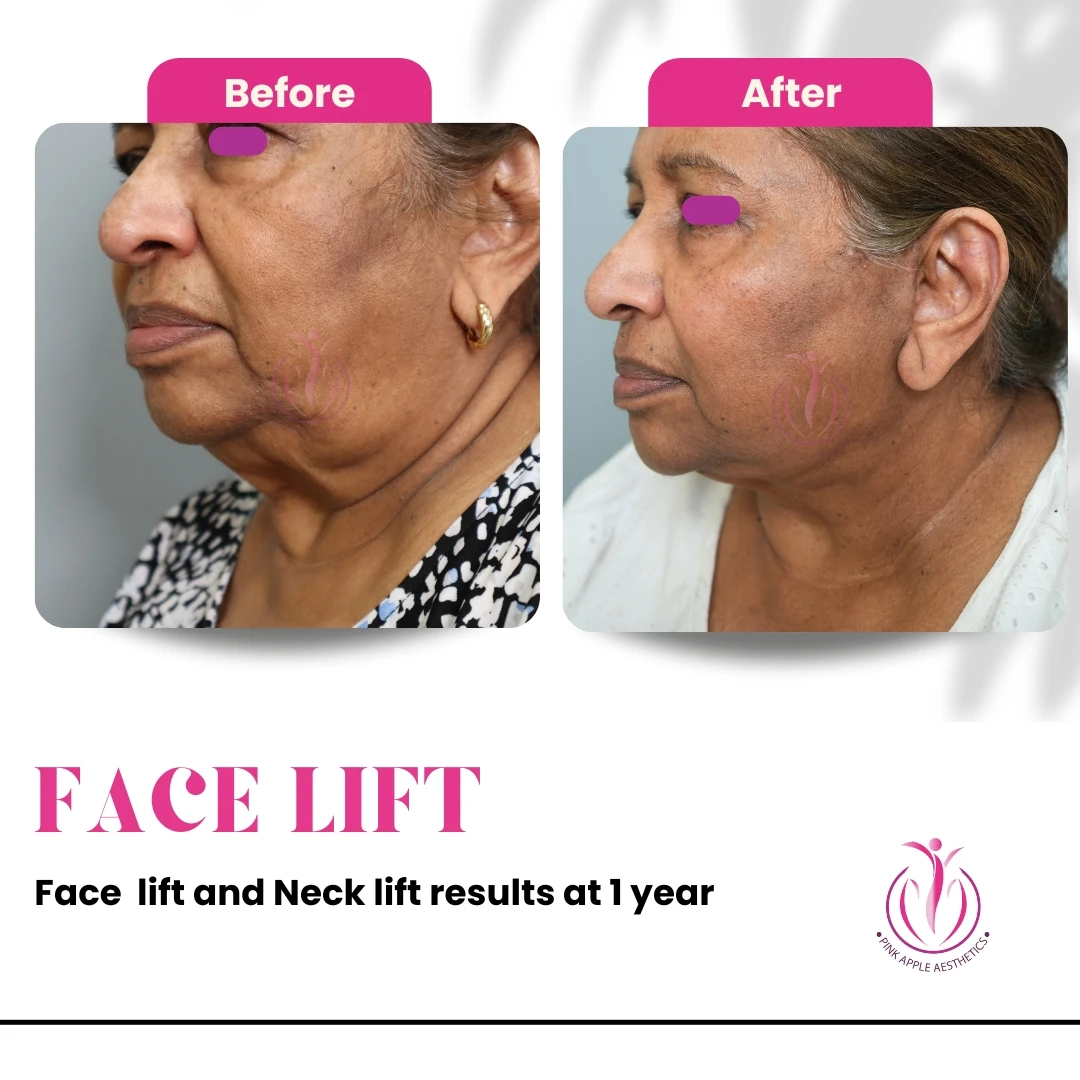
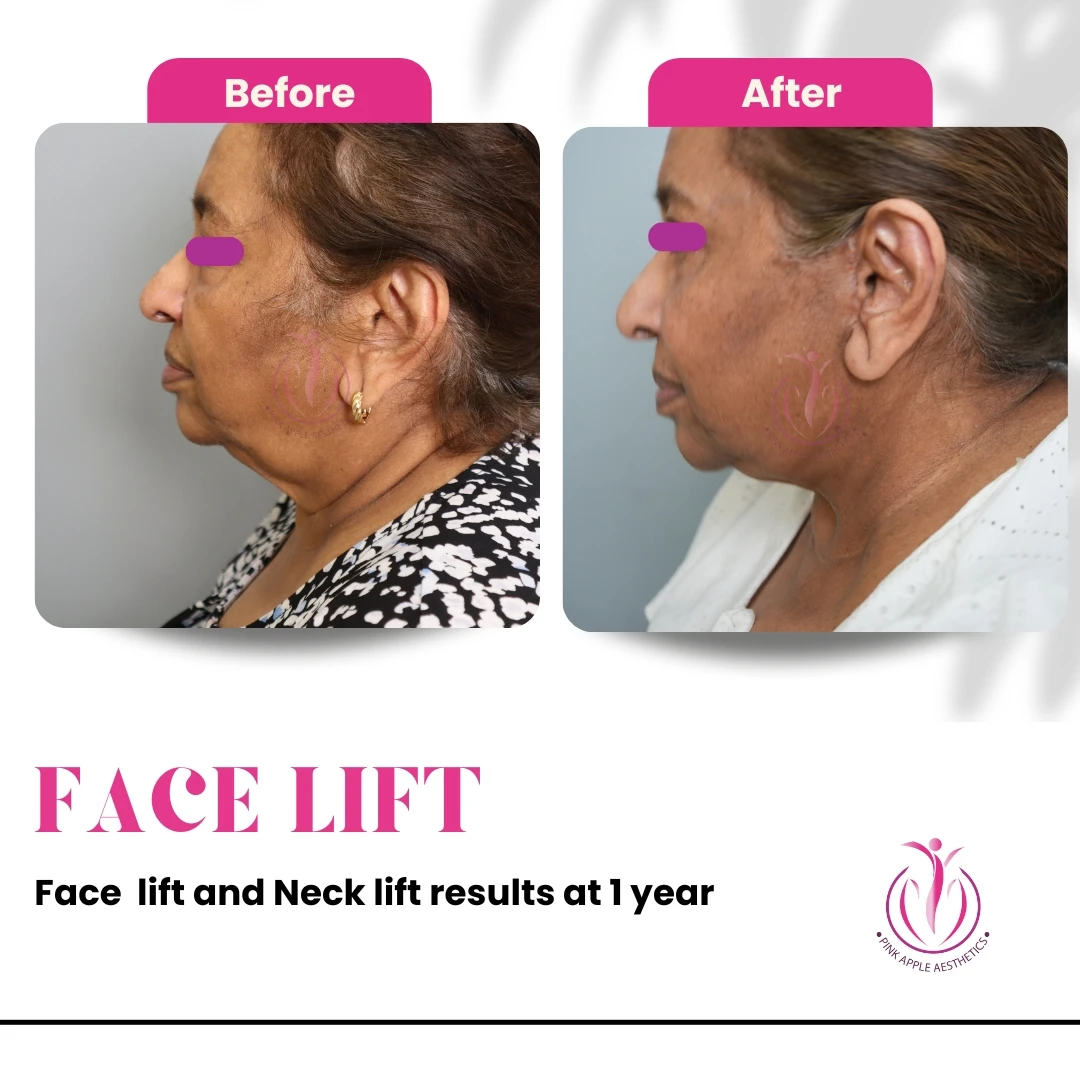
Results shown are from actual patients of Dr. Pinky Devi Ayyappan at Pink Apple Aesthetics, Bangalore. Individual outcomes vary based on facial anatomy, degree of ageing, technique used, and the specific goals discussed in consultation. All images are shared with patient consent.
How Indian Skin Ages — and Why It Matters for Facelift Planning
Indian and South Asian skin has distinct characteristics that affect both how it ages and how a facelift should be planned. Understanding this is an important part of getting a natural-looking result.
Indian skin tends to have higher melanin content and slightly greater dermal thickness compared to lighter skin types. This means that Indian patients often maintain skin texture and elasticity for longer — the visible signs of ageing can appear a decade later than in lighter-skinned patients of the same age. When ageing does become visible, it often presents differently:
- Volume loss and fat descent — rather than fine wrinkling, Indian patients often see prominent nasolabial folds, jowling, and heaviness in the lower face caused by fat migration.
- Pigmentation changes — age-related pigmentation, melasma, and uneven skin tone are more common and require separate management alongside surgical rejuvenation.
- Neck heaviness — neck and submental (under-chin) fullness with moderate skin laxity is a frequent presentation.
- Earlier loss of defined jawline — jowl formation can be the first significant sign of facial ageing in many Indian patients.
A facelift surgeon treating Indian patients must account for these differences. Lifting vectors need to be appropriate for the facial fat distribution, skin thickness, and the natural proportions of the South Asian face — not simply copied from a Western approach. Dr. Pinky’s training in Seoul, where facial aesthetics for Asian anatomies are the primary focus, makes her particularly equipped to plan and execute facelifts that work with Indian facial structure.
Facelift Surgery Cost at Pink Apple Aesthetics
Facelift surgery at Pink Apple Aesthetics starts from ₹3,00,000 to ₹3,50,000 (terms and conditions apply). Your confirmed cost will be provided after a personal consultation with Dr. Pinky, once your facial anatomy and specific goals have been assessed.
A facelift is a significant, highly personalised procedure — the cost reflects the surgical complexity, the specific technique used, the operating time required, and the aftercare involved. We do not quote a single fixed price without examining you, because the right procedure varies considerably from patient to patient.
What your facelift cost typically includes:
- Surgeon's fee — Dr. Pinky Devi Ayyappan, MCh Plastic Surgery.
- Anaesthesia and anaesthesiologist's fee — facelift surgery is performed under general anaesthesia.
- Surgical facility / operating theatre charges.
- One night of post-operative care — most facelift patients are admitted for one night.
- Dressings and compression garments — worn in the first days after surgery for support and comfort.
- Pre-operative blood tests and investigations.
- Follow-up appointments — scheduled at 1 week, 1 month, 3 months and 6 months.
Factors that influence the final cost:
- Type of facelift technique — a mini facelift is less involved than a full SMAS facelift; a deep plane procedure requires additional surgical time and expertise.
- Whether a neck lift is included — combining facelift with neck lift (the most common approach) involves additional surgical steps.
- Combination procedures — patients who address the brow, eyelids, or other areas in the same session will have a different total cost than a facelift alone.
- Anaesthesia duration — longer, more complex surgeries involve extended anaesthesiologist time.
Facelift surgery is a cosmetic procedure and is not covered by health insurance. EMI payment options are available at Pink Apple Aesthetics. Please discuss financing preferences at your consultation.
Types of Facelift Surgery at Pink Apple Aesthetics
The right facelift technique depends on your age, the extent of ageing changes, which areas of the face are affected, and your recovery preferences. Dr. Pinky will assess all of these during your consultation before recommending an approach.
1. Mini Facelift
A mini facelift — sometimes called a short-scar facelift or S-lift — uses smaller incisions, typically around the ear, to lift and tighten the lower face and jawline. It is best suited to patients in their late 30s to early 50s who have early jowling, mild skin laxity, and want a meaningful improvement without the recovery commitment of a full facelift. Results are natural and the procedure can be performed under local anaesthesia with sedation in many cases. Recovery is faster, typically 7 to 10 days.
2. SMAS Facelift (Traditional Full Facelift)
The SMAS facelift is the established gold standard for comprehensive facial rejuvenation and the most widely performed facelift technique. Incisions are placed along the hairline, around the ear, and sometimes beneath the chin. The surgeon lifts and repositions the SMAS layer — the structural muscle and tissue layer beneath the skin — and tightens the overlying skin separately. Because the skin is not bearing the tension of the lift (the SMAS carries it), the result looks natural and lasts considerably longer than older skin-only techniques.
SMAS facelifts are particularly effective for patients in their 40s to early 60s with moderate facial ageing, jowling, and lower face and neck laxity. Results typically last 7 to 10 years.
3. Deep Plane Facelift
The deep plane facelift is the most advanced facelift technique available today, and the most technically demanding. Unlike the SMAS facelift — which tightens the SMAS by folding or plicating it — the deep plane approach lifts the SMAS and underlying fat pads together as a single composite unit, after releasing the deep retaining ligaments of the face. This allows the cheeks, midface, and nasolabial folds to be lifted more completely and with far less tension on the overlying skin.
The result is extremely natural-looking — there is no pulled or tight appearance because the skin is under minimal tension. The deep plane facelift is particularly effective for patients with significant midface descent, deep nasolabial folds, heavy jowling, and more advanced ageing in the 50s to 60s and beyond. Results typically last 10 to 15 years.
The deep plane facelift requires extensive surgical training to perform safely. Dr. Pinky's fellowship at the clinic of Dr. Patrick Tonnard and Dr. Alexis Verpaele in Belgium — two globally recognised leaders in facial rejuvenation — included training in deep-layer facial techniques. This level of training is not common among facelift surgeons in Bangalore.
4. Mid Facelift (Cheek Lift)
The mid facelift focuses specifically on the midface — the cheeks and the area beneath the eyes. As the cheek fat pads descend with age, this creates hollowing under the eyes, prominent nasolabial folds, and a flattening of the cheek contour. A mid facelift restores volume and lift to this zone. It is often combined with lower blepharoplasty (eyelid surgery) for comprehensive periorbital and midface rejuvenation.
5. Neck Lift (Platysmaplasty)
A neck lift addresses loose skin, neck bands (caused by the platysma muscle), and excess fat in the neck and submental (under-chin) area. It is frequently performed in combination with a facelift to ensure the neck and face age cohesively after surgery — a facelift that does not address the neck can look incomplete. As an independent procedure, a neck lift is an excellent option for patients whose primary concern is the neck and jawline rather than the mid or upper face.
6. Combined Facelift + Neck Lift
The most complete lower face and neck rejuvenation is achieved when a facelift and neck lift are performed together in a single surgical session. This is the most common approach at Pink Apple Aesthetics for patients with significant lower face and neck ageing, ensuring both areas are lifted and contoured cohesively for the most natural and long-lasting outcome.
Are You a Good Candidate for Facelift Surgery?
A facelift delivers the best results when the patient is well selected. The following characteristics describe a suitable candidate:
- Visible signs of lower face and neck ageing — jowling, sagging cheeks, deep nasolabial folds, or neck laxity that bother you and affect how you feel about your appearance.
- Some remaining skin elasticity — facelift surgery works with your tissue. While significant laxity can be addressed, some residual tissue quality produces the best results.
- Good general health — no uncontrolled medical conditions such as poorly managed hypertension, diabetes, or significant cardiovascular disease.
- Non-smoker, or willing to stop smoking — nicotine seriously impairs blood supply to the skin and dramatically increases the risk of wound healing complications after facelift surgery. Stopping for a minimum of 4 to 6 weeks before and after surgery is essential.
- Realistic expectations — a facelift restores a more youthful version of your own face. It does not change your bone structure, alter your ethnicity, or stop the ageing process. Results are lasting but not permanent.
- Aged 40 or above in most cases — although there is no fixed minimum, most facelift patients are in their 40s to 60s. Age is not the deciding factor — the extent of ageing changes is.
If you have a history of significant medical conditions, are taking anticoagulant medications, or have had previous facial surgery, please disclose this fully at your consultation. These factors are manageable but need to be carefully planned for.
What to Expect: From Consultation to Your Result
Step 1 — Consultation
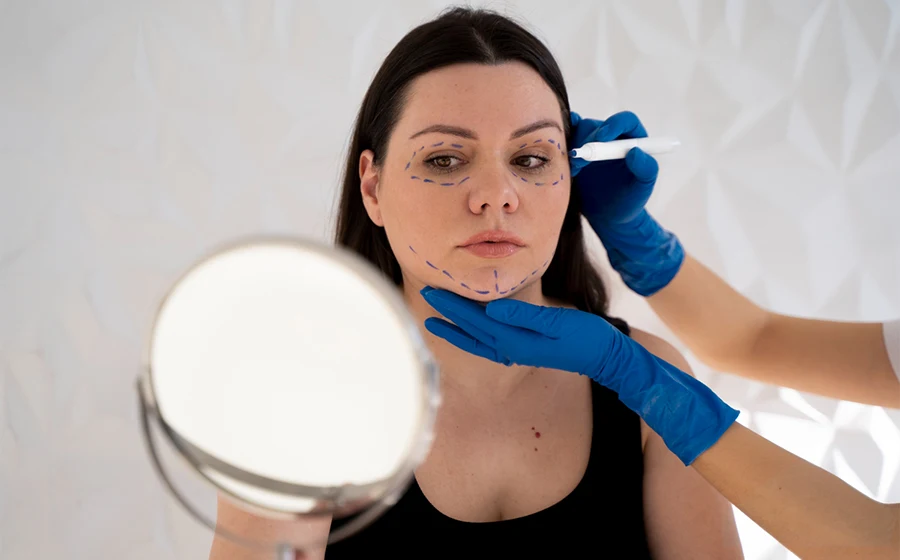
Dr. Pinky will spend significant time in your consultation — assessing your skin quality, facial fat distribution, degree of laxity, and bone structure. She will discuss which facelift technique suits your anatomy and goals, show you imaging previews, and walk you through the surgical plan in plain language. She will also take a full medical history.
Facelift consultations at Pink Apple Aesthetics are unhurried, honest, and thorough. If Dr. Pinky believes a non-surgical approach or a less extensive procedure would give you the result you want, she will tell you. No facelift is recommended unless it is the right choice for you.
Step 2 — Pre-Operative Preparation
4 to 6 weeks before surgery: stop smoking entirely. 1 to 2 weeks before: stop aspirin, blood thinners, certain supplements (fish oil, vitamin E, ginkgo). You will have blood tests and a medical clearance. Arrange for a trusted adult to be with you at home for the first 48 to 72 hours after surgery.
Step 3 — The Surgery
Facelift surgery is performed under general anaesthesia and typically takes 3 to 5 hours, depending on the technique and whether a neck lift is included. The procedure is done in a fully equipped surgical facility. Most patients are admitted for one night and discharged the following morning.
Incisions are placed with great care — along the natural creases in front of the ear, continuing behind the ear into the hairline — so that scars are hidden in natural folds and the hairline remains undisturbed.
Step 4 — The First Two Weeks
A light surgical dressing or compression garment around the face and neck is worn for the first several days. Bruising and swelling are expected and normal — they peak around day 3 to 4 and then gradually subside. Drains, if used, are typically removed within 24 to 48 hours. Sutures are removed at 7 to 10 days. Most patients feel comfortable to be seen socially and return to desk work at 2 weeks, though residual swelling remains.
Step 5 — Weeks 3 to 8
By week 3, most patients look and feel significantly better and the improvement is clearly visible. Residual swelling — particularly in the cheeks and along the jawline — continues to resolve over the following weeks. Numbness or altered sensation around the ears and cheeks is normal and gradually resolves. Strenuous exercise and heavy lifting should be avoided for 4 to 6 weeks.
Step 6 — Your Final Result
The final, fully settled result of facelift surgery becomes visible at around 3 to 6 months, when all swelling has resolved and the skin has fully adapted to its new position. The results are long-lasting: a SMAS facelift typically maintains its effect for 7 to 10 years; a deep plane facelift for 10 to 15 years. The ageing process continues, but from a significantly improved baseline.
What Are the Risks of Facelift Surgery?
Facelift surgery performed by a qualified plastic surgeon in a proper surgical facility has a well-established safety record. However, as a significant surgical procedure, it carries risks that every patient must be clearly informed about:
- Bruising and swelling — expected and temporary, peaking at 3 to 4 days and resolving over 2 to 4 weeks.
- Haematoma (blood pooling) — the most common serious complication of facelift surgery. Occurs in 1 to 3% of cases and requires prompt surgical drainage if it develops. More common in patients who smoke or have uncontrolled hypertension.
- Nerve injury — temporary numbness in the cheeks, ears, and neck is common. Temporary weakness of facial expression muscles can rarely occur and in nearly all cases resolves completely. Permanent nerve damage is rare.
- Skin healing issues — poor wound healing, particularly around the ear or in areas of tension, is significantly more common in smokers. This is one of the primary reasons smoking cessation is non-negotiable before this procedure.
- Infection — uncommon; managed with antibiotics. Preventive antibiotics are given at the time of surgery.
- Scarring — facelift scars are placed in natural creases and the hairline. Abnormal or visible scarring can occasionally occur; it is managed with scar treatments if needed.
- Hair loss around incisions — temporary hair thinning near the temporal hairline incision can occur and typically resolves over several months.
- Asymmetry — some minor asymmetry during healing is normal. Significant asymmetry requiring revision is uncommon with experienced technique.
- Need for revision — a small proportion of patients may wish for further refinement after the initial healing period, typically after 12 months.
Dr. Pinky will discuss all risks in full during your consultation, in the context of your specific health history and anatomy. There are no shortcuts taken at Pink Apple Aesthetics — every patient is fully informed before any decision is made.
Facelift Surgery vs. Non-Surgical Alternatives — An Honest Comparison
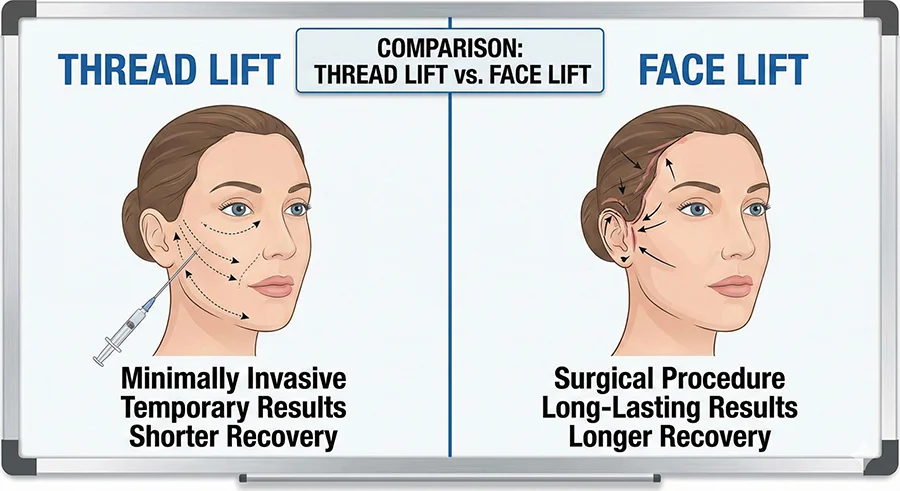
A common question is whether a thread lift, fillers, or other non-surgical treatments can achieve the same result as a facelift. The honest answer is: they cannot — but they each have a role depending on where you are in the ageing process.
| Surgical Facelift | Non-Surgical Options (Threads / Fillers) | |
|---|---|---|
| Best for | Moderate to significant facial ageing — jowling, laxity, deep folds | Early, mild signs of ageing or maintenance |
| Longevity | 7 to 15 years (technique-dependent) | Threads: 12–18 months. Fillers: 6–18 months |
| Structural correction | Yes — repositions the SMAS, fat, and skin | No — adds volume or surface tension only |
| Scars | Minimal — hidden in hairline and ear creases | None |
| Downtime | 2 to 3 weeks before social presentability | 1 to 5 days for most treatments |
| Natural result | Yes — if performed with SMAS or deep plane technique | Variable — excess filler or threads can look unnatural |
If you are not yet ready for surgery, non-surgical maintenance is a valid option. Dr. Pinky offers both surgical and non-surgical facial rejuvenation at Pink Apple Aesthetics and will give you an honest assessment of which approach makes most sense for you right now.
Why Choose Dr. Pinky Devi Ayyappan for Your Facelift?
A facelift is one of the most complex procedures in cosmetic surgery. The results are immediately visible to everyone who looks at you — and they last for years. Choosing the right surgeon is the most important decision you will make in this process.
- MCh (Plastic, Reconstructive & Aesthetic Surgery) — India's highest postgraduate qualification in plastic surgery. Facelift surgery requires this level of training in anatomy, tissue handling, and reconstructive technique.
- Facial Aesthetic Surgery Fellowship — Seoul, South Korea — trained at YK Plastic Clinic and Jayjun Plastic Surgery in dedicated facial aesthetic surgery including facelift, periorbital and midface techniques tailored to Asian anatomy.
- DAFPRS Fellowship — Belgium (Dr. Patrick Tonnard & Dr. Alexis Verpaele) — trained by two of the world's leading facial rejuvenation surgeons, whose work includes pioneering contributions to MACS lift and advanced facial lifting techniques. This fellowship is exceptionally rare among Indian plastic surgeons.
- Observership — Dr. Giovanni Botti, Villa Bella, Italy — additional training in European facial aesthetic surgery.
- 12+ years of surgical experience — across facial cosmetic and reconstructive procedures.
- 4.9 stars from 191+ verified Google reviews — consistent patient outcomes and care standards.
- Times of India Top Brand 2024 — independently recognised among Bangalore's leading aesthetic practices.
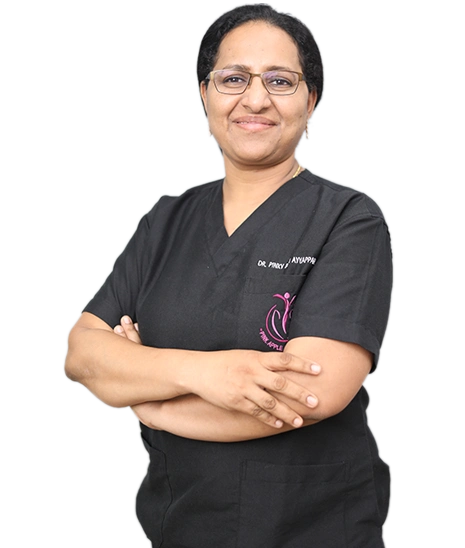
Dr. Tonnard and Dr. Verpaele in Belgium are globally known for their work on the MACS (Minimal Access Cranial Suspension) lift and deep facial rejuvenation. Training under them places Dr. Pinky in a rare group of Indian surgeons with this level of facelift-specific education.
Facelift Surgery — Frequently Asked Questions

How long do facelift results last?
This depends on the technique. A SMAS facelift typically maintains its effect for 7 to 10 years. A deep plane facelift — the more advanced technique — typically lasts 10 to 15 years because it addresses the deeper structural causes of facial ageing rather than just the skin surface. The ageing process continues after a facelift, but from a significantly improved baseline. Most patients who have a facelift at 50 still look better at 65 than they would have without it.
What is the difference between a SMAS facelift and a deep plane facelift?
Both techniques work beneath the skin at the level of the SMAS — a layer of muscle and fibrous tissue. In a SMAS facelift, the SMAS is tightened by folding or plicating it, without fully releasing the deeper ligaments. This produces excellent results for moderate ageing. In a deep plane facelift, the surgeon goes deeper — beneath the SMAS layer, releasing the retaining ligaments of the face — and lifts the facial tissues as a single, composite unit. This addresses the midface and nasolabial folds more completely and produces longer-lasting results with less skin tension. The right technique for you depends on your anatomy and degree of ageing.
Will I look natural after a facelift, or 'pulled'?
Modern facelift surgery — especially SMAS and deep plane techniques — is specifically designed to avoid the pulled, over-tightened look associated with older facelift methods. When the deeper tissues carry the lift rather than the skin, the result moves naturally and looks genuinely like a rested, younger version of your own face. The ‘windswept’ look people fear is almost always the result of older techniques or poorly performed surgery. With an experienced surgeon using contemporary methods, it should not be visible to others that you have had surgery at all.
What is the recovery time for facelift surgery in Bangalore?
Most facelift patients are comfortable to return to desk work and light daily activity at 2 weeks. The majority of the bruising and significant swelling resolves by that point, though some residual swelling remains. Strenuous physical activity and exercise should be avoided for 4 to 6 weeks. The full settled result is visible at 3 to 6 months. Most patients find that by the time they return to social situations at 2 to 3 weeks, the improvement is already visible and they are pleased with how they look.
Can a facelift be combined with other procedures?
Yes, and it frequently is. The most common combination is facelift with neck lift, performed in the same session to ensure the face and neck age cohesively. Facelift is also commonly combined with upper or lower blepharoplasty (eyelid surgery), brow lift, fat grafting to the face, and non-surgical treatments such as laser resurfacing or chemical peels. Combining procedures in one session is more efficient and typically more cost-effective than separate surgeries. Dr. Pinky will advise on the safest and most appropriate combination for you.
What is a MACS lift and is it different from a facelift?
A MACS (Minimal Access Cranial Suspension) lift is a specific facelift technique that uses purse-string sutures placed through smaller incisions to lift and suspend the facial tissues. It is technically a type of facelift — not a non-surgical treatment — and was developed and refined by Dr. Patrick Tonnard and Dr. Alexis Verpaele in Belgium, under whom Dr. Pinky trained. The MACS lift can be an excellent option for patients seeking meaningful facial rejuvenation with shorter incisions and a faster recovery, and is one of the techniques in Dr. Pinky’s repertoire.
Is there a non-surgical alternative to a facelift?
Thread lifts, dermal fillers, and skin tightening treatments can improve early signs of ageing, but they cannot replicate the structural correction that surgical facelift achieves. Non-surgical options are better suited to patients with mild ageing changes who are not yet candidates for surgery, or as maintenance after a surgical facelift. Dr. Pinky provides both surgical and non-surgical facial rejuvenation at Pink Apple Aesthetics and will recommend the approach that matches where you are in the ageing process.
What is the minimum age for a facelift?
There is no fixed minimum age. Facelift surgery is suitable when there are significant enough changes in the lower face and neck to warrant it — for some patients this is the late 30s or early 40s, for others the 50s or 60s. The decision is based on your anatomy and goals, not a calendar age. A mini facelift or MACS lift is often an appropriate first intervention for patients in their late 30s to mid-40s with early jowling and skin laxity.
How soon after a facelift can I return to normal life?
You will be mobile and able to manage at home from day 2 after surgery. By 7 to 10 days, most patients are managing all daily tasks normally, though they may be self-conscious about residual bruising and swelling. By 2 weeks, most people feel comfortable in social and work situations. By 4 to 6 weeks, exercise and all physical activities can be resumed. Makeup to conceal any remaining bruising can be worn from about 2 weeks post-surgery.