
Otoplasty Surgery in Bangalore
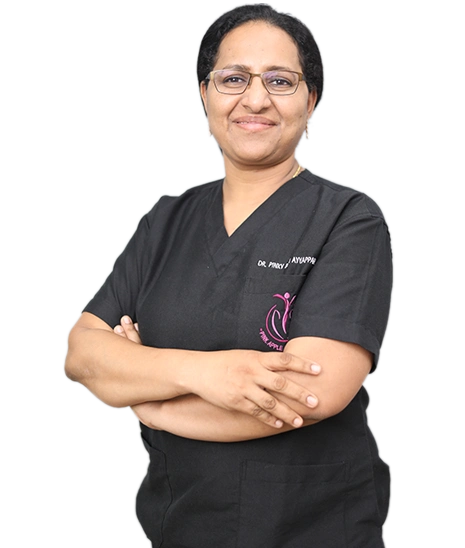
At Pink Apple Aesthetics, Jayanagar, otoplasty is performed by Dr. Pinky Devi Ayyappan, MCh (Plastic Surgery) — a board-certified plastic and reconstructive surgeon with 12+ years of experience and fellowship training in facial surgery in Belgium, Seoul, and Italy. Dr. Pinky treats both children and adults, with careful attention to the unique considerations of paediatric ear surgery — including age-appropriate anaesthesia planning, child-friendly consultation, and the specific cartilage handling required for younger patients.
What Is Otoplasty — Ear Pinning, Ear Correction, and Ear Reshaping Surgery?
Otoplasty is the surgical correction of prominent, misshapen, or asymmetric ears. The word combines ‘oto’ (ear) and ‘plasty’ (reshaping). Also known as pinnaplasty or ear correction surgery, it encompasses a range of procedures that can alter the position, shape, size, and projection of the external ear.
The most common indication is prominent ears — ears that stick out too far from the side of the head. This occurs when the natural folds and contours of the ear cartilage are underdeveloped or when the cartilage bowl (the concha) is too large. The result is an ear that angles away from the head at an excessive degree, drawing immediate visual attention to the ears rather than to the face.
Otoplasty can address:
- Prominent ears (bat ears / protruding ears) — the most common indication. Ears that protrude more than 15 to 20 mm from the side of the head, or that angle forward at more than 35 degrees from the skull surface.
- Underdeveloped antihelical fold — the antihelix is the inner curved ridge of the ear. When this fold fails to develop properly, the ear lacks the natural curve that holds it close to the head. This is corrected with suture techniques (Mustardé technique) that recreate this fold.
- Concha hypertrophy (large ear bowl) — when the bowl-shaped depression of the outer ear is disproportionately deep or large, it pushes the ear away from the head. This is corrected by reducing the conchal cartilage (Furnas conchomastoid suture technique or cartilage reduction).
- Ear asymmetry — a meaningful difference in position, projection, or shape between the two ears.
- Macrotia (large ears) — ears that are disproportionately large. Please also see our dedicated Macrotia Ear Reduction page for more on ear size reduction specifically.
- Ear deformities from birth — including lop ear, cupped ear, Stahl's ear deformity, shell ear, and others.
- Post-traumatic ear deformity — where injury to the ear cartilage has altered its shape.
Also known as: ear pinning surgery, ear correction surgery, bat ear correction, prominent ear surgery, ear reshaping surgery, ear surgery for children, pinnaplasty, otoplasty cost Bangalore.
Why Do Some Ears Protrude? Understanding the Anatomy of Prominent Ears
To understand how otoplasty works, it helps to understand what makes an ear prominent in the first place. The external ear (pinna or auricle) is a complex, three-dimensional cartilage structure with several defined ridges and hollows:
- The helix — the outermost curved rim of the ear.
- The antihelix — the inner curved ridge that runs parallel to the helix. When well-formed, the antihelix creates a natural fold that holds the ear at the correct angle relative to the head.
- The concha — the bowl-shaped depression in the centre of the ear. Its depth determines how far the ear projects from the skull.
- The lobule — the earlobe.
Prominent ears most commonly result from one of two anatomical variations — or a combination of both:
1. Underdeveloped antihelical fold
In a normal ear, the antihelix has a clear, defined fold that acts as a brake — preventing the upper portion of the ear from splaying forward. When the antihelical fold fails to develop completely during fetal development, the upper and middle ear lacks this inward curve and the ear protrudes. This typically affects the upper two-thirds of the ear most significantly. It is the most common cause of prominent ears globally and is corrected with suture techniques (classically the Mustardé technique) that recreate the antihelical fold.
2. Conchal hypertrophy (deep or oversized ear bowl)
When the conchal bowl is disproportionately deep, it physically pushes the ear away from the head — even if the antihelical fold is otherwise present. This is the second most common anatomical cause of prominence. It is corrected by either suturing the conchal cartilage to the mastoid fascia behind the ear (Furnas conchomastoid suture technique) or by direct excision of a crescent of conchal cartilage.
Understanding which anatomical problem is driving the prominence in each patient determines which surgical technique is used. Many patients have both issues simultaneously, requiring a combined approach. Dr. Pinky examines each ear anatomically at consultation to determine the precise correction needed — which is why the result looks natural rather than 'pinned back'.
The ‘over-pinned’ look — where ears appear unnaturally flattened against the head — is one of the most feared outcomes of ear surgery. It results from applying too much correction, or using the wrong technique for the underlying anatomy. At Pink Apple Aesthetics, the target is a natural ear position: close to the head but not plastered against it. Dr. Pinky’s technique is always anatomy-specific — not a single uniform approach applied to every patient.
Otoplasty Cost at Pink Apple Aesthetics
Otoplasty at Pink Apple Aesthetics starts from ₹75,000 to ₹1,00,000 (terms and conditions apply). Your confirmed cost is provided after a personal consultation with Dr. Pinky, once the ear anatomy and extent of correction required have been assessed.
The cost of otoplasty varies based on whether one or both ears are being corrected, the complexity of the anatomical correction needed, and the anaesthesia type. We do not quote a price from a photo or from a phone inquiry — a proper examination is essential to accurate cost assessment.
What your otoplasty cost typically includes:
- Surgeon's fee — Dr. Pinky Devi Ayyappan, MCh Plastic Surgery.
- Anaesthesia — local with or without sedation (adults); general anaesthesia (children and patients who prefer it).
- Surgical facility charges — procedure performed in a fully equipped, sterile facility.
- Head bandage and night headband — provided for use during recovery.
- Pre-operative blood tests.
- Post-operative medications — antibiotics and prescribed pain relief.
- Follow-up appointments — suture removal at 7 to 10 days; further follow-up at 1 month and 3 months.
What affects the final cost:
- Unilateral vs bilateral — correcting one ear is less involved than correcting both.
- Complexity — simple antihelical fold correction vs combined antihelical + conchal correction; standard vs complex cartilage deformity.
- Anaesthesia type — general anaesthesia for children; local ± sedation for adults.
- Revision otoplasty — correcting a previous unsatisfactory result from another clinic is a more complex procedure.
Otoplasty is a cosmetic procedure in most cases and is not covered by health insurance. Where otoplasty is performed for a congenital deformity with documented functional or developmental significance, partial coverage may occasionally apply — check with your insurer. EMI payment options are available at Pink Apple Aesthetics
Otoplasty Surgical Techniques — Mustardé, Furnas, and Cartilage Scoring
There is no single ‘standard’ otoplasty — the correct technique is chosen based on which anatomical structure is causing the ear to protrude. At Pink Apple Aesthetics, Dr. Pinky uses the technique that matches the patient’s ear anatomy.
Mustardé Technique (antihelical fold creation — suture technique)
The Mustardé technique uses permanent mattress sutures placed through the cartilage — without incising it — to recreate or strengthen the antihelical fold. The sutures fold the cartilage inward and hold it in its new position permanently. This is a cartilage-sparing approach: the cartilage is not cut, only bent and held. The advantage is a smoother, more natural-looking fold that avoids the sharp, angular appearance that can result from cartilage incision techniques. It is the most widely used technique for antihelical fold correction. Incision: a single hidden cut behind the ear gives access. Scarring is imperceptible.
Furnas Technique (conchal reduction — conchomastoid suture)
The Furnas technique addresses conchal hypertrophy by placing sutures from the conchal cartilage to the mastoid fascia — the firm fibrous tissue behind the ear. These sutures pull the ear bowl back toward the head and reduce the effective conchal projection. It can be combined with a small excision of conchal cartilage for more significant cases. Used alongside Mustardé sutures when both antihelical underdevelopment and conchal hypertrophy are present.
Cartilage Scoring / Incision Techniques
In some ears — particularly those with very stiff, resistant cartilage — suture techniques alone may not achieve sufficient reshaping. In these cases, careful scoring (shallow incisions on the cartilage surface to weaken it and allow it to bend) or full cartilage incision techniques are used. These allow the cartilage to be reshaped more aggressively but require careful technique to avoid sharp edges or irregularities showing through the thin skin of the ear.
Combined Approach
Most otoplasty procedures in clinical practice combine Mustardé sutures for the antihelical fold with Furnas sutures for conchal positioning, tailored to the relative contribution of each factor to the specific ear’s prominence. Dr. Pinky will identify at consultation whether your ear’s prominence is from antihelical underdevelopment, conchal hypertrophy, or a combination, and will plan the technique accordingly.
Otoplasty for Children — A Guide for Parents
Prominent ears are not just a cosmetic issue in children. The psychological and social impact of ear prominence during childhood and adolescence is well documented. Children with prominent ears frequently experience teasing, bullying, and the kind of self-consciousness that can affect their confidence and willingness to participate socially at school. Many affected children become self-conscious about wearing their hair up, participating in swimming or sports, or anything that draws attention to their ears.
Otoplasty in appropriately selected children is one of the most psychologically positive cosmetic interventions available — because the change is immediate, the child adjusts quickly, and the benefits to self-confidence and social comfort are often dramatic and lasting.
What is the right age for otoplasty in children?
Ear cartilage reaches approximately 85 to 90% of its adult size and stiffness by age 5 to 6. Most plastic surgeons recommend waiting until this age before performing otoplasty — not because the surgery cannot be performed earlier, but because the cartilage is too soft before age 5 to hold sutures reliably. Operating on very young children also requires general anaesthesia, which carries a small but incremental risk at younger ages.
The ideal timing for most children is between 5 and 8 years — before they begin primary school or shortly after, and well before the teasing phase that typically intensifies from around age 7 onwards. Adult patients can have otoplasty at any age.
Anaesthesia for children's otoplasty
In children under approximately 10 to 12, general anaesthesia is the standard approach — keeping the child completely still, comfortable, and unaware during the procedure is both kinder and technically important for precision. In older children (12+) and adults, local anaesthesia with or without sedation is commonly used. Dr. Pinky coordinates with a paediatric or adult anaesthesiologist as appropriate for the patient's age and comfort.
What parents should know about the consultation
Dr. Pinky conducts the consultation with both the child and the parent present. She will explain the procedure to the child in age-appropriate language, ask them questions to understand their own feelings about their ears, and ensure the child understands what will happen and what recovery involves. A child who is willing and motivated — not just parental-driven — is one of the most important factors in a positive surgical experience and outcome.
Should I wait or operate now? The clinical evidence strongly supports early intervention when a child is psychologically ready and the ear cartilage has matured (age 5+). The social and psychological benefits of correction before the peak teasing years (age 7 to 12) are well established. Waiting until adulthood is not necessary and has no clinical advantage. If your child is asking about or distressed by their ears, a consultation is the appropriate next step.
Who Is a Good Candidate for Otoplasty?
- Children aged 5 and above — once ear cartilage has matured sufficiently. The child should be emotionally willing and not objecting to surgery when it is discussed with them.
- Teenagers and adults of any age — there is no upper age limit. Many adults in their 30s, 40s, and beyond have otoplasty having lived with the concern for decades.
- Patients with visible ear prominence — ears that protrude more than 15 to 20 mm from the skull, or that cause consistent self-consciousness and social discomfort.
- Patients with ear asymmetry — one ear that differs noticeably in position or projection from the other.
- Patients with ear shape deformities — congenital deformities including lop ear, cupped ear, Stahl's ear, and others.
- Good general health — no uncontrolled conditions affecting healing. No history of keloid scarring (which increases the risk of abnormal scarring behind the ear and should be discussed at consultation).
- Realistic expectations — otoplasty creates a natural ear position, not an artificially flat or pinned-back appearance. The goal is an ear that blends harmoniously with the head and face.
Patients with a known history of keloid formation or hypertrophic scarring should discuss this specifically at consultation. The incision behind the ear is at increased risk in keloid-prone individuals, and Dr. Pinky will factor this into the treatment plan.
What Are the Risks of Otoplasty?
Otoplasty has an excellent safety record and a very low rate of serious complications. Patients should be clearly informed of all relevant risks:
- Swelling and bruising — expected and temporary. Peaks at 2 to 3 days, resolves significantly by 2 weeks.
- Asymmetry — minor differences in the position or appearance of the two ears are common during healing. Significant asymmetry requiring revision is uncommon with careful pre-operative planning and symmetric technique.
- Suture relapse — in 3 to 5% of cases, the permanent sutures may partially loosen over time, resulting in mild recurrence of prominence. This is the most common long-term issue with suture-based otoplasty. It is usually addressable with a minor revision under local anaesthesia.
- Haematoma — collection of blood beneath the skin behind the ear. Uncommon; prevented by careful surgical technique and managed promptly if it occurs.
- Infection — uncommon with antibiotic cover and proper wound care. Infected suture material occasionally requires removal.
- Scarring — the scar behind the ear heals in the natural crease between the ear and head and is essentially invisible in normal presentation. In patients prone to keloid formation, abnormal scar development behind the ear is a specific risk — this is why keloid history is important to disclose at consultation.
- Numbness or altered sensation — temporary altered sensation around the ear or behind it is common during healing as sensory nerves adjust. Typically resolves over 2 to 4 months.
- Over-correction ('pinned-back' appearance) — when the ear is pulled too close to the head, the result looks unnatural. Prevented by anatomy-specific technique planning and intraoperative assessment of ear position before closing.
- Under-correction — when insufficient correction is achieved. Managed with revision surgery if the patient wishes.
Dr. Pinky discusses every applicable risk in the context of your (or your child’s) specific ear anatomy and health history at consultation. Informed consent is the foundation of every procedure at Pink Apple Aesthetics.
What to Expect: From Consultation to Your Final Result
Step 1 — Consultation
Dr. Pinky examines each ear individually — assessing the antihelical fold development, the conchal depth, the degree of protrusion, the cartilage stiffness, and any asymmetry between the two ears. She will discuss the planned technique and the target ear position, and show the patient (and parents for children) what the corrected position will look like. She will explain the procedure, anaesthesia plan, recovery timeline, and what to expect from the result. For children, the consultation is conducted with parent and child together.
Step 2 — Pre-operative preparation
Blood tests are completed before surgery. Stop blood-thinning medications and supplements 1 week before the procedure. Stop smoking 4 weeks before. On the day of surgery, hair should be washed and free of pins, clips, or accessories. Arrange for a trusted adult to accompany the patient home. For children undergoing general anaesthesia, fasting instructions will be provided by the anaesthesiologist.
Step 3 — The surgery (1 to 1.5 hours)
A small incision — approximately 3 to 4 cm — is made in the natural crease behind the ear, hidden between the ear and the head. Through this incision, Dr. Pinky accesses the cartilage and applies the planned technique: Mustardé sutures to recreate the antihelical fold, Furnas sutures to reduce conchal projection, cartilage scoring if needed, and any skin excision required to close the new position neatly. The incision is closed with fine sutures. A soft dressing or head bandage is applied to hold the ears in position during the initial healing phase.
Most patients undergo otoplasty as a day-care procedure — going home on the same day as surgery.
Step 4 — Recovery: the first two weeks
A supportive head bandage is worn continuously for the first 5 to 7 days. This holds the ears gently in their new position, controls swelling, and protects the healing sutures. After the bandage is removed at 7 days, an elastic headband is worn at night for a further 4 to 6 weeks — this is particularly important during sleep when the ears can be inadvertently folded forward. Sutures behind the ear are removed at 7 to 10 days.
Bruising and swelling are expected and resolve significantly within 1 to 2 weeks. Most children return to school in 7 to 10 days; adults return to work in 5 to 7 days. Contact sports, swimming, and any activity that could impact the ears should be avoided for 6 weeks.
Step 5 — Your final result
The ears gradually settle into their new position as healing continues. By 6 to 8 weeks, all swelling has resolved and the final, permanent result is visible. The corrected ear position is stable and lasting — permanent in the vast majority of patients. In approximately 3 to 5% of cases, the sutures may partially loosen over time, resulting in very minor relapse — manageable with minor revision under local anaesthesia.
Why Choose Dr. Pinky Devi Ayyappan for Ear Correction Surgery?
Otoplasty is deceptively precise. The ear is a complex three-dimensional structure of thin cartilage, and the difference between a natural-looking result and an over-pinned, unnatural appearance lies entirely in the accuracy of cartilage assessment and technique selection before and during surgery.
- MCh (Plastic, Reconstructive & Aesthetic Surgery) — India's highest postgraduate qualification in plastic surgery. Formal training in both cosmetic otoplasty and reconstructive ear surgery — covering the full spectrum from prominent ear correction to congenital deformities
- Anatomy-specific technique selection — Dr. Pinky examines each ear's specific anatomical cause of prominence — antihelical fold underdevelopment, conchal hypertrophy, or combined — and selects the technique that addresses that specific cause. This is what produces natural-looking results.
- Children and adults treated — Dr. Pinky has experience with both paediatric and adult otoplasty, including the specific considerations of working with younger patients and their families.
- DAFPRS Fellowship — Belgium (Dr. Patrick Tonnard & Dr. Alexis Verpaele) — trained by two of the world's leading facial plastic surgeons. Otoplasty technique was part of this fellowship training.
- Facial Aesthetic Surgery Fellowship — Seoul, South Korea — additional facial surgical training at YK Plastic Clinic and Jayjun Plastic Surgery.
- 4.9 stars from 191+ verified Google reviews — consistent, trusted patient outcomes.
- Times of India Top Brand 2024 — recognised among Bangalore's leading aesthetic clinics.
Otoplasty — Frequently Asked Questions

What is the right age for otoplasty in children?
The ear cartilage reaches approximately 85 to 90% of its adult size and stability by age 5 to 6. Most plastic surgeons recommend waiting until this age before operating because younger cartilage is too soft to hold sutures reliably. The ideal window for most children is age 5 to 8 — before or at the early school years, and well before the teasing phase that typically intensifies around age 7 to 10. Adolescents and adults can have otoplasty at any age. There is no clinical advantage to waiting until adulthood.
What is the difference between Mustardé and Furnas technique otoplasty?
The Mustardé technique uses permanent mattress sutures to recreate the antihelical fold — the curved inner ridge of the ear that, when underdeveloped, allows the upper ear to splay forward. It is the technique of choice for antihelical fold deficiency. The Furnas technique uses sutures to anchor the conchal bowl cartilage to the mastoid fascia behind the head, reducing how far the ear’s main bowl pushes the ear outward. It is used for conchal hypertrophy. Most patients need a combination of both techniques because both factors are usually present to varying degrees. Dr. Pinky assesses the relative contribution of each at consultation to select the most appropriate approach.
Will there be a visible scar after otoplasty?
The incision for otoplasty is made in the natural crease between the back of the ear and the side of the head. In this position, the scar is hidden from the front, from the side, and during normal hairstyling — it sits in a concealed location that is essentially invisible during all ordinary social situations. The scar fades progressively over 6 to 12 months. In patients with normal healing, it becomes a fine, pale, imperceptible line.
Is the result of otoplasty permanent?
Yes — in the great majority of patients, the result is permanent. The permanent sutures hold the cartilage in its corrected position and, as healing completes over 6 to 8 weeks, the cartilage adapts to its new configuration. In approximately 3 to 5% of patients, the sutures may partially loosen over time — typically within the first year — causing mild recurrence of prominence. This is usually manageable with a minor revision under local anaesthesia. Wearing the protective night headband consistently for the first 6 weeks after surgery is an important factor in reducing relapse risk.
Is otoplasty painful?
The procedure itself is not painful — it is performed under appropriate anaesthesia throughout. After surgery, the primary sensation is tightness, pressure, or an aching discomfort around the ears rather than sharp pain, which is easily managed with prescribed pain relief. Most patients describe the discomfort as mild and manageable by day 2 or 3. Children typically adapt and are comfortable quickly once the initial bandage phase is over.
Can otoplasty be done under local anaesthesia?
Yes — for older children (typically 12 and above) and adults, otoplasty is very commonly performed under local anaesthesia, sometimes with light sedation for added comfort. For younger children, general anaesthesia is used because keeping a young child completely still throughout a 1 to 1.5 hour procedure requires full anaesthetic. The anaesthesia approach for each patient is discussed and planned at consultation based on age, patient preference, and clinical suitability.
When can my child return to school after otoplasty?
Most children return to school within 7 to 10 days after surgery. The main restriction is physical contact — any activity where the ears might be bumped, pulled, or compressed must be avoided for 6 weeks. Contact sports, swimming, and rough play with peers should be avoided during this time. For school activities, the protective night headband continues to be worn; children can wear their hair over the ears if they prefer not to explain the headband. Most children and their parents find the recovery easier than anticipated.
What is revision otoplasty and is it more complex?
Revision otoplasty is performed when a previous otoplasty has produced an unsatisfactory result — whether under-correction, asymmetry, over-correction (the ‘telephone ear’ deformity or over-pinned appearance), or suture relapse. Revision surgery is generally more challenging than primary otoplasty because the cartilage has already been operated upon and may have scar tissue, altered tissue planes, or changed cartilage consistency. It requires a thorough assessment of what the original procedure achieved and what specifically needs to be corrected. Dr. Pinky will assess whether revision is appropriate and feasible at consultation.


