
Liposuction Surgery in Bangalore
Liposuction is not a weight-loss surgery. It is a body contouring procedure: a surgical method for removing specific pockets of stubborn, exercise-resistant fat from defined areas of the body to reshape and refine the contour when the patient is already close to their ideal weight. The result is a leaner, more proportionate silhouette — in the areas that exercise cannot reach.
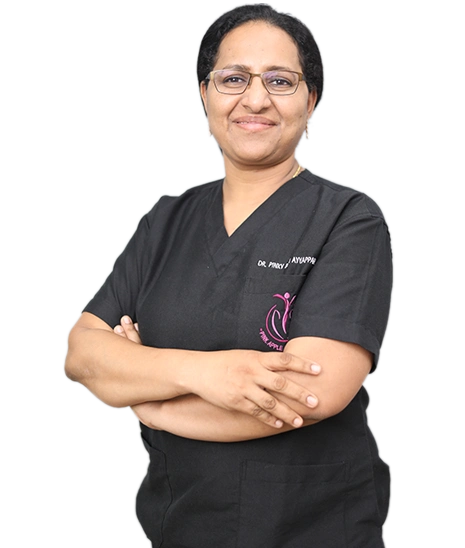
At Pink Apple Aesthetics, Jayanagar, liposuction is performed by Dr. Pinky Devi Ayyappan, MCh (Plastic Surgery) — a female, board-certified plastic and reconstructive surgeon with 12+ years of experience and international fellowship training in Belgium and Seoul. Dr. Pinky performs tumescent liposuction and power-assisted liposuction (PAL) — the internationally established, evidence-based techniques with the strongest safety records and the most consistent, natural-looking contouring outcomes.
What Is Liposuction — And What Can It Realistically Achieve?
Liposuction (also called liposculpture, lipoplasty, or fat removal surgery) is a surgical procedure in which a thin hollow tube called a cannula is inserted through small incisions and used to break up and suction out localised fat deposits. The cannula moves through the fat layer in a controlled back-and-forth motion, dislodging fat cells which are then removed by a vacuum suction device.
The procedure reshapes the body by permanently removing fat cells from targeted areas. The remaining fat cells do not multiply — the structural reduction is permanent, provided the patient maintains a stable weight after surgery.

What liposuction CAN achieve:
- Reduction of localised fat deposits — fat that does not respond to diet and exercise in specific areas.
- Body contouring and silhouette refinement — improving overall shape and proportion.
- Inch loss — visible reduction in the circumference and projection of treated areas.
- Permanent fat cell removal — the removed cells do not regenerate.
- Multiple area treatment in one session — abdomen, flanks, thighs, arms, back and more simultaneously.
- Fat harvesting for fat transfer — liposuctioned fat can be used for breast augmentation, facial fat grafting, or Brazilian butt lift in the same session.
What liposuction CANNOT achieve:
- Weight loss — liposuction removes fat volume but not body weight in any clinically meaningful sense. It is not a treatment for obesity.
- Skin tightening — fat is removed but loose skin remains. Patients with significant skin laxity may need a tummy tuck, arm lift, or thigh lift in addition.
- Cellulite treatment — liposuction does not improve the dimpled texture of cellulite.
- Stretch mark removal — stretch marks are not affected by liposuction.
At every liposuction consultation, Dr. Pinky assesses the patient’s goals honestly against what liposuction can and cannot achieve. If a combination with a tummy tuck or skin excision procedure is needed to achieve the patient’s goals, this is explained clearly — rather than performing liposuction alone and producing an incomplete result.
Before and After Procedures
Look At The Difference


Results shown are from actual patients of Dr. Pinky Devi Ayyappan at Pink Apple Aesthetics, Bangalore. Individual outcomes vary based on body anatomy, areas treated, volume removed, skin quality, and post-operative weight maintenance. All images are shared with patient consent.
What Is Tumescent Liposuction — And Why Is It the Safety Foundation of Modern Liposuction?
Tumescent liposuction is not one technique among many — it is the essential safety foundation of all modern liposuction regardless of which additional technique is layered on top. Every liposuction procedure at Pink Apple Aesthetics begins with tumescent infiltration.
The word ‘tumescent’ means swollen and firm. Before fat is removed, a large volume of sterile tumescent solution is injected throughout the fat layer. This solution contains:
- Saline (sterile salt water) — swells the fat layer, making fat cells easier to dislodge and creating a uniform medium for the cannula.
- Lidocaine — a local anaesthetic that numbs the fat layer during and after the procedure, reducing pain and anaesthesia requirements.
- Epinephrine (adrenaline) — constricts blood vessels in the treated area, dramatically reducing bleeding. Tumescent technique blood loss is typically less than 1% of the fat removed — compared to 20 to 45% with older non-tumescent methods.
The benefits are substantial: dramatically reduced blood loss (the biggest historical advance in liposuction safety), reduced post-operative pain, easier fat removal, and more uniform results.
Tumescent technique was pioneered by Dr. Jeffrey Klein in the 1980s and has transformed liposuction safety globally. It is now the universal foundation of all modern liposuction. A surgeon performing liposuction without tumescent infiltration is using an outdated approach.
Liposuction Surgery Cost at Pink Apple Aesthetics
Liposuction at Pink Apple Aesthetics starts from ₹1,00,000 to ₹2,50,000 (terms and conditions apply). Your confirmed cost is provided after consultation with Dr. Pinky, based on the number of areas treated, volume of fat removal, and technique used.
What your cost typically includes:
- Surgeon's fee — Dr. Pinky Devi Ayyappan, MCh Plastic Surgery.
- Anaesthesia and anaesthesiologist's fee.
- Surgical facility / operating theatre charges.
- Tumescent solution and surgical consumables.
- Compression garments — provided for the recovery period.
- One night post-operative observation (for multi-area general anaesthesia cases).
- Pre-operative blood tests.
- Post-operative medications — antibiotics and pain relief.
- Follow-up appointments — at 1 week, 1 month, and 3 months.
What affects the final cost:
- Number of areas treated — single area vs multi-area.
- Volume of fat removed — larger volumes require more surgical time.
- Technique — PAL involves additional equipment.
- Combination procedures — liposuction with tummy tuck, arm lift, or fat transfer.
- Anaesthesia type — general vs local with sedation.
Liposuction is a cosmetic procedure and is not covered by health insurance. EMI payment options are available at Pink Apple Aesthetics.
Liposuction Techniques at Pink Apple Aesthetics — Tumescent and Power-Assisted (PAL)
Pink Apple Aesthetics performs tumescent liposuction and power-assisted liposuction (PAL) — techniques with the strongest evidence base, the most established safety records, and the most consistent outcomes. These are the techniques Dr. Pinky was trained in and that international plastic surgery guidelines recommend.
Tumescent liposuction (standard technique)
After tumescent infiltration, fat is removed using a traditional cannula connected to a suction device. The surgeon’s manual control of the cannula — direction, depth, and pressure of each pass — is the primary determinant of contouring quality and the smoothness of the result. This is the gold standard for refined body contouring and is used for most procedures at Pink Apple Aesthetics.
- Best for: most body areas; small to medium fat volume; precise contouring of delicate or smaller areas.
- Advantages: maximum surgical control; proven safety; excellent results in experienced hands.
Power-Assisted Liposuction (PAL — MicroAire)
PAL uses a specialised cannula that vibrates at high speed — typically 4,000 oscillations per minute — powered by compressed air. The rapid vibration mechanically breaks up fat tissue as the cannula moves, making removal more efficient with less manual effort. PAL is particularly effective for fibrous fat areas and for larger-volume cases where efficiency reduces operating time.
- Best for: fibrous fat areas (upper back, male chest, gynecomastia tissue); large-volume liposuction; revision liposuction.
- Advantages: more efficient in dense areas; gentler on surrounding tissue in fibrous fat; less surgeon fatigue for extended procedures.
Pink Apple Aesthetics does not perform laser-assisted liposuction (SmartLipo / laser lipo). Laser liposuction applies heat energy via a laser fibre, carrying a risk of thermal injury to surrounding tissue and nerves. Published literature shows no consistently superior contouring outcomes from laser liposuction compared to expert tumescent or PAL technique. Our commitment is to evidence-based techniques with established safety profiles.
Which Body Areas Can Be Treated with Liposuction?
Liposuction can address virtually any area where localised, exercise-resistant fat accumulates. The most commonly treated areas at Pink Apple Aesthetics:
| Area | Common Indian Presentation | Related Page |
|---|---|---|
| Abdomen (upper & lower) | Post-pregnancy lower abdominal fat; central fat resistant to diet | See: Tummy Tuck for skin laxity cases |
| Flanks / Love handles | Side fat persisting even with overall weight loss | See: Liposculpturing |
| Thighs (inner & outer) | Inner thigh chafing; outer thigh saddlebag fullness | See: Thigh Liposuction |
| Arms (upper arm / bat wings) | Upper arm fat visible in sleeveless clothing | See: Arm Liposuction |
| Double chin / neck | Submental fat; prominent in Indian facial proportions | See: Double Chin Treatment |
| Back (upper, mid & lower) | Bra strap bulge; back rolls; upper back fullness | Combined with tummy tuck |
| Hips and buttocks | Hip fat affecting saree drape and fitted clothing | See: Brazilian Butt Lift |
| Male chest (gynecomastia) | Male chest fat or glandular tissue | See: Gynecomastia page |
| Axilla / armpit | Armpit fat pad or axillary breast tissue | See: Axillaplasty |
| Inner knees | Fat above inner knee causing silhouette distortion | Combined with thigh liposuction |
Multiple areas can be treated in the same session, provided the total aspirate stays within the safe clinical limit of approximately 5 litres. Treating multiple areas in one session is more efficient and cost-effective than staging them separately.
Liposuction for Indian Body Types — What Makes Planning Different
Indian and South Asian body fat distribution has well-documented characteristics that influence liposuction planning — rarely addressed on Bangalore clinic pages despite being highly relevant to outcomes.
- Central abdominal fat predominance — Indians tend to accumulate a disproportionate amount of central abdominal fat relative to overall body weight — driven by genetic and metabolic factors. The abdomen is therefore the single most common and highest-volume liposuction area for Indian patients.
- Visceral vs subcutaneous fat — critically important — visceral fat (deep fat around the organs inside the abdominal cavity) is NOT accessible to liposuction — only subcutaneous fat (the layer beneath the skin and above the muscle) can be removed. A patient with predominantly visceral abdominal fat will see limited change from liposuction. Dr. Pinky assesses this specifically at consultation via pinch test and physical examination.
- Skin quality and elasticity — Indian skin in younger patients (under 40) tends to have good elasticity and redrapes well. In older patients or those with significant post-pregnancy laxity, skin may not retract adequately — these patients need a combined approach with skin excision.
- Post-pregnancy combination presentation — the most common liposuction presentation among Indian women is the combination of post-pregnancy lower abdominal fat plus mild to moderate skin laxity. Whether liposuction alone or with tummy tuck is appropriate depends on the fat-to-skin proportion.
- Incision site hyperpigmentation — in darker Indian skin, small incision sites can develop post-inflammatory hyperpigmentation. Incision placement in natural skin folds and creases, careful wound care, and sun protection minimise this.
Who Is a Good Candidate for Liposuction Surgery?
- Near ideal body weight — within approximately 10 to 20% of ideal weight with specific localised fat deposits. Not an obesity treatment.
- Stubborn, localised fat resistant to diet and exercise — the defining characteristic of the ideal liposuction candidate.
- Good skin elasticity — the skin must retract to conform to the new contour. Poor skin elasticity requires skin excision in addition.
- Stable body weight for at least 6 months — fluctuating weight compromises both candidacy and long-term results.
- Good general health — no uncontrolled diabetes, cardiovascular conditions, or bleeding disorders.
- Non-smoker or committed to stopping — smoking impairs healing and anaesthetic safety.
- Realistic expectations — contouring and inch loss — not weight loss, skin tightening, cellulite improvement, or stretch mark removal.
Patients who are significantly overweight or obese are not appropriate candidates. Dr. Pinky will advise on appropriate weight management before any liposuction at Pink Apple Aesthetics.
What to Expect: From Consultation to Your Final Result
Step 1 — Consultation and body assessment
Dr. Pinky examines the areas of concern — assessing fat volume, pinch thickness, skin elasticity, the visceral vs subcutaneous fat proportion, and overall body proportions. She marks the planned treatment areas and discusses what result is realistic based on the anatomy. If a combination with tummy tuck or skin excision would serve the patient better, this is discussed honestly at consultation.
Step 2 — Pre-operative preparation
Blood tests, anaesthesia assessment. Stop smoking 4 weeks before. Stop blood thinners 1 to 2 weeks before. Maintain stable weight. Compression garments sized pre-operatively. Pre-operative photographs taken.
Step 3 — Surgery (1 to 3 hours depending on areas)
Most liposuction at Pink Apple Aesthetics is performed under general anaesthesia for comfort and safety, particularly for multi-area cases. Single small-area liposuction may use local anaesthesia with sedation. Tumescent solution infiltrated throughout treatment areas. Cannula used for fat removal in controlled passes. Pinch test performed at the end to confirm even, thorough fat removal. Compression garments applied immediately.
Step 4 — Recovery: weeks 1 to 4
Compression garments worn continuously day and night for 3 to 4 weeks — the single most important post-operative instruction. Compression reduces swelling, supports skin retraction, and helps treated areas conform to the new contour. Significant swelling and bruising peaks at 3 to 5 days and improves progressively. Return to desk work: 3 to 7 days. Walking from day one. Driving at 5 to 7 days. Strenuous exercise at 4 to 6 weeks.
Step 5 — The 3 to 6 month settling phase
Results improve progressively as swelling resolves and skin redrapes. Initial improvement visible at 2 to 3 weeks. Significant result at 6 to 8 weeks. Final settled result at 3 to 6 months. The result is permanent — removed fat cells do not return. Weight maintenance after surgery preserves the result.
What Are the Risks of Liposuction Surgery?
Liposuction is a major surgical procedure with an excellent safety record when performed by a qualified plastic surgeon in a proper facility. Patients should be fully informed:
- Swelling and bruising — expected and significant in the first 2 to 3 weeks; resolves progressively over 3 to 6 months.
- Contour irregularities — uneven surface, waviness, or dimpling. Prevented with meticulous even technique. Revision can address significant irregularities.
- Seroma — lymphatic fluid collecting beneath the skin; managed with aspiration if significant.
- Loose skin — if skin does not retract after fat removal. Proper patient selection and skin elasticity assessment prevents this.
- Numbness and altered sensation — temporary in most cases; resolves over weeks to months.
- Infection — uncommon; managed with antibiotics.
- Deep vein thrombosis (DVT) — rare; prevented with compression stockings, early mobilisation, and anti-coagulation where indicated.
- Over-removal of fat — producing an unnatural appearance. At Pink Apple Aesthetics, the pinch test is used throughout surgery to prevent over-extraction.
- Fat embolism — extremely rare; risk minimised with proper technique and volume limits.
Liposuction safety depends on three non-negotiable factors: surgeon skill and training, adherence to safe volume limits (approximately 5 litres maximum per session), and proper patient selection. All three are standard at Pink Apple Aesthetics.
Why Choose Dr. Pinky Devi Ayyappan for Liposuction Surgery?
MCh (Plastic, Reconstructive & Aesthetic Surgery)
India’s highest postgraduate plastic surgery qualification. Liposuction is a core MCh training component.
Female, board-certified plastic surgeon
One of very few female MCh plastic surgeons in Bangalore. For consultations involving body examination — abdomen, thighs, arms — many women find the experience significantly more comfortable with a female surgeon.
Tumescent + PAL — evidence-based techniques
Pink Apple Aesthetics does not offer techniques that add cost without consistent evidence of superior outcomes over skilled tumescent and PAL liposuction.
Visceral vs subcutaneous assessment
The most important liposuction predictor for Indian patients — assessed specifically at every consultation.
Honest skin laxity assessment
Patients with significant skin laxity are told clearly if liposuction alone will not achieve their goals.
Safe volume adherence
The approximately 5-litre aspirate safety limit is strictly observed. Multi-area cases are planned to stay within this limit.
Multi-area planning in single sessions
Efficient, coordinated treatment of multiple areas in one surgical episode.
DAFPRS Fellowship — Belgium (Dr. Patrick Tonnard & Dr. Alexis Verpaele).
4.9 stars from 191+ verified Google reviews
Times of India Top Brand 2024
Liposuction Surgery — Frequently Asked Questions

Is liposuction a weight-loss surgery?
No — this is the most important misconception about liposuction. The total fat volume removed in a safe single session (approximately 2.5 to 3 litres of pure fat) is not a meaningful weight change for most patients. The scale may not change significantly; the shape and contour absolutely will. Liposuction is for patients already near their ideal weight with specific resistant fat deposits. Patients who are significantly overweight are not appropriate candidates.
Will the fat come back after liposuction?
The removed fat cells do not return — they are permanently gone. However, the remaining fat cells in the treated area and elsewhere can enlarge with weight gain. Patients who maintain their weight after liposuction typically enjoy a permanent improvement in the treated areas.
What is the difference between liposuction and a tummy tuck?
Liposuction removes fat through small incisions but does not tighten skin or repair muscle. A tummy tuck (abdominoplasty) removes excess abdominal skin, repairs separated abdominal muscles (diastasis recti), and includes liposuction. Patients with good skin elasticity and predominantly fat accumulation may be suitable for liposuction alone. Patients with significant skin laxity, loose hanging skin, or abdominal muscle separation after pregnancy need a tummy tuck — liposuction alone will leave loose skin.
How much fat can be safely removed in one session?
The internationally accepted safe limit for outpatient liposuction is approximately 5 litres of total aspirate. The pure fat component is approximately 50 to 60% of this — roughly 2.5 to 3 litres of actual fat. Exceeding this limit significantly increases the risk of serious fluid and electrolyte complications. Patients needing larger-volume fat removal have staged procedures separated by several weeks. This limit is a safety standard, not a technical limitation.
I exercise regularly but still have belly fat — will liposuction help?
This is exactly the patient profile liposuction was designed for. Localised fat deposits that persist despite regular exercise and a healthy diet are the primary indication. The reason is structural — the fat cells in those locations are genetically predisposed to accumulate and resist releasing fat. Exercise burns fat from all body areas in a sequence determined by genetics, not by the exercises you perform. Liposuction directly removes these cells, producing the contour change that exercise cannot — provided the fat is subcutaneous (beneath the skin) rather than visceral (deep inside the abdomen). Dr. Pinky assesses this specifically at your consultation.
How long does liposuction recovery take?
Return to desk work: 3 to 7 days. Driving: 5 to 7 days. Compression garments: 3 to 4 weeks (non-negotiable — do not shorten). Exercise and heavy lifting: 4 to 6 weeks. Initial result visible: 2 to 3 weeks. Fully settled final result: 3 to 6 months as swelling resolves and skin redrapes.


