
Thigh Liposuction Surgery in Bangalore
Thigh liposuction is the direct solution to this structural problem. By removing the specific fat deposits that hormonal fat storage programmes have placed in the thighs, liposuction produces a leaner, more proportionate leg contour — and, in the case of inner thigh treatment, ends the daily physical discomfort of thigh chafing and friction that many patients have simply accepted as unavoidable.
At Pink Apple Aesthetics, Jayanagar, thigh liposuction is performed by Dr. Pinky Devi Ayyappan, MCh (Plastic Surgery) — a female, board-certified plastic and reconstructive surgeon with 12+ years of experience. The consultation assesses all five thigh fat zones individually, evaluates skin elasticity for each zone, and plans the treatment to address the specific areas causing concern — rather than a single standard approach applied to every patient.
The Five Thigh Fat Zones — Where Does Your Thigh Fat Actually Sit?
Not all thigh concerns are the same — and the right treatment depends entirely on which zone or combination of zones is the source of the problem. This is the most underexplained aspect of thigh liposuction, and why generic pages that simply say ‘inner and outer thigh liposuction’ fail to address the full anatomy of thigh contouring.
Zone 1 — Inner thigh (medial thigh)
The inner thigh is the fat compartment along the inside of the upper leg, from the groin crease to the inner knee. This is the zone most associated with thigh-on-thigh rubbing and chafing — the friction that causes skin irritation, intertrigo (skin rash), discomfort in warm weather, and the characteristic wearing away of the inner thigh seam on trousers and leggings.
Inner thigh liposuction is simultaneously one of the most cosmetically and functionally significant body contouring procedures. The cosmetic benefit — a slimmer inner thigh line and (for some patients) a visible thigh gap — is significant. The functional benefit — eliminating friction and chafing — is often life-changing for patients who have suffered through Bangalore summers with thigh rash and discomfort for years.
Incision placement for inner thigh liposuction: the access incision is most commonly placed within the groin crease — the natural skin fold at the junction of the inner thigh and the body. In this position the incision scar is completely hidden in the fold. A second small incision may be placed near the inner knee for more complete lower inner thigh access.
Zone 2 — Outer thigh (lateral thigh / saddlebags)
The outer thigh is the fat depot on the lateral (outside) surface of the thigh, from the hip to the knee. The term ‘saddlebags’ describes the characteristic shape of outer thigh excess — a widened, bulging outer contour that creates a pronounced hip-to-thigh profile when viewed from the front. This zone is among the most genetically determined of all female fat depots — driven specifically by oestrogen, which directs fat storage to the hips and outer thighs as part of reproductive biology.
Outer thigh liposuction directly targets these saddlebag fat deposits, streamlining the outer leg contour, improving the hip-to-thigh-to-knee proportion, and transforming how trousers, fitted skirts, and Indian churidars fit and drape. The incision is placed within the buttock crease or at the outer hip, where it is hidden from normal view
Zone 3 — Banana roll (posterior thigh crease)
The banana roll is the crescent of fat that sits in the horizontal crease between the lower buttock and the upper posterior thigh. When present, it creates a visible fold that blurs the natural buttock-thigh transition, making the buttocks appear lower and less defined. The banana roll is particularly visible in swimwear, fitted skirts, and when climbing stairs.
Banana roll liposuction specifically targets this posterior crease fat, sharpening the buttock-to-thigh transition and creating the visual impression of a slightly lifted buttock by removing what sits below it. It is most commonly treated in combination with outer thigh liposuction in the same session.
Zone 4 — Anterior thigh (front of thigh)
The anterior thigh is the fat layer over the front of the upper leg. This zone is less commonly the primary concern but contributes to overall thigh bulk, and is addressed when the patient wants comprehensive thigh contouring or when the front thigh projects noticeably in profile. Incisions are placed at the groin crease and above the knee for anterior thigh access.
Zone 5 — Circumferential thigh contouring (all zones together)
For patients with significant fat in multiple thigh zones, circumferential thigh contouring treats the inner, outer, banana roll, and anterior zones in a single session, producing the most complete and harmonious thigh reshaping. The total fat volume removed is carefully managed within the safe 5-litre session limit. Circumferential contouring requires more operating time and is typically performed under general anaesthesia.
Most patients present with one or two primary zones of concern — typically inner thighs alone, or outer thighs (saddlebags) alone, or both inner and outer together. Dr. Pinky assesses all five zones at consultation and recommends treating only the zones that will produce a meaningful improvement for each patient’s specific anatomy.
Before and After Procedures
Before and After Thigh Liposuction in Bangalore
We maintain a strong portfolio of before-and-after results (shared during consultation) showcasing real patient outcomes performed by Dr. Pinky Devi Ayyappan, one of the top Thigh Liposuction Surgeons in Bangalore.
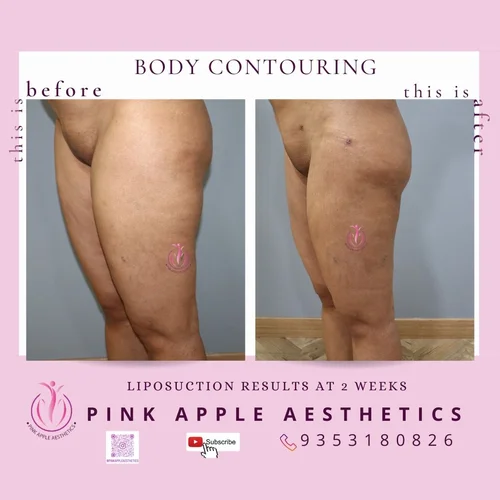

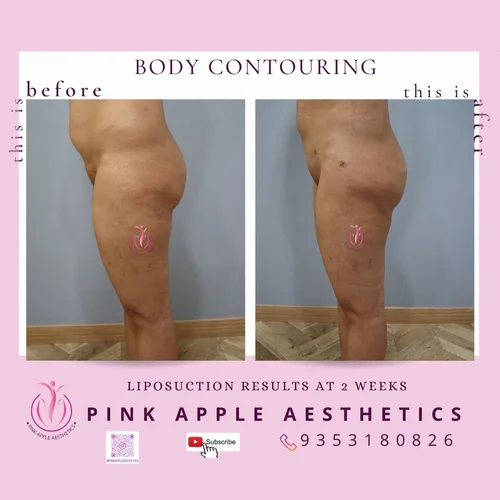
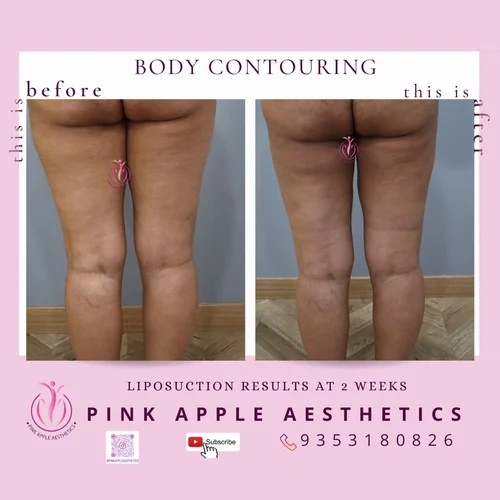
Results shown are from actual patients of Dr. Pinky Devi Ayyappan at Pink Apple Aesthetics, Bangalore. Individual outcomes vary based on thigh anatomy, fat distribution, skin elasticity, zones treated, and post-operative weight maintenance. All images are shared with patient consent.
Why Thigh Fat Is So Resistant to Exercise — The Science Explained
If you have been doing squats, lunges, cycling, running, and targeted leg exercises for years without meaningful change in your thigh shape, there is a biological reason — and it is not a failure of commitment.
- Oestrogen-driven fat storage — the female sex hormone oestrogen specifically promotes fat storage in the thighs, hips, and buttocks. This fat serves as an energy reserve related to reproductive biology — and it is designed to be stubborn. The fat cells in these zones have a disproportionately high density of alpha-2 adrenoreceptors (fat-storing receptors) compared to the beta receptors (fat-releasing receptors) found in more metabolically active fat depots. This chemical imbalance means these cells are highly efficient at absorbing fat and highly resistant to releasing it during exercise.
- Spot reduction is not possible — exercise burns calories and creates a generalised fat deficit across the entire body in a sequence determined by your specific genetics and hormonal makeup. There is no exercise that specifically targets fat release from the thighs — if your body is programmed to hold thigh fat for last, no combination of squats, leg presses, and cardio will change that.
- Lipodystrophy — the technical term for hormonally programmed, localised fat distribution — means that some patients have a structural body shape that exercise and diet cannot modify. The only tool that physically removes the specific fat cells contributing to this shape is liposuction.
- Post-pregnancy amplification — pregnancy and the hormonal changes of motherhood frequently intensify thigh fat storage. Many Indian women first notice their thigh concerns during or after pregnancy, when oestrogen levels shift the fat distribution pattern toward the lower body.
Many patients who consult for thigh liposuction have been exercising consistently for years. Their cardiovascular fitness and muscle tone are excellent — it is purely the subcutaneous thigh fat that has not changed. This is a biological reality, not a personal failure. Liposuction is the tool that fills the gap that exercise cannot.
Thigh Liposuction Surgery Cost at Pink Apple Aesthetics
Thigh liposuction at Pink Apple Aesthetics starts from ₹1,00,000 to ₹1,25,000 (terms and conditions apply). Your confirmed cost is provided after consultation with Dr. Pinky, based on the zones treated, the volume of fat removal, and the anaesthesia approach.
What your thigh liposuction cost typically includes:
- Surgeon's fee — Dr. Pinky Devi Ayyappan, MCh Plastic Surgery.
- Anaesthesia — local with IV sedation or general anaesthesia as planned.
- Surgical facility charges.
- Tumescent solution and surgical consumables.
- Compression garment — high-waist compression shorts provided for the 4 to 6 week recovery period.
- Post-operative medications — antibiotics and prescribed pain relief.
- Follow-up appointments — at 1 week and 1 month.
What affects the final cost:
- Zones treated — inner thigh alone vs outer thigh alone vs combined vs circumferential.
- Volume of fat — larger fat volumes require more surgical time.
- Anaesthesia type — general anaesthesia for circumferential cases.
- Combined with other areas — thigh liposuction combined with abdomen, flanks, or arms in the same session.
Thigh liposuction is a cosmetic procedure and is not covered by health insurance. EMI payment options are available at Pink Apple Aesthetics.
Skin Elasticity — The Most Important Factor in Thigh Liposuction Outcomes
As with all liposuction procedures, the skin’s ability to retract after fat removal is the critical determinant of the outcome quality. This is particularly important for thigh liposuction because the inner thigh skin is thinner and more prone to laxity than many other body areas.
The thigh pinch test: pinch and lift the skin of the inner thigh (the typical assessment site) and release it. Does it snap back firmly and smoothly? Or does it wrinkle, fold loosely, or settle slowly? Good elasticity — the skin snaps back promptly — indicates the skin will redrape beautifully after fat removal. Poor elasticity — the skin wrinkles or settles slowly — suggests that liposuction alone will leave visible loose skin.
| Skin Elasticity | What It Means | Recommended Approach |
|---|---|---|
| Good — snaps back immediately | Fat is the primary concern. Skin will redrape smoothly after liposuction. | Thigh liposuction alone — excellent candidate for natural smooth result. |
| Moderate — partial snap-back | Fat and some skin laxity. Skin will partially retract but minor residual laxity possible. | Thigh liposuction — good candidate. Realistic expectations for minor residual laxity discussed at consultation. |
| Poor — hangs, folds, slow | Skin laxity is primary concern. Fat removal without skin excision will leave visible sagging. | Thigh lift (medial thighplasty) recommended — either alone or with liposuction. Liposuction alone will not produce a satisfactory result. |
Inner thigh skin tends to be more prone to laxity than outer thigh skin. This is particularly relevant for patients over 40, those who have had significant weight loss, or post-pregnancy patients. Dr. Pinky assesses inner and outer thigh skin separately at consultation — the two zones often have different elasticity.
Thigh Liposuction for Indian Women — Why Thigh Contour Matters in Indian Daily Life
For Indian women, the impact of thigh fat goes beyond body aesthetics — it directly affects the most fundamental daily clothing experiences:
- Churidars and tight-fit leggings — the fitted silhouette of churidars, leggings, and jeggings that are a staple of Indian daily wear makes saddlebag and inner thigh fullness immediately visible. Many women avoid these styles entirely despite wanting to wear them — choosing looser salwar or wider kurti cuts to conceal thigh shape.
- Fitted saree silhouette — when a saree is draped tightly — as is fashionable for formal occasions — the outer thigh and hip profile is visible through the drape. Saddlebag fullness can distort the line of a beautifully draped saree.
- Inner thigh chafing in Indian summers — Bangalore's heat and humidity make inner thigh chafing a genuine health and quality-of-life problem for women with significant inner thigh fat. The resulting intertrigo (skin rash, friction sores), the need for anti-chafing shorts or creams in warm weather, the avoidance of certain types of walking or physical activity — these physical limitations are reported by patients as significantly affecting daily life.
- Swimming, yoga, and fitness wear — the rise of yoga, swimming, and gym culture in Bangalore's urban professional community means more women in fitted fitness wear more often. Thigh self-consciousness is a specific barrier to full participation in these activities.
- Wedding and special occasion wear — fitted blouses, lehengas, and anarkali silhouettes for weddings and events expose the thigh profile in ways that not all women are comfortable with.
For many Indian patients, inner thigh chafing is not a cosmetic concern — it is a physical health and daily comfort issue. The functional improvement from inner thigh liposuction — the elimination of friction, rash, and the discomfort of thighs rubbing together — is reported by patients as one of the most significant quality-of-life improvements from any cosmetic procedure. Freedom to walk normally in summer heat, to wear shorts, to exercise without discomfort — these are gains that go far beyond appearance.
What Happens During Thigh Liposuction — Step by Step
Step 1 — Consultation and five-zone assessment
Dr. Pinky examines all five thigh zones and performs the skin elasticity pinch test at each location. She assesses the fat volume and distribution, identifies the primary zones of concern, and discusses whether inner thigh alone, outer thigh alone, banana roll, or a combined approach will produce the result the patient wants. The planned incision sites and their concealment positions are shown and discussed. The relationship between thigh and hip-to-waist proportion is assessed — because over-removing outer thigh fat without addressing the hip creates a narrower thigh that sits below a disproportionate hip.
Step 2 — Pre-operative preparation
Blood tests and pre-operative medical assessment. Stop smoking 4 weeks before. Stop blood thinners 1 to 2 weeks before. Stable weight for at least 6 months. Compression garments sized pre-operatively. Comfortable, loose trousers or a skirt are recommended for the journey home.
Step 3 — Anaesthesia
Inner thigh liposuction alone can often be performed under local anaesthesia with IV sedation as a day-care procedure. Outer thigh, banana roll, or circumferential thigh contouring is more comfortably performed under general anaesthesia. The anaesthetic approach is discussed and planned at consultation. Both thighs are always treated in the same session — staged single-thigh treatment produces asymmetry in the recovery phase.
Step 4 — The procedure (1 to 2.5 hours)
Tumescent solution is infiltrated throughout the zones to be treated. Tiny incisions (2 to 3 mm) are placed in the most concealed positions: the groin crease for inner thigh access; the buttock crease or outer hip for outer thigh; near the knee crease for lower thigh access. Power-assisted liposuction (PAL) or standard tumescent cannula is used for fat removal in multiple controlled passes, with the pinch test used throughout to ensure even removal. Both thighs are contoured in the same session. Compression shorts or thigh garments are applied immediately after.
Step 5 — Recovery: weeks 1 to 6
Compression garments (high-waist compression shorts covering the full thigh) are worn continuously day and night for 4 to 6 weeks. Swelling and bruising in the thighs peaks at 3 to 5 days — significantly more visible than arm liposuction swelling because of the larger fat volume treated and the dependent position of the legs. Walking is encouraged from day 1; prolonged sitting in one position is avoided for the first 2 weeks to prevent prolonged pressure on the treated areas. Return to desk work: 3 to 5 days. Driving: 5 to 7 days. Cycling, running, strenuous lower body exercise: 4 to 6 weeks. Final settled result: 3 to 6 months.
Who Is a Good Candidate for Thigh Liposuction?
- Near ideal body weight — within approximately 10 to 20% of ideal weight with specific localised thigh fat that is disproportionate or exercise-resistant.
- Localised thigh fat excess — inner thighs, outer thighs (saddlebags), banana roll, or anterior thigh excess that has not responded to consistent exercise.
- Good to moderate skin elasticity — skin that will retract after fat removal. Patients with significant thigh skin laxity may need a thigh lift (medial thighplasty) in addition to or instead of liposuction.
- Stable weight for at least 6 months — significant weight gain after surgery can cause remaining fat cells to enlarge.
- Inner thigh chafing and discomfort — functional improvement from reducing inner thigh friction is a specific indication for inner thigh liposuction.
- Good general health — no uncontrolled conditions affecting surgical safety.
- Non-smoker or willing to stop — smoking impairs healing.
- Realistic expectations — thigh liposuction produces a leaner, more proportionate thigh contour. It is not a thigh gap guarantee — the achievable gap depends on each patient's skeletal anatomy. It does not address cellulite, stretch marks, or skin laxity.
A thigh gap is partly determined by the width of the hip bones — a structural factor that no surgery can change. Inner thigh liposuction reduces the inner thigh fat volume, which creates more space between the thighs — but the degree of visible gap depends on bone structure as well as fat. Patients should discuss their specific expectations with Dr. Pinky at consultation.
What Are the Risks of Thigh Liposuction Surgery?
Thigh liposuction is a well-established, safe body contouring procedure. Patients should be fully informed:
- Swelling and bruising — more significant than arm liposuction due to the larger fat volumes and dependent position of the legs. Peaks at 3 to 7 days; largely resolved by 4 to 6 weeks; fully resolved at 3 to 6 months.
- Temporary numbness — altered sensation in the inner thigh is common as small sensory nerve fibres recover; typically resolves over 4 to 12 weeks.
- Contour irregularities — surface unevenness or dimpling. Prevented with even cannula technique. Revision possible at 6 months if significant.
- Loose skin — inadequate skin retraction after fat removal; prevented by honest elasticity assessment at consultation. Thigh lift recommended at consultation if laxity is significant.
- Seroma — fluid collection; more common in thigh liposuction than smaller areas; managed with aspiration and compression.
- Medial thigh skin necrosis (rare) — if the inner thigh access incision placement or technique compromises skin blood supply; prevented with careful incision placement and conservative skin flap elevation.
- DVT risk — compression stockings and early walking are used routinely to reduce DVT risk.
- Asymmetry — minor differences between the two thighs; uncommon with careful bilateral planning.
At Pink Apple Aesthetics, the most avoidable thigh liposuction complication — loose skin after fat removal — is addressed at consultation with an honest skin elasticity assessment. Patients who need a thigh lift for optimal results are told so before surgery.
Why Choose Dr. Pinky Devi Ayyappan for Thigh Liposuction Surgery?
MCh (Plastic, Reconstructive & Aesthetic Surgery)
India’s highest postgraduate plastic surgery qualification. Body contouring — including thigh liposuction, circumferential contouring, and combined liposuction with thigh lift — is a core MCh training area.
Female, board-certified plastic surgeon
One of very few female MCh plastic surgeons in Bangalore. Thigh liposuction consultations involve close examination of intimate body areas — for many patients, having a female surgeon makes the consultation more comfortable and the discussion of specific concerns easier.
Five-zone thigh assessment
Inner, outer, banana roll, anterior, and circumferential zones all assessed at consultation. Treating only the inner thigh when the outer thigh is the primary visual concern — or vice versa — produces an incomplete result. The assessment is zone-specific, not generic.
Proportional contouring
Thigh liposuction outcomes depend on proportion: the thigh contour must sit harmoniously with the hip above and the knee below. Dr. Pinky assesses the full leg proportion at consultation and plans treatment to optimise the overall leg silhouette, not just the treated zone in isolation.
Inner thigh functional improvement
The reduction of inner thigh chafing and friction is treated as a serious quality-of-life benefit, not merely a cosmetic side effect, at Pink Apple Aesthetics.
Skin elasticity honesty
Patients with significant thigh skin laxity are told clearly if thigh lift rather than liposuction is more appropriate for their anatomy.
DAFPRS Fellowship — Belgium (Dr. Patrick Tonnard & Dr. Alexis Verpaele)
4.9 stars from 191+ verified Google reviews
Times of India Top Brand 2024

Thigh Liposuction — Frequently Asked Questions

What is saddlebag fat and can liposuction permanently remove it?
Saddlebag fat is the excess fat deposit on the outer thigh and hip that creates a widened, bulging lateral profile — the ‘saddlebag’ shape when viewed from the front. It is one of the most genetically and hormonally determined female fat depots — driven by oestrogen, designed to be stubborn, and highly resistant to diet and exercise. Outer thigh liposuction directly removes the fat cells in these deposits permanently. The removed cells do not regenerate. Patients who maintain their weight after surgery enjoy a permanent improvement in outer thigh contour. The saddlebag shape that has frustrated years of exercise is structurally eliminated
Can thigh liposuction help with inner thigh chafing?
Yes — and this is one of the most significant functional benefits of inner thigh liposuction. Reducing the fat volume of the inner thighs creates space between the legs that eliminates the skin-to-skin friction that causes chafing, intertrigo (skin rash), soreness, and the physical difficulty of walking normally in warm or humid weather. Many patients describe the relief from chronic inner thigh chafing as the most personally significant change from the procedure — more immediately impactful, in daily practical terms, than any cosmetic improvement.
What is the banana roll and how is it treated?
The banana roll is the curved crescent of fat that sits in the crease between the lower buttock and the posterior upper thigh. When prominent, it creates a visible horizontal fold that blurs the natural buttock-to-thigh transition and makes the buttock appear lower and less defined. Targeted liposuction of the banana roll — through a small incision in the lower buttock crease — sharpens this transition, makes the buttock appear slightly lifted, and improves the posterior leg contour in swimwear and fitted clothing. It is most commonly treated in combination with outer thigh liposuction.
Is a thigh gap possible after inner thigh liposuction?
A visible thigh gap after inner thigh liposuction is possible for many patients — but it is not guaranteed for all, and the degree of gap depends on bone structure as well as fat volume. The width of the hip bones (specifically the angle of the femoral necks) determines how far apart the thighs naturally stand when the feet are together. Narrow hip bones create a natural gap even at higher weight; wide hip bones may not produce a visible gap even after maximum fat removal. Inner thigh liposuction reduces the fat volume and creates more space between the legs — but the achievable result depends on each patient’s underlying skeletal anatomy. Dr. Pinky discusses this specifically at consultation.
Should I treat inner thighs, outer thighs, or both?
It depends on where your specific concern lies. Inner thigh fat causes thigh touching, rubbing, and chafing — the functional discomfort and the desire for a thigh gap or slimmer inner line. Outer thigh saddlebag fat causes widening of the hips and thighs, visible bulk in the lateral profile, and difficulty with fitted clothing silhouette. Many patients have both concerns — treating both in the same session produces the most complete and harmonious thigh result. Dr. Pinky assesses both zones at consultation and discusses which combination addresses the specific concerns the patient has described.
How long does the compression garment need to be worn after thigh liposuction?
The compression garment — high-waist compression shorts covering the full treated thigh zone — should be worn continuously day and night for 4 to 6 weeks. The thigh is a large, dependent region that swells significantly after liposuction. Consistent compression is the most important post-operative measure for reducing swelling, supporting skin retraction, and helping the thigh conform to its new contour during healing. Patients who shorten the compression period consistently have higher rates of residual swelling and less smooth contour results.
Ready for Thighs That Move Freely and Look the Way You Want?
The thigh liposuction consultation at Pink Apple Aesthetics is a thorough zone-specific assessment of where your thigh fat actually sits, how the skin will respond to fat removal, and exactly which treatment plan will produce the result you want. Many patients arrive knowing what bothers them but unsure which procedure addresses it — and leave with a clear, specific plan and realistic expectations of what is achievable.
- Phone / WhatsApp: +91 93531 80826
- Email: info@pinkappleaesthetics.com
- Clinic address: 40, First Floor, 36th F Cross, 23rd Main Rd, 4th T Block East, Jayanagar, Bengaluru – 560 041
Please wear fitted trousers or leggings to your consultation — the examination requires clear visual and tactile assessment of all thigh zones. Consultations are available on weekdays and selected Saturdays.


