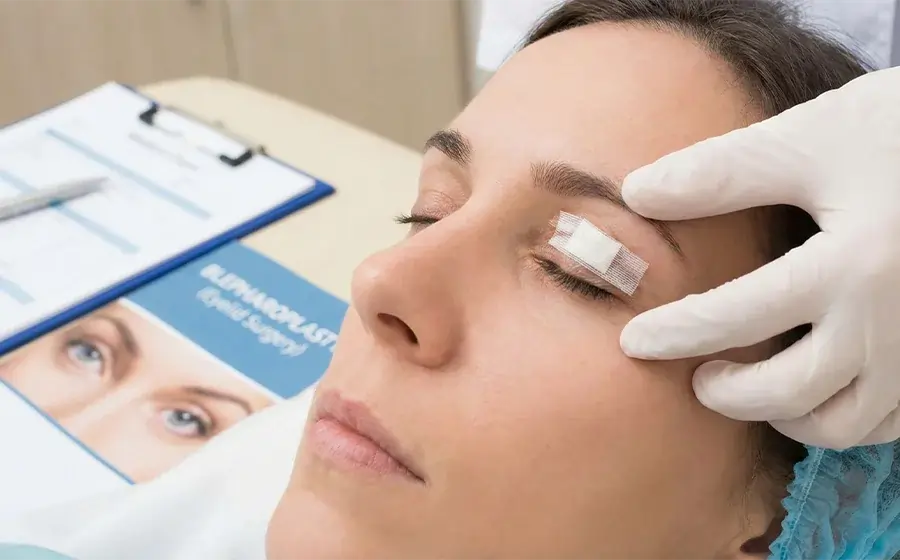
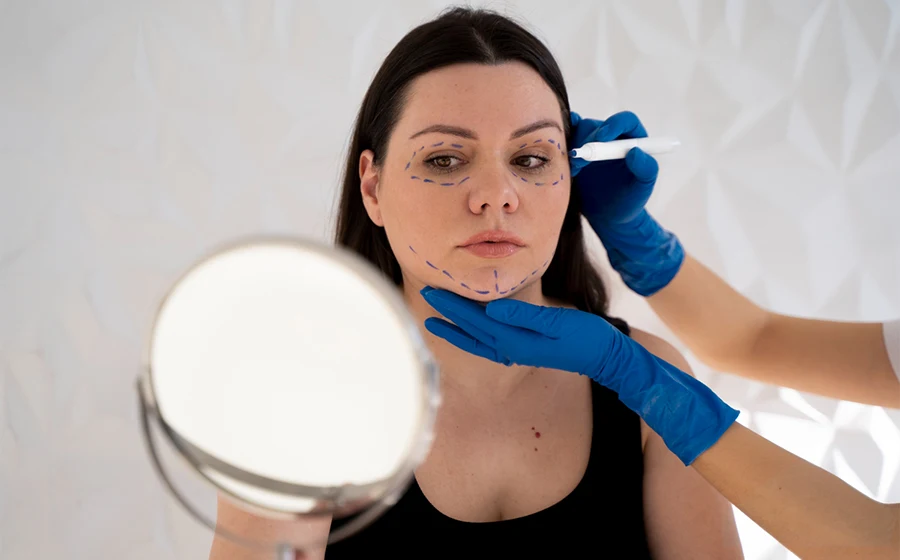
Blepharoplasty (Eyelid Surgery) in Bangalore
At Pink Apple Aesthetics, Jayanagar, eyelid surgery is performed by Dr. Pinky Devi Ayyappan, MCh (Plastic Surgery) — a board-certified plastic surgeon with over 12 years of experience and dedicated fellowship training in facial surgery from South Korea and Europe.
What Is Blepharoplasty — And What Can It Actually Fix?
Blepharoplasty is a surgical procedure that reshapes the upper eyelids, lower eyelids, or both by removing or repositioning excess skin, fat, and in some cases muscle. It is one of the most effective and long-lasting ways to refresh the appearance of the eyes.
What blepharoplasty can address:
- Drooping or hooded upper eyelids — where excess skin folds over the lash line, making the eyes look smaller, heavier, or tired. In significant cases this can also partially obstruct the upper field of vision.
- Under-eye bags — caused by fat that has shifted forward beneath the lower lid, creating a persistently puffy look that no amount of sleep or eye cream can correct.
- Excess lower eyelid skin — fine crinkling or loose skin beneath the eyes that contributes to an aged appearance.
- Asymmetric eyelids — where one upper or lower eyelid sits or looks noticeably different from the other.
- Asian eyelids without a visible crease — a natural variation in which the upper eyelid has no crease (monolid), which some patients wish to modify with double eyelid surgery.
What blepharoplasty does not fix: dark circles caused by pigmentation, crow’s feet wrinkles at the outer eye corners, or sagging eyebrows. If these are also concerns, Dr. Pinky will discuss complementary options such as a brow lift or non-surgical treatments during your consultation.
Blepharoplasty Before & After Results


Results shown are from actual patients of Dr. Pinky Devi Ayyappan at Pink Apple Aesthetics, Bangalore. Individual outcomes vary based on eyelid anatomy, skin type, age, and the specific goals discussed in consultation. All images are shared with patient consent.
Types of Eyelid Surgery Performed at Pink Apple Aesthetics
The right type of blepharoplasty depends on which part of the eyelid you want to address, and what your specific anatomy looks like. Dr. Pinky will assess this during your consultation.
1. Upper Blepharoplasty (Upper Eyelid Surgery)
The most commonly requested eyelid procedure. Excess skin — and occasionally a small amount of fat — is removed from the upper eyelid through an incision placed precisely in the natural upper eyelid crease. Once healed, this crease completely conceals the scar, making it one of the most scar-friendly procedures in all of cosmetic surgery. Results are long-lasting and often permanent for the skin component.
2. Lower Blepharoplasty (Under-Eye Bag Removal)
Addresses puffy under-eye bags and excess lower eyelid skin. There are two main approaches:
- Transcutaneous (external) approach — a fine incision just below the lower lash line allows removal or repositioning of fat, and skin tightening if needed. Suited to patients who have both fat excess and skin laxity.
- Transconjunctival approach — the incision is made inside the lower eyelid, leaving absolutely no visible external scar. Excellent for younger patients whose main concern is fat excess without significant skin looseness.
3. Combined Upper and Lower Blepharoplasty (Four-Lid Surgery)
When both upper and lower eyelids need addressing, both procedures can be performed in a single surgical session. This gives a more comprehensive eye rejuvenation result and is more efficient than scheduling two separate operations. The total recovery period remains similar to lower blepharoplasty alone.
4. Asian Blepharoplasty / Double Eyelid Surgery
A significant proportion of South and East Asian individuals are born with a single eyelid — an upper eyelid without a visible crease (called a monolid). Asian blepharoplasty, also known as double eyelid surgery, creates a natural upper eyelid crease, making the eyes appear more open and defined. There are two main techniques:
- Suture technique (non-incision method) — tiny sutures create a crease without a skin incision. Suitable for patients with minimal excess skin and a desire for subtle enhancement. Faster recovery.
- Incision technique — a small incision is made to create a more defined, permanent crease. Preferred when there is some excess skin or when a very precise crease position is needed. More durable long-term result.
Dr. Pinky’s Seoul training specifically included double eyelid procedures for Asian patients — this is not a general technique she has adapted; it was part of her formal fellowship training.
5. Functional Blepharoplasty (Ptosis Correction)
When the upper eyelid droops low enough to partially cover the pupil and obstruct vision, this is called ptosis. Functional blepharoplasty corrects the underlying muscle weakness or excess skin causing the problem, restoring a full field of vision. In documented cases of visual impairment, a portion of the procedure may be covered by health insurance — Dr. Pinky can advise on this during your consultation.
6. Revision Blepharoplasty
If you have had a previous eyelid procedure elsewhere and are unhappy with the outcome — whether due to asymmetry, insufficient correction, or an unnatural result — revision blepharoplasty can address and correct the issues. This requires a surgeon experienced in working with previously operated eyelid tissue.
Who Is a Good Candidate for Blepharoplasty?
Most healthy adults with concerns about the appearance or function of their eyelids are potentially good candidates. The following characteristics make for a suitable patient:
- Age 25 or above — although there is no fixed minimum age, the concerns that blepharoplasty addresses most commonly present from the late 20s onwards. Double eyelid surgery can be appropriate from early adulthood.
- Good general health — no uncontrolled systemic conditions such as unmanaged hypertension or diabetes, and no active eye infections or conditions.
- No serious pre-existing eye conditions — patients with dry eye syndrome, glaucoma, or significant thyroid eye disease need careful assessment before proceeding. These are manageable but require planning.
- Non-smoker, or willing to stop smoking — smoking significantly affects healing, particularly in the delicate eyelid tissue.
- Realistic expectations — blepharoplasty can genuinely refresh and rejuvenate the eye area, but it cannot change bone structure, eliminate deep lines, or stop ageing entirely. Results last many years and sometimes a lifetime, but the face continues to age naturally.
- Your decision is personal — the best outcomes come from patients acting for themselves, not due to pressure from others.
If you wear glasses or contact lenses, please mention this at your consultation. If you are currently taking blood-thinning medications or supplements (including aspirin, fish oil, or vitamin E), these will need to be paused in advance of surgery.
What to Expect: From Your Consultation to Your Results
Step 1 — Consultation and gStep 1 — Consultation with Dr. Pinkyrading
Your consultation begins with Dr. Pinky understanding your concerns and goals — not rushing to offer a treatment. She will examine your upper and lower eyelids carefully, assess how much excess skin or fat is present, review your facial proportions and symmetry, and check for any functional concerns such as lid drooping that could affect vision. She uses imaging to help you see a realistic preview of what is achievable.
If you have any history of dry eyes, thyroid conditions, or previous eye surgery, she will factor these in before recommending a plan.
Step 2 — Pre-Operative Preparation
Before your surgery date, you will have blood tests and any other relevant investigations. You will receive written instructions about which medications and supplements to stop in advance, fasting requirements, and what to arrange at home for your recovery period. You will also need someone to drive you home after the procedure.
Step 3 — The Surgery
Depending on the type and extent of the procedure, blepharoplasty typically takes between 45 minutes and 2 hours. Upper eyelid surgery alone can be performed under local anaesthesia with sedation. Combined upper and lower procedures are generally performed under general anaesthesia for patient comfort. The procedure is typically day-care — you go home the same day.
Step 4 — The First Week
Cold compresses applied gently to the eyelid area help reduce swelling and bruising in the early days. Prescribed antibiotic eye drops or ointment keep the area clean. Most patients find the discomfort mild — more of a sensation of tightness than pain. Sutures are typically removed at 5 to 7 days for the upper eyelid and slightly later for the lower. You should avoid screens, reading, and contact lenses for the first several days, as eye strain increases discomfort.
Step 5 — Returning to Normal Life
Most patients feel comfortable returning to office-based work and light daily activity within 7 to 10 days. By 2 weeks, any residual bruising or swelling is usually well enough concealed with light makeup. Strenuous activity and gym sessions should be avoided for 3 to 4 weeks. Full visual clarity — including to contact lens wear — typically returns at 2 to 3 weeks.
Step 6 — Your Final Results
Upper eyelid surgery results are often clearly visible within 2 to 3 weeks as swelling settles. Lower eyelid results take slightly longer to fully appreciate — subtle swelling around the lower lids can persist for 4 to 8 weeks. The final result, with the eyelids fully settled into their new position, is typically evident by 3 months. For most patients, the upper eyelid result is essentially permanent. Lower eyelid results are also very long-lasting and rarely require revisiting.
What Are the Risks of Blepharoplasty?
Blepharoplasty performed by a board-certified plastic surgeon is considered a safe and well-established procedure with a high satisfaction rate. As with any surgery, however, there are risks every patient should understand before making a decision:
- Swelling and bruising — expected and completely temporary. Most patients see significant reduction within 7 to 14 days.
- Temporary dry eyes or increased tearing — common in the early weeks as the eyelids adjust. Usually resolves on its own; artificial tear drops help.
- Temporary blurred or double vision — can occur in the first few days due to eye ointment and swelling. Resolves as healing progresses.
- Infection — rare with proper post-operative care; managed with antibiotics if it occurs.
- Asymmetry — minor differences between the two eyelids during healing are normal; significant asymmetry requiring correction is uncommon with an experienced surgeon.
- Scarring — incisions are placed in natural eyelid creases and typically heal to a very fine, inconspicuous line. Abnormal scar formation is rare in eyelid tissue.
- Difficulty fully closing the eyes (lagophthalmos) — rare, and when it does occur after upper eyelid surgery, is almost always temporary.
- Under-correction or need for revision — a small percentage of patients may want or require a minor revision. This is not done for at least 6 to 12 months after the primary procedure.
Dr. Pinky will walk you through all risks that are relevant to your specific case during your consultation. No question is too small — informed patients make the best decisions.
Blepharoplasty Surgery Cost at Pink Apple Aesthetics
Blepharoplasty at Pink Apple Aesthetics starts from ₹50,000 to ₹75,000 (terms and conditions apply). Your confirmed cost will be given after your personal consultation with Dr. Pinky.
We do not quote a fixed price without first seeing you, because the cost depends on which eyelids are being addressed and the extent of correction needed. Quoting a number before examining you would not be honest — or useful to you.
What is typically included in your blepharoplasty cost:
- Surgeon's fee — Dr. Pinky Devi Ayyappan, MCh Plastic Surgery.
- Anaesthesia fee — local with sedation for upper eyelid alone; general anaesthesia for combined procedures.
- Operating theatre / facility charges.
- Post-operative medications — antibiotic eye drops or ointment, prescribed pain relief.
- Pre-operative blood tests and investigations.
- Follow-up appointments — Dr. Pinky monitors your healing at key intervals including suture removal.
What typically affects the final cost:
| Factor | How it affects cost |
|---|---|
| Procedure type | Upper eyelid alone is typically the lower end. Lower or combined upper & lower is more involved. |
| Anaesthesia type | Local anaesthesia with sedation costs less than general anaesthesia used for combined procedures. |
| Extent of correction | Minor excess skin removal is simpler than cases requiring significant fat repositioning or muscle tightening. |
| Functional vs cosmetic | Ptosis correction with a documented visual field deficit may qualify for partial insurance coverage. |
| Revision cases | Secondary procedures on previously operated eyelids are more complex and are priced accordingly. |
Cosmetic blepharoplasty is not covered by health insurance. If you have a medically documented visual impairment caused by drooping upper eyelids (ptosis), the functional element of the surgery may be partially covered by your insurer — we advise checking directly with your insurance provider. EMI payment options are available.
Why Choose Dr. Pinky Devi Ayyappan for Blepharoplasty?
Eyelid surgery is exceptionally demanding. The skin of the upper and lower eyelids is the thinnest on the entire body — typically just 0.5 mm. The margin for error is nearly zero, and the result is on constant display every time a patient makes eye contact with another person.
Dr. Pinky Devi Ayyappan brings a combination of qualifications and international training that is rare among eyelid surgery providers in Bangalore:
- MCh (Plastic, Reconstructive & Aesthetic Surgery) — the highest postgraduate qualification in plastic surgery in India, covering both functional and cosmetic eyelid procedures.
- Facial Aesthetic Surgery Fellowship — Seoul, South Korea — trained at YK Plastic Clinic and Jayjun Plastic Surgery, two of Asia's most respected centres for precision facial surgery, including upper eyelid and double eyelid procedures.
- Fellowship — Dr. Patrick Tonnard & Dr. Alexis Verpaele, Belgium — trained by two of Europe's leading surgeons in periorbital rejuvenation and facial aesthetic surgery.
- Observership — Dr. Giovanni Botti, Villa Bella, Italy — additional exposure to advanced European eyelid and facial techniques.
- 12+ years' experience — across cosmetic and reconstructive eyelid procedures.
- Times of India Top Brand 2024 Award — recognised as one of Bangalore's leading aesthetic clinics.
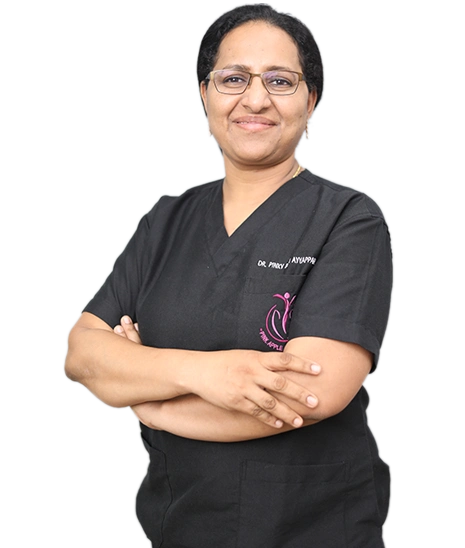
Dr. Pinky’s Seoul fellowship specifically included training in Asian and double eyelid techniques — making her particularly suited to Indian patients who want eyelid surgery that respects their natural features and ethnicity.
Blepharoplasty — Frequently Asked Questions

What is the difference between upper and lower blepharoplasty?
Upper blepharoplasty addresses the upper eyelids — most commonly excess skin that makes the eyes look heavy, hooded, or tired. Lower blepharoplasty addresses the lower eyelids — typically under-eye bags caused by fat that has shifted forward, or loose skin beneath the eyes. Both can be done in the same session when needed.
What is Asian blepharoplasty / double eyelid surgery?
Asian blepharoplasty is a procedure specifically designed to create or define an upper eyelid crease in individuals who do not have one naturally (known as a monolid or single eyelid). It is common among East and South Asian patients. At Pink Apple Aesthetics, Dr. Pinky trained in this technique specifically during her facial surgery fellowship in Seoul, South Korea — it is not a general technique she has adapted.
Will my eyelid surgery scars be visible?
For upper blepharoplasty, incisions are placed in the natural upper eyelid crease and heal into a very fine line that sits invisibly within that fold. For lower blepharoplasty via the external approach, the incision is placed immediately below the lower lash line and also becomes virtually invisible. With transconjunctival lower blepharoplasty, there is no external scar at all — the incision is inside the eyelid.
How long does blepharoplasty last? Is it permanent?
Upper eyelid surgery is effectively permanent for the skin that is removed — that skin does not return. The underlying ageing process continues, but most patients do not require a repeat procedure. Lower eyelid fat repositioning is also very long-lasting, with few patients ever needing revision to the lower lids. This makes blepharoplasty one of the best long-term value cosmetic procedures available.
What is the recovery time for eyelid surgery in Bangalore?
Most patients return to office work and light daily activity within 7 to 10 days. Bruising and swelling reduce significantly within 2 weeks. You can return to gym and strenuous exercise at 3 to 4 weeks. Contact lenses can typically be worn again from 2 to 3 weeks. Most people do not feel they need to ‘hide’ from social life beyond the first 10 to 14 days.
Is blepharoplasty painful?
During the procedure, you will be under local anaesthesia (with or without sedation) or general anaesthesia, so you feel nothing during surgery. Afterwards, most patients describe a feeling of tightness and mild soreness around the eyes rather than sharp pain. This is well managed with prescribed pain medication and cold compresses, and reduces significantly within the first 2 to 3 days.
Can blepharoplasty fix dark circles under the eyes?
It depends on the cause. Under-eye bags (fat pouches) creating shadow can be addressed with lower blepharoplasty. However, dark circles caused by pigmentation in the skin — which is common in Indian skin tones — are not corrected by surgery alone. Non-surgical treatments such as PRP, fillers, or skin-lightening treatments may be more appropriate for pigmentation-based dark circles. Dr. Pinky will assess which category your dark circles fall into and recommend accordingly.
Can I combine blepharoplasty with other procedures?
Yes. Blepharoplasty is frequently combined with a brow lift (to address brow descent that contributes to upper eyelid hooding), a facelift, or non-surgical treatments such as Botox and dermal fillers. If you have concerns beyond the eyelids, mention them at your consultation — it may be more practical and cost-effective to address multiple areas in a single session.
What age is best for eyelid surgery?
There is no single ‘best age.’ Upper eyelid surgery is most commonly requested from the late 30s to 60s, when skin laxity becomes noticeable. Double eyelid surgery is frequently requested in the 20s and 30s. Functional blepharoplasty for ptosis can be performed at any adult age. The key factor is not age but rather whether your concerns are present, your health is good, and your expectations are realistic.