
Liposculpturing in Bangalore
Liposculpturing — also called liposculpture or body sculpting surgery — is a comprehensive, multi-zone body contouring approach that simultaneously treats the abdomen, flanks (love handles), waist, and often the outer thighs and back in a single coordinated surgical session. The result is not just less fat in isolated spots. It is a reshaped body — a defined waist, a flatter abdomen, an improved waist-to-hip ratio, and a silhouette that looks naturally proportionate rather than surgically modified.
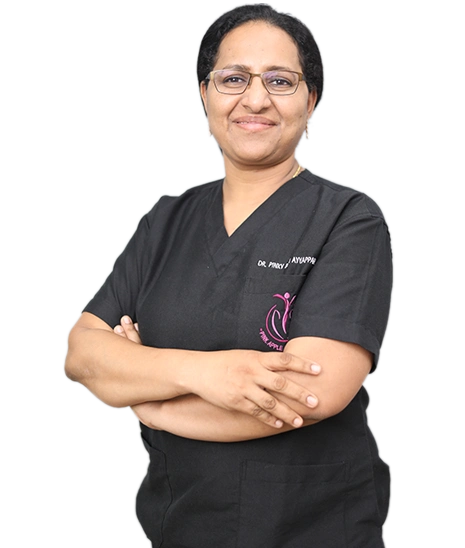
At Pink Apple Aesthetics, Jayanagar, liposculpturing is performed by Dr. Pinky Devi Ayyappan, MCh (Plastic Surgery) — a female, board-certified plastic and reconstructive surgeon with 12+ years of experience. The planning philosophy at Pink Apple Aesthetics treats liposculpturing as an artistic and anatomical process — every zone treated in relation to the others, with the goal of proportion and harmony, not simply removal.
What Is Liposculpturing — And How Is It Different From Standard Liposuction?
The term ‘liposculpturing’ places the emphasis on sculpture — on the artistic shaping of the body contour — rather than simply on the mechanical removal of fat. In practical surgical terms, the distinction lies in the planning philosophy and the scope of treatment.
| Standard Liposuction | Liposculpturing | |
|---|---|---|
| Treatment scope | One or two isolated areas — e.g. abdomen only, or arms only | Multiple zones treated in a coordinated single session — abdomen, flanks, waist, back, hips, thighs |
| Planning philosophy | Remove fat from the area of concern | Reshape the overall body silhouette by treating zones in relation to each other |
| Visual result | Flatter or smaller single area | Transformed proportionate body shape — defined waist, improved waist-to-hip ratio, harmonious contour |
| Session structure | Single area, typically 1-1.5 hours | Multiple zones, typically 2.5-4 hours under general anaesthesia |
| Best suited to | Patients with one isolated area of specific concern | Patients wanting comprehensive body reshaping — complete silhouette transformation |
| Cost structure | Per area | Comprehensive session — more efficient than treating areas separately in staged procedures |
The most important insight in liposculpturing planning: removing fat from the abdomen alone while leaving the flanks untreated narrows the front but leaves visible side bulges. Removing flanks alone while leaving the abdomen creates an inconsistent result. These areas are contiguous — they are part of the same silhouette. Treating them together produces a result that is more than the sum of its parts.
The Liposculpturing Zone Map — What Areas Are Treated and in What Combination
Liposculpturing at Pink Apple Aesthetics is planned as a 360-degree body assessment. Dr. Pinky assesses the following zones at consultation and recommends the combination that will produce the most harmonious result for each patient’s specific body shape:
The core sculpting zones (most commonly treated together):
- Abdomen (upper and lower) — the central panel of fat that creates abdominal projection. Upper abdominal fullness and lower abdominal fullness are treated as two separate sub-zones — the cannula approach and depth of treatment differ between them. The lower abdomen is the most common primary concern; the upper abdomen is often undertreated by surgeons who focus only on the lower zone.
- Flanks (love handles) — the bilateral fat deposits on the lateral waist that create the 'love handle' silhouette. The flanks are the single most important zone for creating waist definition — because waist definition is not about the front of the abdomen, it is about the narrowing of the lateral profile. Flank liposuction transforms the waist-to-hip ratio more dramatically than any other single zone.
- Upper back / bra roll — the fat pads on either side of the upper back that create the 'back bra roll' bulge visible in fitted clothing. Treating the back alongside the abdomen and flanks creates a circumferential improvement in the middle-body contour — a consistent silhouette from front to back.
- Lower back / lumbar rolls — the bilateral fat deposits above the posterior hips that create the 'hip dip' transition zone. Removing this lower back fat smooths the posterior waist-to-buttock transition and is particularly relevant for patients wanting a more defined posterior profile.
Extended sculpting zones (added when the anatomy indicates):
- Outer thighs / saddlebags — when the outer thigh fullness is creating a disproportionate hip-to-thigh profile, including the outer thighs in the same session as the flanks produces a more complete improvement in the hip-to-thigh-to-knee proportion.
- Inner thighs — when inner thigh chafing or fullness is a concurrent concern, including the inner thighs in the same session as the abdominal and flank work is more efficient than a staged procedure.
- Lateral chest wall — for female patients with fullness in the axillary fold area (lateral chest between the arm and the breast) that is not axillary breast tissue, this can be addressed in the same session as the flank and abdominal work.
Not every patient needs every zone. Dr. Pinky marks the specific zones on the body at consultation and discusses the rationale for each — explaining why treating a specific combination will produce the most proportionate result for that patient’s anatomy.
Liposculpturing Cost at Pink Apple Aesthetics
Liposculpturing at Pink Apple Aesthetics starts from ₹1,00,000 to ₹1,50,000 depending on the areas treated (terms and conditions apply). Your confirmed cost is provided after consultation with Dr. Pinky, based on the specific zones included in the sculpting plan.
The cost of liposculpturing reflects the scope of the treatment: a multi-zone session treating the abdomen, flanks, and back in a single general anaesthesia episode involves significantly more planning, surgical time, and facility use than single-area liposuction. However, staging the same zones as separate procedures over multiple sessions would be considerably more expensive in total — the efficiency of a single coordinated liposculpturing session makes it the more cost-effective approach for patients wanting comprehensive body reshaping.
What your liposculpturing cost typically includes
- Surgeon's fee — Dr. Pinky Devi Ayyappan, MCh Plastic Surgery.
- General anaesthesia and anaesthesiologist's fee.
- Surgical facility / operating theatre charges.
- One night post-operative admission.
- Full body compression garment.
- Tumescent solution and surgical consumables for all zones.
- Pre-operative blood tests.
- Post-operative medications.
- Follow-up appointments — at 1 week, 1 month, and 3 months.
What affects the final cost:
- Number of zones — core sculpting zones vs extended zones (e.g. including thighs or chest).
- Volume of fat — larger total volumes require more surgical time.
- Combination with skin excision — if a tummy tuck component is added for patients with abdominal skin laxity.
Liposculpturing is a cosmetic procedure and is not covered by health insurance. EMI payment options are available at Pink Apple Aesthetics.
The Science of Body Proportion — Waist-to-Hip Ratio and Why It Drives Body Contouring Goals
Understanding why certain body contours are perceived as proportionate — and why targeted fat removal in specific zones produces a dramatically more attractive silhouette even without weight change — is rooted in the science of body proportion.
The waist-to-hip ratio (WHR) — the circumference of the waist divided by the circumference of the hips — is the single most consistent measure of perceived female body attractiveness across cultures, ages, and time periods. Cross-cultural research consistently identifies a WHR of approximately 0.7 (the waist measuring approximately 70% of the hip circumference) as the ‘golden proportion’ associated with the hourglass silhouette.
A WHR of 0.7 does not require a particular weight or breast size — it is purely about the relationship between waist and hip. Many women who are at a healthy weight have a WHR of 0.8 or above — because genetic fat storage patterns place disproportionate fat in the flanks and abdomen, effectively obscuring the waist-to-hip differentiation that creates the feminine silhouette.
Liposculpturing addresses exactly this problem: by removing the excess fat from the flanks and lateral waist while preserving (or allowing the existing structure of) the hips, the procedure mathematically improves the WHR. The body has not changed in weight — but the proportion has changed dramatically. The result: clothing fits better, the silhouette looks more defined, and the body looks leaner than the scale suggests.
This is why many liposculpturing patients say they look and feel leaner after surgery even when their weight has barely changed. The waist definition created by flank and abdominal sculpting transforms the perceived body proportion more powerfully than any equivalent amount of weight loss from general dieting — because dieting reduces fat proportionally from all areas, while liposculpturing specifically targets the zones that are distorting the waist-to-hip ratio.
Liposculpturing for Indian Women — Body Proportion, Clothing, and the Saree Silhouette
Indian women face a specific set of body proportion concerns that make liposculpturing particularly relevant as a body contouring solution:
Indian fat distribution pattern
Indian and South Asian women disproportionately accumulate central abdominal fat relative to overall body weight — a pattern driven by genetics and metabolic factors. This means the abdomen and flanks are the primary sites of excess fat for most Indian patients, making these zones the highest-impact liposculpturing targets.
The saree silhouette
When a saree is draped and a fitted blouse is worn, the midrift is exposed or closely contoured. The waist, flanks, and lower abdomen are directly visible. The waist-to-hip curve that creates an elegant saree silhouette is determined by the flank and abdominal contour — the exact zones liposculpturing addresses. Many patients specifically cite wanting to wear a saree without self-consciousness as a motivation for liposculpturing
Churidars, leggings, and fitted kurtas
The fitted silhouette of everyday Indian wear makes flank and abdominal fullness visible in a way that loose or draped clothing does not. The most common complaint: clothing that fits at the hip but is tight at the waist, because the flanks are wider than they should be proportionally.
Post-pregnancy body changes
The combination of central abdominal fat accumulation, post-pregnancy lower abdominal skin laxity, and bilateral flank fullness is one of the most common liposculpturing presentations at Pink Apple Aesthetics. The multi-zone approach addresses all components of the post-pregnancy silhouette change in a single coordinated session.
Wedding and event wear
Lehenga cholis, fitted anarkali silhouettes, crop-top and skirt combinations for weddings and functions directly expose the midriff and waist contour. Many patients specifically time liposculpturing to precede a significant life event.
What Happens During Liposculpturing — From Pre-Operative Planning to Recovery
Step 1 — Consultation and body sculpting assessment
Dr. Pinky examines the body systematically — assessing fat distribution across all primary and extended sculpting zones, performing the skin pinch test for elasticity in each zone, evaluating the overall body proportion and which zone combination will produce the most harmonious result. She draws the treatment zones on the body and discusses the expected change in contour from each. For patients whose primary motivation is waist definition, she specifically explains the flank removal effect on WHR. She discusses whether the case is appropriate for local-with-sedation or requires general anaesthesia, and what the recovery will involve.
Step 2 — Pre-operative preparation
Blood tests and medical assessment. Stop smoking 4 to 6 weeks before. Stop blood thinners and supplements 1 to 2 weeks before. Stable body weight for at least 6 months. Compression garments sized pre-operatively — for a multi-zone torso case this is typically a full body compression garment or high-waist compression shorts combined with a compressive mid-section wrap. Pre-operative photographs taken from front, side, and back.
Step 3 — The surgery (2.5 to 4 hours)
Liposculpturing involving the abdomen, flanks, and back is performed under general anaesthesia for patient comfort and safety during what is a longer procedure. The patient is repositioned during surgery to allow access to all zones — typically beginning supine (lying face up) for the abdomen and flanks, then prone (lying face down) for the back and posterior zones. This repositioning is planned as part of the surgical sequence.
Tumescent solution is infiltrated in each zone before treatment. Power-assisted liposuction (PAL) is used for the flanks and any fibrous zones. Standard tumescent technique is used for the abdominal zones. The pinch test is used continuously throughout to confirm even, thorough fat removal without over-extraction. Incisions are 2 to 3 mm placed in concealed positions — the navel, groin crease, or natural skin folds. Compression garments are applied before the patient leaves the operating table.
Step 4 — Recovery: weeks 1 to 6
A full compression garment is worn continuously day and night for 4 to 6 weeks. This is the most important recovery instruction for liposculpturing — the garment supports the treated torso, reduces swelling, and helps the skin redrape and conform to the new contour as healing progresses. Swelling and bruising peaks at 3 to 7 days and reduces progressively. One-night post-operative admission is standard for multi-zone general anaesthesia cases. Return to desk work: 5 to 7 days. Driving: 7 days. Strenuous exercise: 4 to 6 weeks. The waist definition and flank reduction is visible from the earliest stages of healing even through the compression garment.
Step 5 — Your result
The most dramatic transformation is visible at 6 to 8 weeks once the acute swelling has resolved. Final, fully settled result at 3 to 6 months. Most patients are struck by how significant the change in their overall silhouette is — the waist definition, the flattened abdomen, the reduced flanks — particularly when comparing pre-and post-operative photographs from the front, side, and back. The result is permanent with weight stability.
Why Choose Dr. Pinky Devi Ayyappan for Liposculpturing Surgery?
MCh (Plastic, Reconstructive & Aesthetic Surgery)
India’s highest postgraduate plastic surgery qualification. Multi-zone body contouring is a core MCh training area — the technical demands of multi-position surgery, 360-degree fat removal, and proportional planning require this level of training.
Female, board-certified plastic surgeon
One of very few female MCh plastic surgeons in Bangalore. For a procedure focused on reshaping the female torso, many patients find the consultation and planning experience significantly more comfortable with a female surgeon who intuitively understands the clothing and proportional goals being discussed.
Proportional sculpting philosophy
The goal of every liposculpturing case at Pink Apple Aesthetics is a proportionate, natural-looking result — not just fat removal. The WHR improvement, the waist definition, the clothing fit — these are the actual goals, and they require treating zones in relation to each other, not in isolation.
Multi-position surgical experience
Liposculpturing requires intra-operative patient repositioning to access all sculpting zones. This demands surgical planning, team coordination, and experience with positioning-specific technique. Dr. Pinky plans the zone sequence at consultation, not just the zones themselves.
Honesty about what liposculpturing can and cannot achieve
Liposculpturing produces a proportionate, sculpted contour. It is not abdominal etching (which requires very lean patients for visible muscle definition). It is not a substitute for skin excision when skin laxity is significant. Dr. Pinky communicates this clearly at every consultation.
DAFPRS Fellowship — Belgium (Dr. Patrick Tonnard & Dr. Alexis Verpaele).
4.9 stars from 191+ verified Google reviews
Times of India Top Brand 2024
Who Is a Good Candidate for Liposculpturing?
- Near ideal body weight — within approximately 10 to 20% of ideal weight with localised fat deposits across multiple body zones that are distorting body proportion.
- Comprehensive body contouring goal — not just one isolated area, but a desire for overall silhouette improvement — waist definition, flatter abdomen, reduced flanks, improved proportion.
- Good skin elasticity across the treatment zones — skin that will retract and redrape after multi-zone fat removal.
- Stable weight for at least 6 months — the transformation liposculpturing produces is maintained through weight stability.
- No significant skin laxity — patients with significant abdominal skin laxity, a pannus, or hanging skin post-pregnancy need a tummy tuck in addition to or instead of liposculpturing alone.
- Good general health — able to tolerate a longer general anaesthesia procedure (2.5 to 4 hours).
- Non-smoker or committed to stopping.
- Realistic expectations — liposculpturing produces a proportionate, naturally sculpted contour. It is not HD abs etching and does not produce visible muscle definition in patients who are not already very lean.
Liposculpturing is appropriate for men as well as women. Male liposculpturing most commonly addresses the abdomen, flanks, and chest (in combination with gynecomastia treatment) — creating a leaner, more defined male torso. The aesthetic goals for male liposculpturing differ from female (waist-to-hip ratio enhancement vs flat, defined torso) and are discussed at consultation.
What Are the Risks of Liposculpturing Surgery?
Liposculpturing carries the same risks as any major liposuction procedure, with considerations specific to the multi-zone scope:
- Extended swelling — multi-zone treatment produces more significant and longer-lasting swelling than single-area liposuction. Full resolution at 3 to 6 months.
- Contour irregularities — surface unevenness across any treated zone. Prevented with even tumescent technique and the pinch test. Revision liposuction at 6 months for significant residual irregularities.
- Seroma — particularly in larger treatment areas; managed with aspiration and compression.
- DVT and pulmonary embolism — risk is slightly higher in longer general anaesthesia procedures; managed with compression stockings, early mobilisation, and anti-coagulation where indicated.
- Fluid and electrolyte management — in larger-volume multi-zone cases, careful fluid management during surgery is important. The 5-litre safe aspirate limit per session applies regardless of the number of zones treated.
- Haematoma — uncommon with proper tumescent technique.
- Infection — uncommon; managed with prophylactic antibiotics and wound care.
- Skin laxity — residual loose skin if elasticity was insufficient; prevented by honest skin assessment at consultation.
Multi-zone liposculpturing requires a surgeon with specific experience in extended procedures — patient positioning, fluid management, and proportional fat removal across multiple zones simultaneously. This is where MCh plastic surgery training and body contouring experience directly determine the quality and safety of the outcome.
Liposculpturing — Frequently Asked Questions

What is the difference between liposculpturing and regular liposuction?
Standard liposuction removes fat from one or two isolated areas independently. Liposculpturing is a multi-zone, comprehensive approach that treats the abdomen, flanks, waist, back, and often the thighs in a single coordinated session — planning each zone’s treatment in relation to the others to produce a proportionate, harmonious body shape. The distinction is philosophical as much as technical: liposuction removes fat, liposculpturing reshapes the silhouette. For patients wanting a genuine body transformation — not just a flatter single area — liposculpturing is the appropriate approach.
What is the golden waist-to-hip ratio and how does liposculpturing achieve it?
The 0.7 waist-to-hip ratio (waist circumference approximately 70% of hip circumference) is consistently identified in cross-cultural research as the most attractive female body proportion — the mathematical expression of the hourglass silhouette. Many women who are at a healthy weight have a higher WHR (0.8 or above) because genetically programmed fat storage in the flanks and lateral abdomen obscures the waist differentiation. Liposculpturing of the flanks and waist — while leaving the hip structure intact — physically improves the WHR. The body has not changed in weight, but the proportion has been surgically optimised. This is why the waist definition visible after liposculpturing looks more significant than the scale change suggests.
How is liposculpturing different from HD liposuction or abdominal etching?
HD liposuction (high-definition / abdominal etching) is a highly specialised technique that removes the deep fat overlying the abdominal muscles to create visible muscle definition — a ‘six-pack’ appearance. It requires extremely lean patients (body fat around 15 to 18% or less) who already have well-developed abdominal muscles. Liposculpturing at Pink Apple Aesthetics is a proportional body shaping approach for a broad range of patients — creating a smooth, defined, feminine or masculine contour without the athletic extremes of HD techniques. The majority of body contouring patients want to look well-shaped and proportionate, not sculpted for stage or sport. Liposculpturing delivers this goal.
Can liposculpturing treat love handles?
Yes — the flanks (love handles) are one of the primary and most impactful liposculpturing zones. Removing the bilateral lateral waist fat creates waist definition, improves the waist-to-hip ratio, and produces the curve that transforms both the front and side profile. Flank treatment is almost always included in a liposculpturing plan — because the waist definition that patients seek when they request ‘liposculpturing’ is created primarily by flank removal, not abdominal removal alone.
Can I have liposculpturing after a tummy tuck?
Yes — in appropriately timed circumstances. If you have had a previous tummy tuck and have subsequent fat accumulation in adjacent zones, liposculpturing of the flanks, back, and outer areas can complement the tummy tuck result. Areas directly within the tummy tuck scar territory require more careful planning, as the skin blood supply has been altered. Dr. Pinky will review the previous surgery details and plan any liposculpturing accordingly at consultation.
How long do liposculpturing results last?
The fat cells removed are permanently gone — they do not regenerate. The improved waist-to-hip proportion and the sculpted contour achieved by liposculpturing are maintained as long as body weight remains stable. Significant weight gain after surgery will cause remaining fat cells in all areas — treated and untreated — to enlarge. Patients who maintain their weight after liposculpturing consistently report enjoying their result for many years. Weight stability is the single most important factor in preserving the long-term outcome.
What Patients Say About Pink Apple Aesthetics
We highly value our patients’ feedback. Discover the heartfelt experiences of those who have entrusted us with their care.
EXCELLENT Based on 191 reviews
 Posted on Google
 Kusum SultaniaWent in for the treatment of a keloid scar. Dr. Pinky understood the concern very well and provided the best solution. Treatment has been going on very well and I am very pleased with the results. The clinic is very well designed and maintained. Totally recommend!Posted on Google
 Sam CharI had a great experience at this clinic. The doctor was very patient and understanding. I will definitely visit here again. Thank you! 😀Posted on Google
 Amit jainEverything is gud with my skin N treatment is done so smoothly.....Posted on Google
 Andang LothaI had recently undergone cosmetic surgery with Dr. Pinky Devi and I’am very satisfied with the results. She is highly skilled and approachable and made sure I was comfortable throughout the process. The staff at the clinic were very polite and had good customer service. I would definitely recommend my friends and family to come and visit here for future appointments.Posted on Google
 sithara k ramanThe best clinic to visit for my skin-related cosmetic problems. Dr. Pinky is the best cosmetic surgeon in near me Bnagalore to consult for any cosmetic-related issues you have.The clinic facilities are clean, well-organized, and maintained to a high standard. Overall, my experience was superb.Posted on Google
 Abhirami aami"I had five PRP treatments to prevent hair loss and promote hair growth, and I saw fantastic results . Dr. Pinky Devi Ayyappan administered the treatments and provided excellent explanations throughout the process I highly recommend her clinic and her friendly staff!Posted on Google
 praveen prasadDr.Pinky is awesome! The Customer service is top notch. The location is very central and easily reachable.Posted on Google
 Shruthi CRBest place for Aesthetics. Dr. Pinky is very professional and treats her patients very well. We had sector rhinoplasty from her for my husband. The team took a complete care right from consultation admission and post surgery till complete recovery. We are very happy with the team specially Ms. Sangeeta and very importantly Many thanks to Dr. Pinky Devi. She is the best!
Ready for a Sculpted, Proportionate Silhouette?
The liposculpturing consultation at Pink Apple Aesthetics is a comprehensive body assessment — not a simple discussion of which area to treat. Dr. Pinky maps the full body contour, identifies the zone combination that will produce the most harmonious result for your specific anatomy, explains the WHR improvement that can realistically be achieved, and gives you a clear, honest picture of the procedure, the recovery, and the result. Many patients leave this consultation understanding their body’s shape in a completely new way — and feeling genuinely optimistic about what is possible.
- Phone / WhatsApp: +91 93531 80826
- Email: info@pinkappleaesthetics.com
- Clinic address: 40, First Floor, 36th F Cross, 23rd Main Rd, 4th T Block East, Jayanagar, Bengaluru – 560 041
Please wear close-fitting clothing that allows clear visual assessment of the torso, waist, hips, and thighs. Consultations are available on weekdays and selected Saturdays.


