
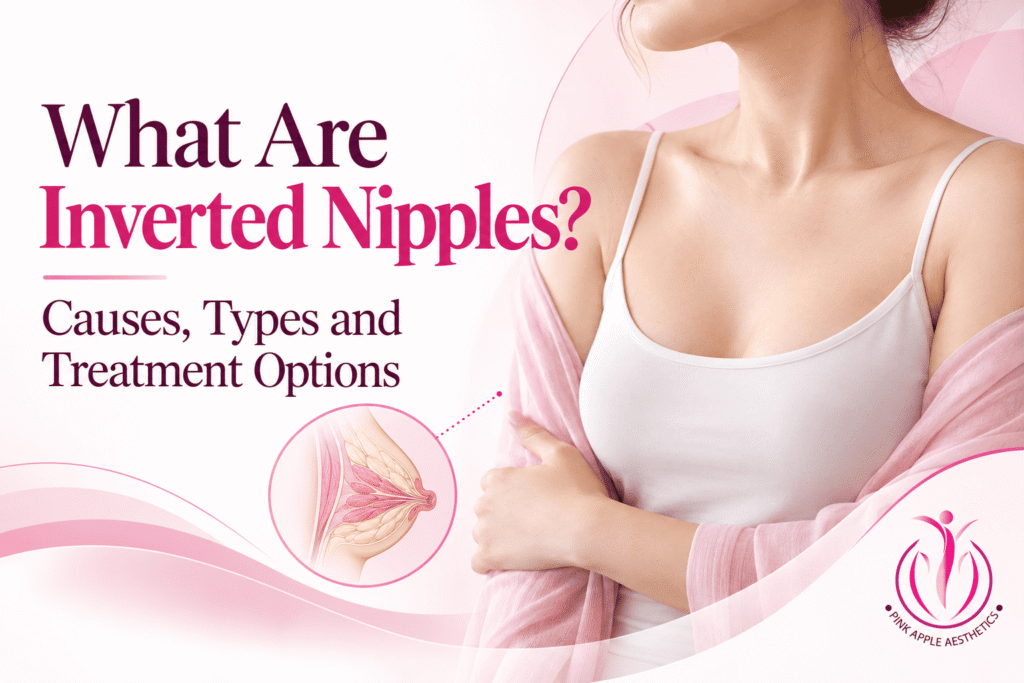
Inverted nipples are a condition in which one or both nipples turn inward rather than projecting outward. They may be present from birth or develop later in life. For some people, inverted nipples are simply a natural variation in breast anatomy, while others may seek treatment because of concerns about appearance, comfort or breastfeeding.
Understanding the causes, types and available treatment options can help you make informed decisions about your breast health. Depending on the degree of inversion and its underlying cause, treatment may range from observation and non-surgical approaches to inverted nipple correction surgery.
At Pink Apple Aesthetics, Bangalore, individuals considering nipple correction should receive an appropriate clinical assessment to understand the available options, expected outcomes and potential risks.
What Are Inverted Nipples?
Inverted nipples occur when the nipple retracts inward instead of projecting outward from the surrounding areola. The condition can affect one breast or both breasts and varies in severity.
Nipple inversion is often associated with the structure of the milk ducts, connective tissue and supporting structures beneath the nipple. Shortened or tight milk ducts and fibrous tissue can pull the nipple inward.
Some people have inverted nipples throughout their lives without experiencing any medical problems. However, nipple inversion that develops suddenly or represents a new change should be medically evaluated, particularly when accompanied by a breast lump, unusual nipple discharge or skin changes.
Are inverted nipples normal?
Yes. Inverted nipples can be a normal anatomical variation, particularly when they have been present since puberty or earlier and have remained unchanged.
Some nipples naturally project outward, while others are flat, partially inverted or fully inverted. These variations do not automatically indicate a medical problem.
The important distinction is whether the nipple appearance is longstanding and stable or whether it has changed recently.
What Causes Inverted Nipples?
Several factors can contribute to nipple inversion. Understanding the possible cause helps determine whether treatment is necessary and which approach may be appropriate.
1. Congenital nipple inversion
Congenital inverted nipples are present from birth or become noticeable during breast development.
They may occur because of naturally short milk ducts, tight connective tissue or differences in the development of the supporting structures beneath the nipple.
Congenital inversion may affect one or both breasts. If it remains unchanged and there are no other concerning symptoms, it is often simply an anatomical variation.
2. Shortened or tight milk ducts
Milk ducts carry breast milk towards the nipple. In some individuals, these ducts or the surrounding fibrous tissue may be relatively short or tight, pulling the nipple inward.
The degree of tethering can influence whether the nipple can be brought outward manually or tends to retract immediately.
This factor is particularly important when planning corrective surgery because some techniques involve releasing the tissue responsible for the inversion.
3. Breast changes associated with ageing
Changes in breast tissue, skin elasticity and supporting structures can affect nipple position over time.
Although ageing alone does not necessarily cause nipple inversion, new changes in nipple position should not automatically be attributed to ageing. A clinician should assess any unexplained acquired inversion.
4. Pregnancy and breastfeeding-related changes
Pregnancy and breastfeeding can alter breast tissue, skin elasticity and the appearance of the nipples.
Some individuals notice changes in nipple projection during these periods. However, persistent or newly developed inversion may have other causes and should be assessed when appropriate.
People who are pregnant, breastfeeding or planning to breastfeed should discuss these factors before considering nipple correction surgery.
5. Breast surgery, injury or scarring
Previous breast surgery, trauma or scar formation may change the supporting structures around the nipple.
Scar tissue can sometimes pull the nipple inward. Treatment depends on the cause, the extent of scarring and the condition of the surrounding breast tissue.
6. Underlying breast conditions
Acquired nipple inversion can occasionally be associated with an underlying breast condition, including infection, inflammation or breast cancer.
Seek prompt medical assessment if a nipple becomes newly inverted, particularly on one side, or if you notice a breast lump, bloody nipple discharge, skin dimpling, redness or other unexplained changes. These symptoms do not necessarily mean cancer is present, but they should not be ignored or treated as a cosmetic concern without evaluation.
What Are the Different Types of Inverted Nipples?
Inverted nipples are commonly described according to how easily the nipple can be brought outward and whether it remains projected or retracts again.
The following descriptions are a simplified guide. Clinical grading systems vary, and a surgeon should assess the anatomy before recommending treatment.
Grade 1: Mild inversion
In mild inversion, the nipple can generally be brought outward relatively easily and may remain projected for some time.
People with this type of inversion may have fewer functional concerns, although individual experiences differ.
Depending on the cause and the person’s preferences, observation or selected non-surgical approaches may be considered. Surgery is not automatically necessary.
Grade 2: Moderate inversion
With moderate inversion, the nipple can often be brought outward, but it may retract again shortly afterwards.
This may be associated with tighter supporting tissue or milk ducts.
Treatment decisions depend on the degree of tethering, whether the condition causes symptoms and the person’s desired outcome. A specialist can explain whether a non-surgical option or a surgical correction is appropriate.
Grade 3: Severe inversion
In severe inversion, the nipple remains retracted and is difficult or impossible to bring outward manually.
More substantial tissue tethering may be present, and surgical correction may be considered by individuals seeking a change in nipple projection.
The procedure may involve releasing the structures pulling the nipple inward and supporting the desired position. The exact technique depends on the individual’s anatomy and whether preservation of breastfeeding function is a priority.
Important: The severity of inversion alone does not determine whether treatment is medically necessary. Treatment is based on the cause, symptoms, individual preferences and clinical assessment.
What Are the Treatment Options for Inverted Nipples?
Treatment depends on the type of inversion, its cause and whether the person is experiencing any symptoms or functional difficulties.
1. Observation and monitoring
If the nipples have always been inverted, remain unchanged and are not associated with concerning symptoms, treatment may not be required.
Some individuals choose to leave their nipples as they are, while others seek correction for personal or cosmetic reasons.
Observation is not an appropriate substitute for medical evaluation when inversion is new or associated with other breast changes.
2. Non-surgical nipple correction
Selected non-surgical approaches may help some individuals achieve temporary or sustained outward projection, depending on the underlying anatomy.
Options may include:
- Nipple eversion devices: Specially designed devices that apply suction to draw the nipple outward.
- Selected nipple stimulation techniques: Gentle stimulation may temporarily change nipple projection in some individuals, but it does not reliably correct structural inversion.
Results vary, and non-surgical approaches may be less effective when substantial tissue tethering is present. Avoid forceful manipulation or unverified home remedies that could injure the nipple.
A clinician can advise whether a non-surgical option is suitable.
3. Inverted nipple correction surgery
Inverted nipple correction surgery is a procedure intended to improve nipple projection by addressing the structures that pull the nipple inward.
Depending on the technique, the surgeon may release tight tissue, modify supporting structures or use sutures to help maintain the nipple in a projected position.
The procedure is generally planned according to the degree of inversion, the underlying anatomy and the person’s goals.
Factors considered during planning include:
- Whether one or both nipples are affected.
- The severity and cause of inversion.
- Previous breast surgery or scarring.
- Desired nipple projection and symmetry.
- Future breastfeeding plans.
- The potential effects on nipple sensation.
Inverted nipple correction is not a single standard technique. The procedure and expected results differ from person to person.
4. Duct-preserving correction techniques
For individuals who may wish to breastfeed in the future, preservation of the milk ducts may be an important consideration.
Selected surgical techniques aim to correct the inversion while preserving as much ductal tissue as possible. However, suitability depends on the anatomy and severity of inversion, and preservation of the ducts cannot guarantee future breastfeeding.
Discuss your reproductive plans and concerns about sensation with the surgeon before deciding on a procedure.
Does Inverted Nipple Correction Surgery Affect Breastfeeding?
It can, depending on the surgical technique and the extent of tissue release.
Some procedures may involve cutting or releasing milk ducts, which can interfere with milk flow. Other techniques aim to preserve the ducts, but breastfeeding outcomes cannot be guaranteed.
If you are planning a pregnancy or wish to breastfeed in the future, discuss this before surgery. Ask the surgeon about:
- Whether the proposed technique preserves the milk ducts.
- The potential impact on breastfeeding.
- The possibility of altered nipple sensation.
- The risk of recurrence and the need for further treatment.
A personalised discussion helps you weigh cosmetic goals against future functional
considerations.
What Are the Possible Benefits and Risks of Inverted Nipple Correction?
For appropriately selected individuals, correction may improve nipple projection and address personal concerns about appearance or function.
However, like any surgical procedure, inverted nipple correction carries risks.
Possible risks include:
- Infection and delayed wound healing.
- Bleeding, swelling or bruising.
- Scarring.
- Changes in nipple sensation.
- Asymmetry or an unsatisfactory cosmetic result.
- Recurrence of nipple inversion.
- Potential effects on breastfeeding, depending on the technique.
The likelihood of these outcomes varies with the procedure, individual anatomy and healing response. A qualified plastic surgeon should explain the relevant risks and limitations during consultation.
When Should You See a Doctor About Inverted Nipples?
A medical assessment is particularly important if you notice:
- New nipple inversion, especially on one side.
- A breast lump or thickening.
- Bloody or otherwise unexplained nipple discharge.
- Skin dimpling, redness, ulceration or other persistent skin changes.
- Pain or swelling associated with a change in nipple appearance.
These symptoms can have several causes, but they warrant appropriate evaluation before cosmetic treatment is considered.
If the inversion has been present for a long time and has not changed, a consultation can help clarify whether treatment is necessary or simply a personal preference.
Inverted Nipple Correction in Bangalore at Pink Apple Aesthetics
Individuals considering inverted nipple correction can benefit from a consultation with a qualified plastic surgeon to understand the cause of the inversion, available treatment options and realistic outcomes.
At Pink Apple Aesthetics, Bangalore, the consultation process should consider the degree of inversion, breast anatomy, previous procedures, future breastfeeding plans and the patient’s expectations.
The appropriate treatment may involve observation, a selected non-surgical approach or surgical correction. Not everyone requires surgery, and the decision should be made after an individual assessment.
If you are considering treatment, contact Pink Apple Aesthetics to discuss your concerns and arrange a consultation.
Interested in inverted nipple correction? Speak with the clinical team to understand which options may be suitable for you.
Frequently Asked Questions About Inverted Nipples
1. Can inverted nipples become normal naturally?
Some nipples may project outward temporarily with stimulation or changes in temperature.
However, longstanding inversion caused by tight ducts or supporting tissue may persist.
Whether correction is needed depends on the cause and the individual’s preferences.
2. Are inverted nipples a sign of breast cancer?
Not necessarily. Inverted nipples that have been present for a long time can be a normal anatomical variation. However, newly developed inversion, particularly on one side, should be assessed by a healthcare professional, especially when accompanied by a lump, discharge or skin changes.
3. Can inverted nipples be corrected without surgery?
Some people may benefit from nipple eversion devices or other selected non-surgical approaches. Their effectiveness varies, and they may not provide lasting correction when significant tissue tethering is present.
4. Is inverted nipple correction surgery permanent?
Correction can provide lasting improvement, but results are not guaranteed to be permanent. Recurrence may occur, depending on the severity of inversion, the surgical technique and individual healing.
5. Does inverted nipple correction affect nipple sensation?
Changes in nipple sensation are a possible complication. The risk depends on the technique and the structures involved. Discuss this concern with your surgeon before treatment.
6. Can I breastfeed after inverted nipple correction?
Breastfeeding may remain possible after some procedures, particularly when milk ducts are preserved. However, some techniques can affect milk flow, and duct preservation does not guarantee successful breastfeeding.
7. Is inverted nipple correction a major surgery?
The procedure is often performed as a relatively short surgical intervention, but its complexity varies. The appropriate setting, anaesthesia and recovery plan depend on the individual case and the surgeon’s assessment.
8. How long does recovery take after inverted nipple correction?
Recovery varies according to the surgical technique and individual healing. Your surgeon will provide instructions regarding wound care, physical activity, follow-up and when to resume normal activities.
9. Is inverted nipple correction suitable for everyone?
No. Suitability depends on the cause of inversion, breast health, medical history, expectations and individual circumstances. Any newly developed inversion should be evaluated before cosmetic treatment is planned.
10. Where can I get inverted nipple correction in Bangalore?
You can contact Pink Apple Aesthetics in Bangalore to enquire about a consultation with its plastic surgery team. An assessment can help determine whether observation, non-surgical treatment or surgery is appropriate.
Conclusion
Inverted nipples are a common anatomical variation that may be present from birth or develop later in life. Their causes range from naturally tight supporting tissue to acquired breast conditions that require medical evaluation.
Treatment options include observation, selected non-surgical approaches and inverted nipple correction surgery. The most appropriate approach depends on the cause and severity of inversion, personal goals, potential risks and future breastfeeding plans.
If you are considering treatment, a consultation with a qualified plastic surgeon can help you understand your options and make an informed decision.
Explore inverted nipple correction at Pink Apple Aesthetics, Bangalore, to learn more about the treatment options available to you.


