
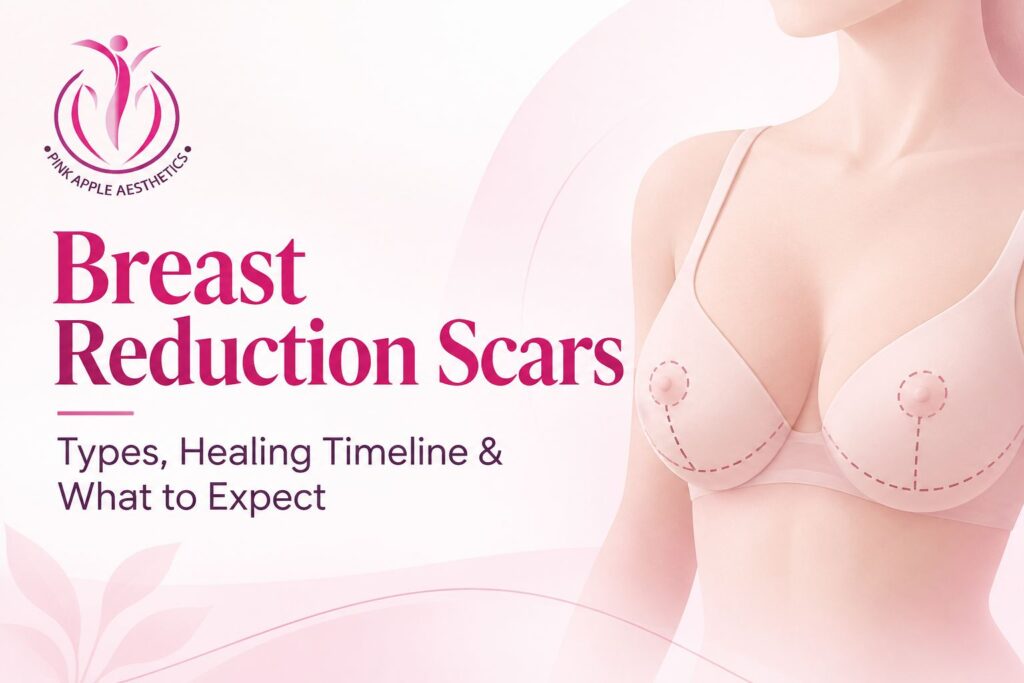
Breast reduction surgery can reduce breast volume and reshape the breasts, but it also involves incisions and therefore produces scars. Understanding where these scars are located, how they change during healing and what can influence their appearance can help you prepare realistically for surgery.
For women considering breast reduction surgery in Bangalore, scar placement is an important part of the surgical consultation. The type and length of the scars depend largely on the amount of reduction required, breast shape, skin excess, degree of drooping and the surgical technique selected.
No surgical technique can guarantee scarless breast reduction. However, surgeons plan the incision pattern carefully to balance breast reshaping, tissue removal, nipple positioning and scar placement.
What Do Breast Reduction Scars Look Like?
The appearance of breast reduction scars depends on the surgical technique used.
Common scar patterns include:
- Around the areola
- Vertically from the areola toward the breast fold
- Along the breast fold
The exact pattern varies from patient to patient.
Two of the commonly discussed approaches are:
Vertical / Lollipop technique:
A scar around the areola with a vertical scar extending downward.
Wise Pattern / Anchor technique:
A scar around the areola, a vertical scar downward and a horizontal scar along the breast fold.
The technique is selected based on the patient’s anatomy rather than simply choosing the shortest possible scar.
Why Does Breast Reduction Require Scars?
Breast reduction involves removing excess:
- Breast tissue
- Fat
- Skin
The surgeon then reshapes the remaining breast tissue and may reposition the nipple and areola.
To perform these steps safely and effectively, incisions are required.
The resulting scars are a normal part of the healing process.
The objective is to place and close the incisions carefully while achieving an appropriate breast shape and proportion.
Types of Breast Reduction Scars
1. Periareolar Scar
This scar runs around the border of the areola.
It is used in several breast reduction techniques and follows the natural transition between the darker areolar skin and surrounding breast skin.
As the scar matures, its appearance can change considerably.
2. Vertical Scar
A vertical scar extends from the lower edge of the areola toward the breast fold.
This is commonly associated with the vertical or lollipop breast reduction technique.
The length of the scar varies depending on the amount of reduction and the patient’s breast anatomy.
3. Horizontal Breast-Fold Scar
A horizontal scar runs along or near the natural crease beneath the breast.
It is commonly associated with the Wise-pattern or inverted-T breast reduction technique.
This additional incision can provide greater access for removing excess skin and reshaping the breast in patients who require more extensive reduction.
What Is the Difference Between Lollipop and Anchor Scars?
The names describe the general appearance of the incision pattern.
Lollipop / Vertical
Usually includes:
Around the areola + vertical line downward
Anchor / Wise Pattern
Usually includes:
Around the areola + vertical line downward + horizontal line along the breast fold
Neither technique is automatically better for everyone.
A surgeon chooses the incision based on factors such as:
- Breast size
- Degree of drooping
- Skin excess
- Amount of tissue to be removed
- Breast shape
- Skin quality
- Desired result
Breast Reduction Scar Healing Timeline
Scar healing is a gradual process.
Everyone heals differently, so the timeline below is a general guide rather than a guarantee.
Immediately After Surgery
During the first few days, the incision may appear:
- Red
- Swollen
- Bruised
- Slightly raised
- Tender
The surrounding breast tissue may also feel tight.
The incision may initially look more noticeable than you expected. This does not necessarily reflect how the scar will eventually look.
Weeks 1–2: Early Healing
During the first couple of weeks, the body is actively repairing the surgical wounds.
You may notice:
- Swelling
- Bruising
- Tightness
- Mild itching
- Sensitivity around the incision
- Temporary changes in sensation
Your surgeon will provide instructions regarding wound care, dressings and supportive garments.
Avoid applying creams, oils or scar products unless your surgeon recommends them.
Weeks 3–6: The Scars Begin to Mature
As the incisions continue to heal, swelling gradually decreases.
The scars may still appear:
- Pink
- Red
- Firm
- Slightly raised
The breasts may also continue to change shape during this period.
Some areas may feel firmer than others as internal healing continues.
This is generally not the stage at which the final appearance of the scars should be judged.
2–6 Months: Gradual Scar Changes
During the following months, scars often begin to change in:
- Colour
- Thickness
- Texture
- Firmness
For some people, scars become flatter and less noticeable.
However, the rate of scar maturation varies significantly between individuals.
6–12 Months and Beyond
Scar maturation can continue for many months.
Over time, scars may become:
- Flatter
- Softer
- Lighter
- Less noticeable
However, they may not completely disappear.
Some people naturally develop more prominent scars than others.
Why Do Some People Develop More Noticeable Scars?
Scar appearance depends on several factors.
Genetics
Some individuals naturally form thicker or more noticeable scars.
Skin characteristics
Skin type and elasticity can influence how scars mature.
Wound healing
Healing problems such as prolonged inflammation or wound separation can affect the final appearance.
Infection
An infection can interfere with normal healing.
Tension on the incision
Excessive tension on a healing wound can influence scar formation.
Surgical technique
Careful incision placement and closure can contribute to the quality of the final scar, although it cannot completely control how an individual’s body heals.
Can Breast Reduction Scars Become Thick or Raised?
Yes.
Some people develop scars that become thicker, firmer or more raised than expected.
These may include:
- Hypertrophic scars
- Keloid scars
A hypertrophic scar generally remains within the boundaries of the original incision, whereas a keloid can extend beyond the original wound.
If you have previously developed prominent scars after surgery, injury or piercing, tell your surgeon during the consultation.
This information can be important when discussing your surgical plan and postoperative scar management.
Can Breast Reduction Scars Be Completely Hidden?
Not always.
The surgeon can strategically position incisions, including along natural breast contours where appropriate.
However, breast reduction requires sufficient access to remove tissue and skin and reshape the breast.
The final scars therefore depend on the technique required.
For some patients, attempting to minimize scars excessively could compromise the ability to achieve the required breast reduction and reshaping.
The priority should be appropriate surgical planning rather than simply minimizing scar length.
Can Scar Creams Make Breast Reduction Scars Disappear?
No scar treatment can guarantee that scars will disappear.
Once the incision has healed sufficiently, your surgeon may recommend appropriate scar-management options depending on your individual healing.
These may include:
- Silicone-based scar products
- Silicone sheets
- Sun protection
- Gentle scar massage when appropriate
- Other treatments if a scar becomes problematic
Do not start scar treatments on fresh or incompletely healed incisions without medical advice.
Why Is Sun Protection Important for Surgical Scars?
Healing scars can be more sensitive to ultraviolet exposure.
Sun exposure may contribute to longer-lasting changes in scar pigmentation.
Once your surgeon confirms that the incision has healed sufficiently, appropriate sun protection can help reduce unnecessary pigmentation changes.
Follow your surgeon’s specific advice regarding when and how to protect the scars.
Do Breast Reduction Scars Hurt?
During early healing, scars can feel:
- Tender
- Tight
- Sensitive
- Itchy
- Numb
Some patients may also experience altered sensation around the incision or nipple.
These sensations can change as healing progresses.
Persistent, worsening or severe pain should be discussed with your surgeon rather than assumed to be part of normal healing.
Can Breast Reduction Scars Open?
Incision separation can occur after surgery, although not every patient experiences it.
Potential factors include:
- Wound tension
- Infection
- Smoking or nicotine use
- Certain medical conditions
- Individual healing characteristics
If an incision begins to separate, becomes increasingly painful or develops unusual drainage, contact your surgical team promptly.
Can Exercise Affect Breast Reduction Scars?
During early recovery, strenuous activity can place stress on healing tissues.
Your surgeon will advise you when you can gradually resume:
- Walking
- Light exercise
- Strength training
- Running
- High-impact activities
Returning to strenuous exercise too quickly may interfere with healing.
Always follow your surgeon’s individual recovery instructions rather than relying on a generic timeline.
Do Scars Affect the Final Breast Shape?
The scars themselves are only one part of the healing process.
After breast reduction, the breast continues to settle as:
- Swelling decreases
- Tissue heals
- Skin contracts
- Internal tissues remodel
The final shape can therefore change for several months.
Scar maturation and breast settling occur gradually rather than immediately after surgery.
What Can You Do to Support Better Scar Healing?
You cannot completely control how your body forms scars, but following your surgeon’s postoperative instructions can support normal healing.
Follow wound-care instructions
Keep the surgical area cared for according to your surgeon’s recommendations.
Avoid smoking and nicotine
Nicotine can interfere with wound healing and should be discussed with your surgeon before surgery.
Don’t rush physical activity
Allow the tissues to heal before returning to strenuous activities.
Protect healed scars from excessive sun exposure
Follow your surgeon’s advice regarding scar protection.
Attend follow-up appointments
Your surgeon can identify healing problems early and recommend appropriate treatment if needed.
When Should You Contact Your Surgeon?
Contact your surgical team if you notice symptoms such as:
- Increasing redness
- Worsening swelling
- Increasing pain
- Pus or unusual drainage
- Fever
- Significant wound opening
- Sudden changes in the breast
- Bleeding that does not settle
These symptoms should be assessed rather than assumed to be part of normal scar healing.
Can Breast Reduction Scars Be Improved Later?
If a scar remains unusually prominent after it has matured, treatment options may sometimes be available.
Depending on the scar, treatments may include:
- Silicone therapy
- Steroid treatment for selected raised scars
- Laser-based treatments
- Other scar-management procedures
- Surgical scar revision in selected cases
The appropriate treatment depends on the type, age and characteristics of the scar.
Scar revision is generally considered only after sufficient healing has occurred.
Does a Larger Breast Reduction Mean Larger Scars?
Not necessarily in a simple one-to-one relationship, but a more extensive reduction may require a more extensive incision pattern.
Patients with:
- Significant breast enlargement
- Pronounced drooping
- Large amounts of excess skin
may require a Wise-pattern or another approach that provides adequate access for reshaping.
This is why scar planning is part of the overall breast reduction consultation.
Frequently Asked Questions
Will breast reduction scars disappear completely?
No. Breast reduction scars are permanent, but they often become flatter and less noticeable as they mature.
How long do breast reduction scars take to heal?
The skin usually heals considerably within the first several weeks, but scar maturation can continue for many months and sometimes longer.
Which breast reduction technique has the least scarring?
There is no technique that is universally associated with the least visible scarring for every patient. The appropriate technique depends on anatomy and the amount of reduction required.
Are Wise-pattern scars worse than vertical scars?
Not necessarily. Wise-pattern surgery generally creates a longer scar pattern, but it may be appropriate when more extensive skin removal and reshaping are required.
Can breast reduction scars become invisible?
They can become significantly less noticeable, but they do not usually disappear completely.
Can I use silicone gel on my breast reduction scars?
Silicone products may be recommended for some patients once the incisions have adequately healed. Use them only according to your surgeon’s instructions.
How long should I wait before judging my breast reduction scars?
Scar appearance continues to change for months. Early redness, firmness or thickness does not necessarily represent the final result.
The Bottom Line
Breast reduction scars are an expected part of surgery, but their appearance changes significantly during healing.
The scar pattern depends on the technique used. A vertical or lollipop approach generally creates a scar around the areola and vertically downward, while a Wise-pattern or anchor approach also includes a scar along the breast fold.
During the first few weeks, scars can appear red, firm or swollen. Over the following months, they typically mature and may become flatter and less noticeable.
However, scar healing is highly individual, and no surgeon can guarantee an invisible scar.
The most appropriate surgical technique should be selected based on the patient’s anatomy, required reduction, breast shape and safety—not simply the desire for the shortest possible scar.
If you’re considering breast reduction surgery in Bangalore, discuss your expected scar pattern and scar-management options with a qualified plastic surgeon during your consultation.
Breast Reduction at Pink Apple Aesthetics
At Pink Apple Aesthetics, Bangalore, breast reduction surgery is individually planned based on breast size, shape, skin quality, degree of drooping and the patient’s desired outcome.
Dr. Pinky Devi Ayyappan, Plastic Surgeon, can explain the expected incision pattern, scar placement, recovery timeline and appropriate postoperative scar care during your consultation.


