
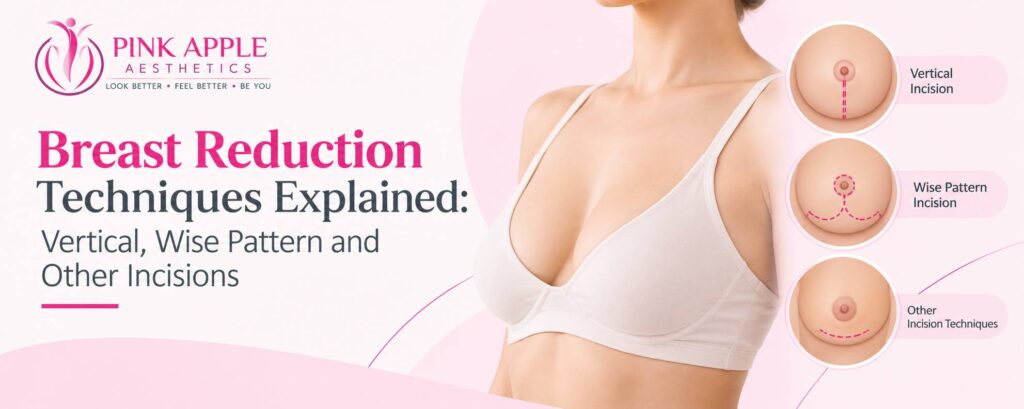
Breast reduction surgery is not performed using one universal technique. The incision pattern and surgical approach are selected according to the patient’s breast size, shape, degree of drooping, amount of excess skin, desired reduction and overall anatomy.
For patients considering breast reduction surgery in Bangalore, understanding the different breast reduction techniques can help explain why one incision pattern may be recommended over another.
The most commonly discussed approaches include the vertical (lollipop) incision and the Wise pattern (inverted-T) incision. Other techniques may also be appropriate in selected patients.
The important point is that the “best” incision is not the same for every patient. The appropriate technique is the one that allows the surgeon to achieve the required reduction and reshaping while considering safety, breast proportions and the patient’s individual anatomy.
What Are Breast Reduction Techniques?
Breast reduction surgery techniques describe the different ways a surgeon can:
-
- Access the breast tissue
-
- Remove excess breast tissue and fat
-
- Remove excess skin
-
- Reshape the remaining breast
-
- Reposition the nipple and areola
-
- Close the skin
The incision pattern is only one part of the surgical technique.
Two patients may have similar-looking scars but different internal tissue arrangements and surgical plans.
What Determines Which Breast Reduction Technique Is Used?
Before choosing an incision pattern, the surgeon considers several factors.
Breast size
Larger breasts may require more extensive tissue and skin removal.
Degree of breast drooping
The amount of ptosis, or sagging, influences how much reshaping and skin removal may be required.
Excess skin
A larger amount of loose skin may require an incision that provides greater access for skin removal and reshaping.
Breast shape
Breast width, projection and tissue distribution all influence the surgical plan.
Skin quality
Skin elasticity can affect how the breast responds to reshaping.
Desired reduction
A moderate reduction may be approached differently from a very significant reduction.
Breast asymmetry
Differences between the breasts may require individualized planning on each side.
1. Vertical Breast Reduction Technique
The vertical breast reduction, sometimes called the lollipop technique, generally involves two components:
-
- An incision around the areola
-
- A vertical incision extending downward from the areola toward the breast fold
The exact length of the vertical component varies depending on the patient’s anatomy.
When may it be considered?
A vertical technique may be suitable for selected patients with:
-
- Moderate breast enlargement
-
- Moderate skin excess
-
- Mild-to-moderate drooping
-
- A breast shape that can be appropriately reshaped through this approach
It can provide access for tissue removal while allowing the surgeon to reshape the breast.
What Are the Potential Advantages of a Vertical Incision?
One potential advantage is that it may result in less visible scarring along the breast fold compared with a Wise-pattern incision.
The scar typically consists of:
Around the areola + vertically downward
However, the suitability of this technique depends on the patient’s anatomy.
A shorter scar does not automatically mean a better surgical approach.
What Are the Limitations?
A vertical approach may not be appropriate for every patient.
Women with:
-
- Very large breasts
-
- Significant excess skin
-
- More pronounced breast drooping
-
- A very large reduction requirement
may require a different approach.
The surgeon must have enough access to remove the required tissue and manage the excess skin effectively.
2. Wise Pattern Breast Reduction
The Wise pattern, also known as the inverted-T or anchor incision, is another commonly used approach.
The incision generally includes:
-
- A circular incision around the areola
-
- A vertical incision downward
-
- A horizontal incision along the breast fold
When viewed together, the resulting pattern resembles an inverted “T” or anchor.
When May a Wise Pattern Be Considered?
This approach may be useful when a patient has:
-
- Significant breast enlargement
-
- More substantial skin excess
-
- Pronounced breast drooping
-
- A need for extensive reshaping
-
- A larger amount of tissue requiring removal
The horizontal component along the breast fold gives the surgeon additional access for removing excess skin and shaping the breast.
What Are the Potential Advantages of the Wise Pattern?
The Wise pattern can provide substantial control over:
-
- Excess skin
-
- Breast shape
-
- Breast width
-
- Breast projection
-
- Overall reshaping
For patients requiring a larger reduction, this additional access can be useful.
However, the trade-off is a longer scar pattern.
What Are the Limitations?
The main consideration is the additional scar along the breast fold.
The final scar pattern generally includes:
Around the areola + vertically downward + along the breast fold
Scar appearance varies significantly between individuals.
Some scars become relatively fine and less noticeable with time, while others may remain more prominent.
3. Periareolar or Circumareolar Technique
Another approach involves an incision around the areola.
This may sometimes be referred to as a periareolar or circumareolar technique.
It can be considered for selected patients requiring a relatively limited reduction and minimal skin adjustment.
However, it is generally not suitable for every breast reduction, particularly when a substantial amount of tissue and skin needs to be removed.
4. Different Pedicle Techniques
There is another important distinction in breast reduction surgery that patients may not see when looking at photographs of scars.
The incision pattern describes where the external incisions are made.
The pedicle technique describes how the nipple and areola remain connected to underlying breast tissue during the operation.
Different pedicle approaches can be used depending on the patient’s anatomy and the surgeon’s preferred technique.
Examples include:
-
- Inferior pedicle
-
- Superior pedicle
-
- Superomedial pedicle
-
- Other variations
The choice depends on factors such as:
-
- Breast size
-
- Breast shape
-
- Nipple position
-
- Degree of drooping
-
- Amount of reduction
-
- Tissue characteristics
This is why two patients with the same external incision pattern can still have different internal surgical approaches.
What Is a Pedicle in Breast Reduction?
A pedicle is a section of tissue that maintains the connection of the nipple-areola complex to its underlying blood supply and, depending on the technique, relevant nerve supply.
During breast reduction, the surgeon removes excess tissue while preserving an appropriate tissue connection to support the nipple and areola.
The exact method depends on the surgical technique selected.
The goal is to maintain adequate blood supply and, where possible, preserve sensation and function.
Vertical vs Wise Pattern Breast Reduction
Both techniques can be effective, but they are suited to different anatomical situations.
| Feature | Vertical Technique | Wise Pattern |
| Common name | Lollipop | Inverted-T / Anchor |
| Scar around areola | Yes | Yes |
| Vertical scar | Yes | Yes |
| Horizontal breast-fold scar | Usually no | Yes |
| Common use | Moderate reductions | Larger reductions / more skin excess |
| Skin removal | Moderate | More extensive when required |
| Reshaping | Yes | Yes |
| Suitable for every patient? | No | No |
This comparison is a general guide. The actual choice should be based on an individual clinical assessment.
Is the Shortest Scar Always the Best Option?
No.
This is one of the most important things to understand when comparing breast reduction techniques.
It can be tempting to choose a procedure based purely on scar length.
But the surgeon also needs to consider:
-
- How much tissue needs to be removed
-
- How much skin needs to be removed
-
- Degree of breast drooping
-
- Desired breast shape
-
- Nipple position
-
- Breast proportions
-
- Tissue quality
-
- Surgical safety
A shorter incision may not provide sufficient access for a patient who requires significant reduction and skin removal.
Therefore, the appropriate goal is not necessarily the shortest scar, but an incision pattern that allows the surgeon to safely achieve the required reduction and reshaping.
Can the Incision Technique Affect Breast Shape?
Yes.
The incision and underlying surgical technique provide access for reshaping the breast.
After excess tissue is removed, the surgeon rearranges the remaining tissue to create the desired shape.
The final appearance depends on multiple factors, including:
-
- Surgical technique
-
- Amount of tissue removed
-
- Skin elasticity
-
- Breast composition
-
- Healing
-
- Gravity
-
- Individual anatomy
Therefore, the incision pattern alone does not determine the final breast shape.
What Happens to the Nipple During Breast Reduction?
In most breast reductions, the nipple and areola remain attached to an underlying tissue pedicle while being repositioned higher on the breast.
The surgeon chooses an appropriate technique based on:
-
- Starting nipple position
-
- Breast size
-
- Degree of drooping
-
- Amount of reduction
-
- Individual anatomy
In extremely large or complex reductions, different approaches may sometimes be considered.
Your surgeon should explain the specific approach planned for you.
What About Breast Asymmetry?
Most women have some natural difference between their breasts.
One breast may have:
-
- Greater volume
-
- Different projection
-
- A different nipple position
-
- A different breast fold
-
- Different skin characteristics
The surgeon can account for these differences during surgical planning.
This may mean that slightly different amounts of tissue are removed from each breast.
The goal is to improve overall symmetry rather than create mathematically identical breasts.
Will Breast Reduction Scars Disappear?
Breast reduction scars are permanent, although their appearance generally changes over time.
Initially, scars may appear:
-
- Pink or red
-
- Raised
-
- Firm
-
- More noticeable
As healing progresses, scars may gradually become flatter and lighter.
However, scar development varies according to:
-
- Genetics
-
- Skin characteristics
-
- Wound healing
-
- Surgical technique
-
- Postoperative care
Your surgeon can explain scar-care options appropriate for your recovery.
Can You Choose Your Breast Reduction Technique?
You can discuss your preferences with your surgeon, including concerns about scars.
However, the final decision should be based on what is appropriate for your anatomy and surgical goals.
For example, a patient may prefer a vertical scar because it avoids a horizontal breast-fold scar.
If that patient has substantial excess skin and requires a large reduction, however, the surgeon may explain why a Wise-pattern approach could provide better control over the skin and breast shape.
The decision is therefore a balance between patient preferences and clinical requirements.
Does Breast Reduction Technique Affect Recovery?
Recovery can vary according to the extent of surgery rather than simply the name of the incision technique.
Factors include:
-
- Amount of tissue removed
-
- Extent of skin removal
-
- Individual healing
-
- Overall health
-
- Surgical complexity
Your surgeon will provide specific instructions regarding:
-
- Wound care
-
- Support garments
-
- Physical activity
-
- Work
-
- Exercise
-
- Follow-up appointments
What Should You Ask Your Surgeon?
Before breast reduction surgery, consider asking:
-
- Which incision pattern do you recommend for me?
-
- Why is this technique appropriate for my breast size and shape?
-
- What scar pattern should I expect?
-
- Which pedicle technique will be used?
-
- How will you address breast asymmetry?
-
- How much tissue do you expect to remove?
-
- Where will my nipple and areola be positioned?
-
- What should I expect during recovery?
-
- How will my scars be managed after surgery?
Understanding the reasoning behind the recommended technique can help you make an informed decision.
Frequently Asked Questions
Which breast reduction technique is best?
There is no single technique that is best for every patient. The appropriate approach depends on breast size, shape, drooping, skin excess, desired reduction and individual anatomy.
What is the difference between a lollipop and anchor breast reduction?
A lollipop or vertical incision generally involves a scar around the areola and a vertical scar downward. An anchor or Wise-pattern technique adds a horizontal scar along the breast fold.
Does a Wise-pattern breast reduction leave more scars?
It generally involves a longer incision pattern because it includes a horizontal component along the breast fold. However, it may provide useful access for patients requiring more extensive skin removal and reshaping.
Is vertical breast reduction suitable for large breasts?
It can be suitable for selected patients, but very large breasts or significant skin excess may require another approach. The decision depends on individual anatomy.
Will breast reduction scars disappear?
No scar can be guaranteed to disappear completely. Breast reduction scars usually mature and become less noticeable over time, but their final appearance varies.
Does the technique determine the final breast size?
Not by itself. Final size depends on the amount of tissue removed, breast anatomy, skin characteristics, surgical planning and individual healing.
The Bottom Line
Vertical and Wise-pattern breast reduction are two commonly used approaches, but neither is universally suitable for every patient.
A vertical or “lollipop” incision may be appropriate for selected patients with moderate reduction requirements, while a Wise-pattern or “anchor” incision may provide greater control when there is substantial skin excess or a larger reduction is needed.
The incision pattern is only one part of breast reduction surgery. The surgeon also needs to consider the underlying tissue, pedicle technique, nipple position, breast shape and overall proportions.
The right technique is ultimately the one that allows the surgeon to achieve the required reduction and reshaping while prioritizing safety, proportion and the patient’s individual goals.
If you’re considering breast reduction surgery in Bangalore, an individual consultation with a qualified plastic surgeon can help determine which technique is appropriate for your anatomy.
Breast Reduction at Pink Apple Aesthetics
At Pink Apple Aesthetics, Bangalore, breast reduction procedures are individually planned based on breast size, shape, skin quality, degree of drooping, desired reduction and the patient’s overall anatomy.
Dr. Pinky Devi Ayyappan, Plastic Surgeon, can explain the recommended incision pattern, surgical technique, expected scars, recovery and potential risks during a consultation.


