
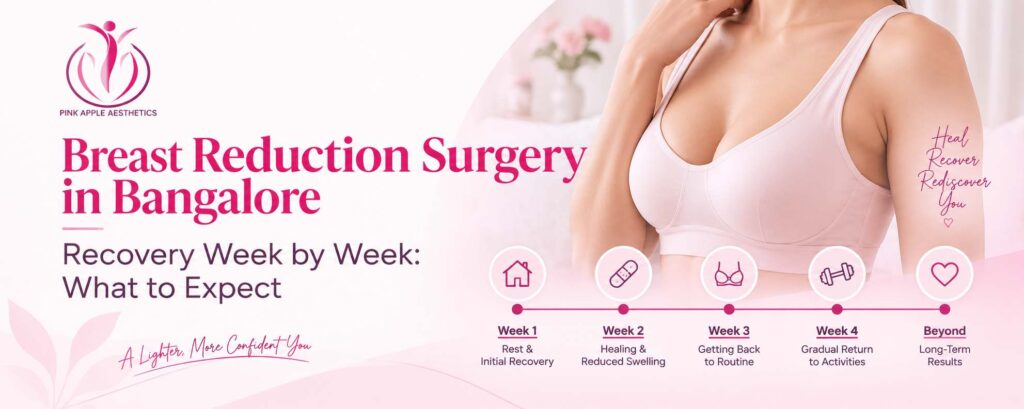
Breast reduction surgery can be an important step for women who experience discomfort or limitations because of large or heavy breasts. But understanding what happens after surgery is just as important as understanding the procedure itself.
The breast reduction recovery time varies from person to person. Some patients return to light daily activities relatively quickly, while swelling, breast settling and scar maturation continue for several months.
If you’re considering breast reduction surgery in Bangalore, having a realistic understanding of the recovery process can help you plan your work, exercise, travel and daily activities.
This guide explains the typical breast reduction healing timeline week by week.
Important: Recovery timelines are general. Your individual recovery may be different depending on the extent of surgery, your health, healing response and your surgeon’s instructions.
How Long Does Breast Reduction Recovery Take?
There isn’t one exact recovery period for every patient.
Many people can gradually return to routine activities within the first few weeks, while complete healing and final breast settling can take several months.
Recovery generally happens in stages:
First few days: Initial healing and managing discomfort
Weeks 1–2: Protecting the incisions and gradually increasing activity
Weeks 3–6: Increasing normal activities while avoiding excessive strain
Months 2–3: Continued breast settling and scar maturation
6–12 months: Longer-term scar and breast-shape changes
Your surgeon will give you specific instructions based on your procedure.
Breast Reduction Recovery: The First 24–48 Hours
Immediately after surgery, you’ll be monitored as you recover from anaesthesia.
You may experience:
- Swelling
- Bruising
- Tightness
- Tenderness
- Fatigue
- Temporary changes in breast sensation
Your breasts may look different from the expected final result because swelling can affect their size and shape.
You may be advised to wear a surgical or supportive bra.
Your surgical team will provide instructions regarding medications, wound care and activity.
Week 1: Protecting the Surgical Area
The first week is primarily about rest, wound care and allowing the body to begin healing.
You may experience:
- Swelling
- Bruising
- Mild-to-moderate discomfort
- Tightness
- Sensitivity around the incisions
- Temporary numbness or altered sensation
Some patients feel tired during this period, particularly during the first few days.
What can you generally do?
Short, gentle walking is often encouraged when appropriate, because prolonged complete bed rest is usually not necessary.
However, you should avoid:
- Heavy lifting
- Strenuous exercise
- Running
- High-impact activity
- Excessive arm movements
Follow your surgeon’s specific instructions rather than using a generic recovery schedule.
Week 2: Early Healing Continues
By the second week, many patients begin feeling more comfortable.
Swelling and bruising may start to decrease, although they can still be noticeable.
The incisions continue to heal and may appear:
- Pink
- Red
- Firm
- Slightly raised
You may still experience some tightness or altered sensation.
Depending on your occupation and recovery, you may be able to return to some forms of work around this period, but this varies considerably.
A desk-based job may require less recovery time than physically demanding work.
Weeks 3–4: Gradually Returning to Routine
During weeks three and four, many patients feel progressively more mobile.
You may be able to increase your normal daily activities gradually.
However, your breasts are still healing internally.
You may continue to experience:
- Mild swelling
- Breast firmness
- Sensitivity changes
- Incision discomfort
- Tiredness after prolonged activity
Your surgeon may gradually allow more activity depending on how your incisions are healing.
Can you exercise?
Light activity may be increased according to your surgeon’s advice.
However, high-impact exercise, heavy lifting and activities that place significant strain on the chest may still need to be avoided.
Weeks 5–6: Increasing Activity
Around the five- to six-week stage, many patients are considerably more comfortable with normal daily activities.
Depending on your healing, your surgeon may allow you to gradually return to more physical activities.
This can include progressing toward:
- Longer walks
- Light exercise
- More normal household activities
- Gradually increasing physical activity
The timing varies from patient to patient.
Don’t assume that reaching week six automatically means you are ready for unrestricted exercise.
Your surgeon should confirm when it is appropriate to increase activity.
Months 2–3: The Breasts Continue to Settle
By this stage, the early recovery period has generally passed, but the breasts are still undergoing changes.
You may notice:
- Reduced swelling
- Softer breast tissue
- Improved comfort
- Changes in breast shape
- Scars becoming less prominent
The breasts may gradually settle into a more natural position.
Some areas may still feel firmer than others.
This is part of the ongoing healing process.
Months 3–6: Continued Healing and Scar Maturation
During this period, the breasts usually continue to settle.
Scar tissue also begins to mature.
Scars that initially appeared:
- Red
- Firm
- Raised
may gradually become:
- Flatter
- Softer
- Lighter
However, scar maturation varies significantly between individuals.
Some patients may continue to have visible scars even after several months.
6–12 Months: Longer-Term Results
Breast reduction results continue to evolve over time.
By this stage, much of the swelling has usually settled, although subtle changes can continue.
The scars may continue to mature and become less noticeable.
The final appearance is influenced by:
- Surgical technique
- Breast size before surgery
- Amount of tissue removed
- Skin quality
- Individual healing
- Weight changes
- Age
- Genetics
It is important to understand that there is no single date when every patient’s breasts suddenly reach their “final” appearance.
Breast Reduction Recovery Timeline at a Glance
| Recovery Stage | What You May Experience |
| First 48 hours | Swelling, bruising, tenderness and fatigue |
| Week 1 | Rest, wound care and gentle movement |
| Week 2 | Early healing and gradual return to routine |
| Weeks 3–4 | Increasing daily activity |
| Weeks 5–6 | Gradual progression of physical activity |
| Months 2–3 | Breast settling and reduced swelling |
| Months 3–6 | Continued scar and tissue maturation |
| 6–12 months | Longer-term settling and scar maturation |
This is a general guide, not a fixed recovery schedule.
When Can You Return to Work After Breast Reduction?
This depends largely on your occupation and how you’re recovering.
Desk-based work
Some patients may return relatively early if they are comfortable and their surgeon agrees.
Physically demanding work
Jobs involving:
- Heavy lifting
- Repeated arm movements
- Physical labour
- Prolonged standing
may require a longer recovery period.
Your surgeon should determine when returning to work is appropriate.
When Can You Exercise After Breast Reduction?
Exercise should be resumed gradually.
Walking and gentle movement may be encouraged relatively early, depending on your surgeon’s instructions.
More strenuous activities generally need to wait until the tissues have healed sufficiently.
This includes:
- Running
- Weight training
- Push-ups
- Chest exercises
- High-impact workouts
- Contact sports
Don’t use the calendar alone to decide when to return to exercise.
Your surgeon should assess your healing and provide individualized clearance.
When Can You Drive After Breast Reduction?
Driving should generally be avoided while you are taking medications that impair alertness or when pain or restricted movement makes it difficult to control the vehicle safely.
You should be able to:
- Move your arms comfortably
- Control the steering wheel
- Perform an emergency manoeuvre
- Wear the seatbelt comfortably
- React quickly if necessary
Your surgeon can advise when driving is appropriate based on your recovery.
When Can You Sleep Normally?
Many patients find sleeping on their back more comfortable during the early recovery period.
Your surgeon may recommend avoiding pressure on the breasts while the incisions are healing.
As healing progresses, you may gradually return to your preferred sleeping position according to your surgeon’s advice.
When Can You Shower After Breast Reduction?
The timing depends on the type of dressings, incision closure and your surgeon’s postoperative instructions.
Do not assume that because a wound looks closed it is ready for prolonged soaking.
Your surgical team should tell you:
- When you can shower
- How to clean the area
- Whether dressings need to remain in place
- When you can bathe or swim
What Happens to Breast Sensation During Recovery?
Temporary changes in breast or nipple sensation can occur after breast reduction.
You may experience:
- Numbness
- Increased sensitivity
- Tingling
- Reduced sensation
- Uneven sensation between the breasts
Sensation can change as nerves recover during healing.
Some changes may improve gradually, although permanent changes are possible in some patients.
When Will Breast Reduction Scars Start to Fade?
Scars don’t mature immediately.
During the early weeks, they may appear red or pink and feel firm.
Over several months, they may gradually become:
- Flatter
- Softer
- Lighter
Scar maturation can continue for a year or longer in some people.
Your surgeon may recommend appropriate scar-management measures once the incisions have sufficiently healed.
When Will Swelling Go Away?
Swelling generally decreases progressively rather than disappearing overnight.
Some swelling may remain for several weeks or months.
One breast may also appear more swollen than the other during recovery.
Small differences during healing don’t necessarily indicate the final result.
However, sudden or significant swelling should be reported to your surgical team.
Can One Breast Heal Faster Than the Other?
Yes.
It is common for the two sides of the body to heal somewhat differently.
You may temporarily notice differences in:
- Swelling
- Bruising
- Sensation
- Firmness
- Breast shape
The breasts can become more symmetrical as healing progresses.
What Can Affect Breast Reduction Recovery Time?
Several factors can influence recovery.
Extent of surgery
A larger reduction may involve more tissue and skin removal.
Individual healing
Everyone’s healing response is different.
General health
Overall health can influence recovery.
Smoking and nicotine
Nicotine can interfere with wound healing.
Physical activity
Returning to strenuous activity too early may place unnecessary stress on healing tissues.
Following postoperative instructions
Following your surgeon’s wound-care and activity instructions can help support appropriate recovery.
What Should You Avoid During Recovery?
Your surgeon will provide specific restrictions, but early recovery commonly involves avoiding:
- Heavy lifting
- Strenuous exercise
- High-impact activity
- Excessive stretching
- Pressure on healing incisions
- Smoking or nicotine
- Swimming until wounds have healed
Don’t compare your recovery with another patient’s timeline.
Warning Signs During Breast Reduction Recovery
Some discomfort, swelling and bruising are expected after surgery.
However, contact your surgical team if you develop:
- Increasing or severe pain
- Significant or rapidly increasing swelling
- Increasing redness
- Fever
- Pus or unusual drainage
- Heavy bleeding
- Wound separation
- Sudden changes in breast appearance
- Shortness of breath or chest pain
Urgent symptoms should receive prompt medical attention.
Does Breast Reduction Recovery Hurt?
Some discomfort is expected after surgery.
The intensity varies between patients and depends on factors such as the extent of surgery and individual pain sensitivity.
Your surgeon may prescribe medication to help manage postoperative discomfort.
Pain generally improves as the initial healing progresses, although tenderness and altered sensation may persist for longer.
What Happens During Follow-Up Appointments?
Follow-up appointments allow the surgeon to assess:
- Incision healing
- Swelling
- Breast shape
- Wound condition
- Signs of infection
- Sensation changes
- Overall recovery
These appointments are an important part of postoperative care.
Your surgeon can also adjust activity restrictions based on your healing.
When Will You See the Final Breast Reduction Result?
The breasts don’t immediately show their final appearance after surgery.
Initially, swelling and tightness can make the breasts appear:
- Higher
- Firmer
- More swollen
- Different from the expected final shape
As healing progresses, the breasts gradually soften and settle.
Final breast shape and scar appearance can continue changing for many months.
Frequently Asked Questions
How long does breast reduction recovery take?
The initial recovery generally takes several weeks, but complete healing, breast settling and scar maturation can continue for several months.
When can I return to work after breast reduction?
It depends on your occupation and recovery. Desk-based work may be possible sooner than physically demanding work. Your surgeon can give you personalized guidance.
When can I exercise after breast reduction?
Gentle movement may begin relatively early, but strenuous exercise and heavy lifting usually need to wait until the surgeon confirms that your tissues have healed sufficiently.
How long does swelling last after breast reduction?
Swelling usually decreases gradually over several weeks, although some residual swelling can persist for longer.
When will breast reduction scars fade?
Scars mature gradually. They may become flatter and lighter over several months, but scar maturation can continue for a year or longer.
Can I sleep on my side after breast reduction?
Your surgeon may initially recommend sleeping on your back to avoid pressure on healing breasts. You can usually return to other positions as healing progresses and your surgeon permits.
Will my breast size change during recovery?
Yes. Swelling and tissue settling can temporarily affect breast size and shape. The early postoperative appearance should not be considered the final result.
The Bottom Line
Breast reduction recovery happens gradually—not overnight.
The first few weeks focus on wound healing, managing swelling and gradually returning to everyday activities. Over the following months, the breasts continue to settle while scars mature and become less noticeable.
A general timeline may look like:
Week 1: Initial healing and rest
Week 2: Gradual return to routine
Weeks 3–4: Increasing daily activity
Weeks 5–6: Gradual progression of physical activity
Months 2–3: Continued breast settling
Months 3–6: Scar and tissue maturation
6–12 months: Longer-term changes
Your actual breast reduction recovery time may be shorter or longer depending on your surgery and individual healing.
If you’re considering breast reduction surgery in Bangalore, discuss your expected recovery, activity restrictions, scar care and follow-up schedule with a qualified plastic surgeon before surgery.
Breast Reduction at Pink Apple Aesthetics
At Pink Apple Aesthetics, Bangalore, breast reduction surgery is planned individually based on the patient’s anatomy, symptoms, desired reduction and overall health.
Dr. Pinky Devi Ayyappan, Plastic Surgeon, can explain the expected recovery after breast reduction, including wound care, activity restrictions, return to work, exercise and scar management.


