
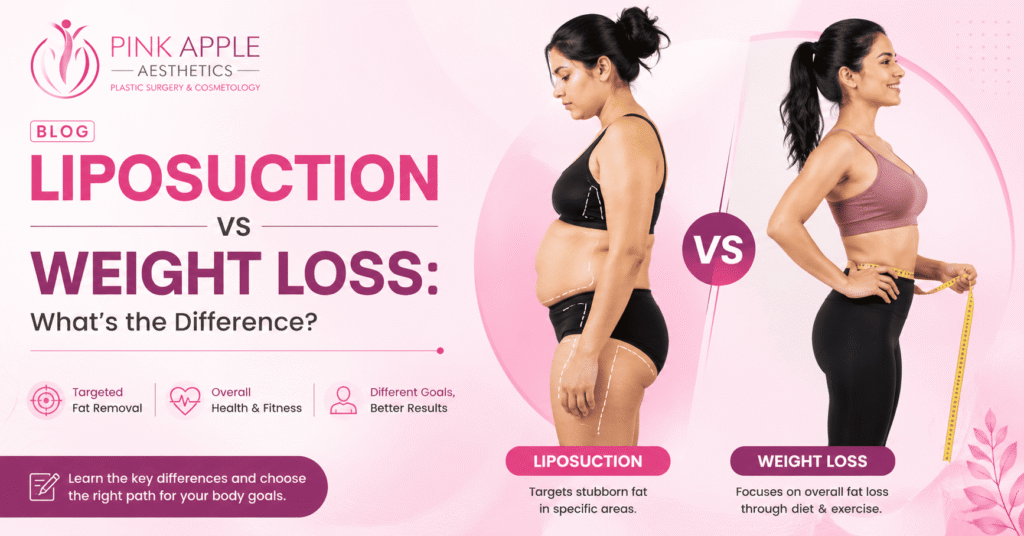
When people notice stubborn fat around the abdomen, thighs, arms, hips or chin, they often wonder whether liposuction could help them lose weight. This leads to a common question: What is the difference between liposuction and weight loss?
Although both involve changes in body fat, they serve very different purposes. Weight loss focuses on reducing overall body weight and improving body composition, while liposuction is primarily a body-contouring procedure designed to remove localized deposits of fat.
Understanding this difference is important before considering liposuction. It can help you set realistic expectations and determine whether you need a weight-management approach, a body-contouring procedure, or potentially a combination of approaches.
Liposuction vs Weight Loss: What Is the Difference?
The simplest way to understand the difference is to look at the goal of each approach.
Weight loss aims to reduce overall body weight. It can involve changes in nutrition, physical activity, lifestyle habits and, where medically appropriate, professional weight-management treatments.
Liposuction, on the other hand, targets specific areas where excess subcutaneous fat remains. The objective is to improve body proportions and contour rather than produce significant weight reduction.
The American Society of Plastic Surgeons describes liposuction as a procedure for removing localized fat deposits and specifically notes that it is not a treatment for obesity or a substitute for a healthy diet and exercise.
This means that someone can be relatively close to their desired weight and still have areas of fat that they find difficult to change through diet and exercise.
Can Liposuction Help You Lose Weight?
Liposuction can remove fat and may cause some reduction in body weight, but it should not be considered a weight-loss procedure.
During liposuction, a surgeon removes subcutaneous fat from selected areas of the body. The amount that can safely be removed depends on factors such as the treatment area, the patient’s health, the surgical plan and safety considerations.
The primary outcome, however, is a change in body contour, not a major change on the weighing scale.
This distinction matters because someone who undergoes liposuction expecting to lose a large amount of weight may be disappointed with the result if their expectations are based only on the number on the scale.
If significant weight reduction is your main goal, it is important to address that goal through an appropriate weight-management strategy rather than relying on liposuction.
What Does Liposuction Actually Treat?
Liposuction is designed to address localized deposits of subcutaneous fat—fat located underneath the skin.
Depending on the individual’s anatomy and goals, areas that may be considered for liposuction include:
- Abdomen
- Waist and flanks
- Hips
- Thighs
- Upper arms
- Back
- Chin and neck
- Other localized areas of excess fat
The American Society of Plastic Surgeons lists several of these areas as common treatment sites.
The objective is not simply to remove as much fat as possible. A plastic surgeon needs to consider the patient’s proportions, skin quality, fat distribution and desired outcome when developing a treatment plan.
In other words, liposuction is about shaping the body rather than simply making the body lighter.
Liposuction for Fat Loss: Why the Term Can Be Misleading
People often search online for “liposuction for fat loss.” Technically, liposuction does involve removing fat from the body, but this should not be confused with conventional weight loss.
During weight loss, fat cells throughout the body generally become smaller as stored energy is used. Liposuction physically removes selected fat cells from specific treatment areas.
However, liposuction does not address every source of body fat.
For example, liposuction primarily targets subcutaneous fat. It does not remove visceral fat—the deeper fat surrounding internal abdominal organs. This is one reason why liposuction cannot replace healthy lifestyle habits or appropriate medical weight management.
Therefore, the phrase “fat loss” should be understood in the context of localized fat reduction and body contouring, rather than overall weight loss.
Is Liposuction Suitable for Overweight Patients?
One of the most common questions is whether overweight patients can have liposuction.
There is no single number on the weighing scale that determines suitability for every individual. A surgeon needs to evaluate the person’s overall health, body composition, distribution of fat, skin elasticity, expectations and surgical risk.
Some people with a higher BMI may still have localized areas that could potentially be treated with liposuction. However, liposuction is not intended to treat obesity or produce substantial weight reduction. The American Society of Plastic Surgeons also emphasizes that higher-BMI patients require careful assessment because obesity can be associated with health factors that may increase surgical risk.
If someone needs significant weight loss, achieving a more stable and appropriate weight may be recommended before elective body-contouring surgery.
This approach can make it easier to evaluate the final body shape and determine whether additional procedures may be needed for concerns such as excess skin.
Should You Lose Weight Before Liposuction?
If you are planning significant weight loss, it is generally sensible to discuss your weight-management goals with your healthcare professional before undergoing liposuction.
Liposuction may be more appropriate when your weight is relatively stable and your main concern is a localized area of stubborn fat.
For example, someone may have achieved their desired weight through diet and exercise but continue to have disproportionate fat around the abdomen or hips. In such a situation, liposuction may be considered as a body-contouring option.
The American Society of Plastic Surgeons identifies healthy individuals who are relatively close to their goal weight, have good skin elasticity and have specific body-contouring goals as potential candidates for liposuction.
However, candidacy is always individual and should be determined through a proper consultation.
What Happens If You Gain Weight After Liposuction?
Liposuction permanently removes fat cells from the treated areas, but it does not make you immune to future weight gain.
The body still contains fat cells in the treated and untreated areas. If you gain significant weight after surgery, the remaining fat cells can enlarge, potentially changing your overall body contour.
This is why maintaining a relatively stable weight and following healthy lifestyle habits remains important after liposuction.
The goal of surgery is to create a contour that complements your body—not to replace the habits that help maintain your health and weight over time.
What About Loose Skin After Weight Loss?
Another important consideration is the difference between excess fat and excess skin.
Someone who has lost a significant amount of weight may be left with loose or excess skin. Liposuction removes fat, but it does not remove significant amounts of loose skin.
If skin laxity is substantial, liposuction alone may not provide the desired result. Depending on the individual’s condition, a different body-contouring procedure may be considered.
Skin elasticity is therefore an important part of the assessment before liposuction. Patients with firmer, more elastic skin may experience better skin adaptation following fat removal.
Liposuction vs Weight Loss: Which One Is Right for You?
The answer depends primarily on what you are trying to achieve.
If your main goal is to lose a significant amount of weight, liposuction is not a substitute for a medically appropriate weight-management plan.
If your weight is relatively stable but you have localized areas of stubborn fat that remain despite healthy lifestyle efforts, liposuction may be worth discussing with a plastic surgeon.
If you have both significant excess weight and localized fat, your surgeon may recommend focusing on weight management first and then reassessing your body-contouring goals.
This is why an individual consultation is more useful than deciding based solely on your weight, BMI or a photograph.
Does Liposuction Replace Diet and Exercise?
No.
Liposuction does not replace a balanced diet, regular physical activity or other healthy lifestyle habits.
It is best viewed as a procedure that can help refine specific areas of the body when localized fat persists despite lifestyle efforts.
Maintaining a stable weight after treatment can also help preserve the results over the long term. The NHS similarly describes liposuction as a procedure intended to alter body shape, with results generally being long-lasting when a healthy weight is maintained.
Frequently Asked Questions
Is liposuction a weight-loss procedure?
No. Liposuction is primarily a body-contouring procedure designed to remove localized deposits of subcutaneous fat. It is not a treatment for obesity or a substitute for weight management.
Can liposuction help me lose weight?
Liposuction removes fat, so some reduction in body weight can occur. However, significant weight loss is not the primary purpose of the procedure. The main objective is improving body contour.
Is liposuction suitable for overweight patients?
Some individuals with a higher body weight may be candidates, but suitability depends on overall health, fat distribution, skin quality, weight stability and surgical risk. A plastic surgeon should assess each patient individually.
Should I lose weight before liposuction?
If you are planning substantial weight loss, your surgeon may recommend reaching a more stable weight before considering liposuction. This allows your body-contouring goals to be assessed more accurately.
Does liposuction permanently remove fat?
Fat cells removed through liposuction do not simply grow back in the treated area. However, remaining fat cells can enlarge with weight gain, so maintaining a stable weight is important.
Can liposuction remove belly fat?
Liposuction can target suitable deposits of subcutaneous fat around the abdomen. However, it does not remove visceral fat located around the internal organs.
The Bottom Line
Liposuction and weight loss are not the same thing.
Weight loss focuses on reducing overall body weight and improving health and body composition, while liposuction focuses on removing localized fat deposits and improving body contours.
If you are significantly overweight or your primary goal is substantial weight reduction, liposuction should not be viewed as a shortcut to weight loss. On the other hand, if you are relatively weight-stable but have specific areas of stubborn fat that affect your body proportions, liposuction may be an option worth discussing.
At Pink Apple Aesthetics, the suitability of liposuction is assessed on an individual basis, considering factors such as your health, weight stability, fat distribution, skin quality and aesthetic goals. A consultation with a qualified plastic surgeon can help determine whether liposuction—or another approach—is appropriate for you.
References: American Society of Plastic Surgeons; NHS guidance on liposuction.


