
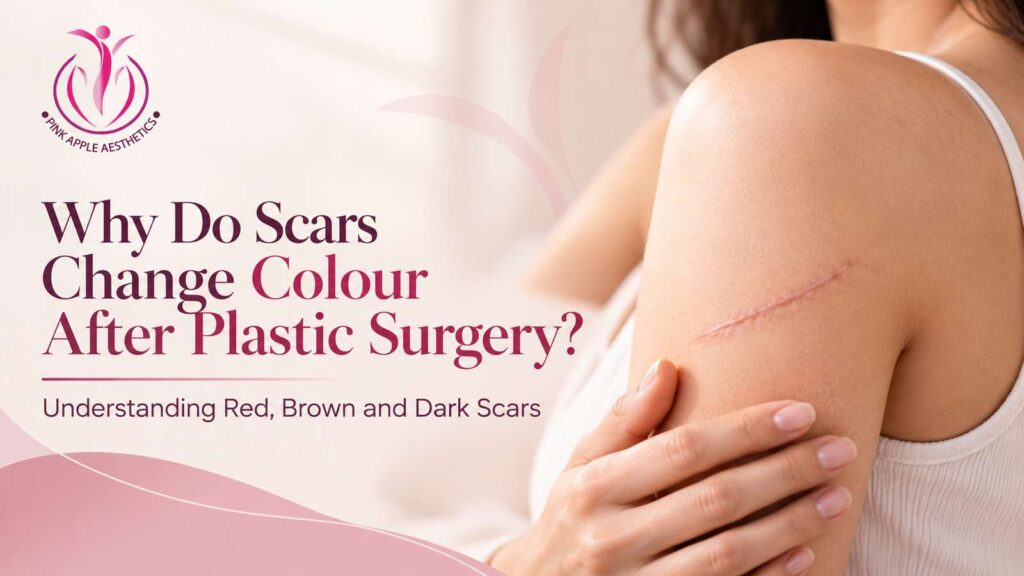
A guide by Pink Apple Aesthetics
You’ve had plastic surgery, your incision is healing, and everything seems to be going well. Then you notice something that wasn’t quite what you expected. The scar looks red. A few weeks later, it seems darker. In some cases, the skin around the incision starts looking brown or uneven.
It’s natural to wonder whether something has gone wrong.
The truth is that scar colour can change several times during healing, and a darker scar doesn’t automatically mean there’s a problem. Your skin is repairing itself, and the final appearance of a scar depends on several factors, including your skin tone, the type of surgery, sun exposure and how your body heals.
Understanding these changes can help you know what to expect, what you can do at home and when it’s worth speaking to your plastic surgeon.
Why Do Scars Change Colour After Plastic Surgery?
A surgical incision affects more than the surface of your skin. Once an incision is closed, your body begins repairing the damaged tissue by producing collagen and developing new blood vessels.
During this process, the scar may look pink, red or purple. As healing progresses, the blood vessels and collagen within the scar gradually change. The scar may become flatter and lighter, or it may remain darker than the surrounding skin.
Sometimes, pigmentation also develops around the incision.
For example, someone who has undergone a tummy tuck might notice a pink incision line in the first few weeks. A few months later, that line may look brown rather than pink. Another person who has undergone breast surgery may find that the incision remains red for longer before gradually fading.
Neither example tells the whole story on its own. The scar’s texture, symptoms, healing progress and timing all matter.
According to the American Academy of Dermatology, new scars commonly appear pink or red and may become lighter or darker than the surrounding skin as they mature. Source: American Academy of Dermatology
1. Why Are My Scars Red After Plastic Surgery?
Redness is one of the most common changes patients notice after surgery.
When your skin is injured, the body increases blood flow to the area and forms new blood vessels to support healing. This can give a fresh surgical scar a pink, red or sometimes purplish appearance.
The colour may be more noticeable after procedures such as:
- Tummy tuck (abdominoplasty)
- Breast augmentation or breast reduction
- Liposuction, particularly around healing incision sites
- Gynecomastia surgery
- Facial plastic surgery
The location of the incision, the amount of tension on the skin and your individual healing response can all influence how the scar looks.
How long does redness last?
There isn’t one timeline that applies to everyone. A scar may remain pink or red for several months, and it can take 12–18 months or longer for the scar to mature fully.
The important thing is to look at the overall trend. Is the scar gradually becoming less noticeable? Is the incision healing as expected? Is the redness stable or improving rather than spreading?
Redness alone doesn’t necessarily indicate a complication. However, increasing redness accompanied by warmth, swelling, worsening pain, fever or discharge needs prompt medical assessment because these can be signs of infection.
Don’t assume that every red scar is simply going through a normal healing phase.
2. Why Do Surgical Scars Turn Brown or Dark?
A scar that becomes brown or darker than the surrounding skin may be experiencing post-inflammatory hyperpigmentation.
In simple terms, inflammation can stimulate melanocytes, the cells that produce melanin. Melanin gives your skin its colour. When more pigment accumulates in an area following inflammation or injury, the skin can look brown, dark brown or greyish.
This is particularly relevant for people with medium to darker skin tones, including many Indian skin types, although anyone can develop pigmentation changes after surgery.
What can cause a scar to darken?
Post-surgical inflammation: The healing process can trigger excess pigment production in the skin around an incision.
Sun exposure: Ultraviolet radiation can make pigmentation more noticeable and may prolong dark discolouration. A scar exposed to sunlight without protection may darken even while the rest of the incision is healing normally.
Skin irritation: Friction from tight clothing, repeated rubbing or irritation from unsuitable skincare products may aggravate the area.
Individual skin response: Some people are more prone to pigmentation after inflammation, insect bites, acne or minor injuries. That tendency can also influence how their skin responds to surgery.
Consider a patient recovering from breast reduction surgery. The incision may initially appear pink, but after spending time outdoors without protecting the area, the surrounding skin may become darker. The incision itself may be healing, yet the difference in colour becomes more noticeable.
That distinction matters. Dark pigmentation and a raised, thickened scar are not the same thing, and they may need different approaches.
3. Can Your Skin Tone Affect Scar Discolouration?
Yes. Your natural skin tone and tendency to develop pigmentation can influence how a surgical scar looks.
People with darker skin may be more prone to post-inflammatory hyperpigmentation. Some may also develop scars that are lighter than the surrounding skin. Neither outcome is inevitable, and skin tone alone cannot predict exactly how an individual scar will heal.
There’s another important difference to understand: scar colour and scar texture are separate issues.
A scar can be:
- Flat but darker than the surrounding skin.
- Pink or red while gradually becoming flatter.
- Raised, firm and itchy.
- Thickened and extending beyond the original incision, as can happen with a keloid.
A dark, flat scar may primarily involve pigmentation. A raised, growing scar may indicate a different type of scar formation that needs assessment.
This is why choosing a treatment based only on colour can be a mistake. A cream intended to reduce pigmentation won’t necessarily address a thickened scar, and a treatment for raised scars may not be appropriate for every flat, dark mark.
Your surgeon or dermatologist can assess the type of scar and recommend care suited to your skin and recovery stage.
4. Does Sun Exposure Make Plastic Surgery Scars Darker?
It can. Sun protection is one of the simplest parts of scar care, yet it’s easy to overlook when the incision is hidden beneath clothing or when recovery seems to be progressing well.
UV exposure can worsen pigmentation in healing skin. This may leave the scar or the surrounding area darker and make the colour difference last longer.
What should you do?
- Keep the healing area covered with clothing or a suitable dressing when possible.
- Once the incision has healed sufficiently, use a broad-spectrum sunscreen with SPF 30 or higher on exposed scar tissue, unless your surgeon advises otherwise.
- Reapply sunscreen as directed, particularly after sweating or swimming.
- Avoid deliberately tanning the area while it is healing.
Don’t apply sunscreen directly to an open incision unless your treating team has specifically advised you to do so. Follow the wound-care instructions provided after your procedure.
Sun protection won’t erase a scar, but it can help reduce avoidable darkening while the skin matures.
5. How Long Does Scar Discolouration Last After Plastic Surgery?
This is one of the most common questions patients have, and the honest answer is that it varies.
Scar maturation is a gradual process. The incision may look quite noticeable during the early weeks, then slowly become softer, flatter or lighter over the following months.
A general guide looks like this:
First few weeks: The incision may be pink, red or purple. Mild swelling and tenderness can occur as part of recovery.
Around 1–3 months: The scar may remain quite visible. Some scars become firmer or darker during this period before gradually improving.
Around 3–12 months: Many scars begin to look less red and may flatten or soften. Pigmentation can still be present.
Around 12–18 months and beyond: The scar may continue to mature and become less noticeable. Some scars take longer, and some remain permanently darker or lighter than the surrounding skin.
These are broad estimates, not deadlines. A scar that hasn’t faded within a few months isn’t automatically healing badly. Likewise, a scar that is becoming increasingly painful, hot or swollen shouldn’t be dismissed as normal maturation.
It’s also worth remembering that a scar may improve in colour without disappearing completely. Surgery leaves scar tissue, and no treatment can guarantee that it will become invisible.
6. What Can You Do to Improve Scar Discolouration?
The right approach depends on whether the scar is still healing, whether the skin is pigmented and whether the scar is raised or symptomatic.
Follow your post-operative instructions
Start here. Keep the incision clean and care for it as instructed by your surgical team. Avoid picking scabs, rubbing the wound or applying unapproved products.
Scar massage should only begin once the wound has fully closed and your surgeon has cleared you to start. Massaging an incision too early can irritate healing tissue.
Consider silicone gel or silicone sheets
Silicone products are commonly used in scar management, particularly for raised scars. They may help improve scar thickness, firmness and certain symptoms over time.
However, silicone isn’t a guaranteed treatment for every type of dark pigmentation. It should be used only once the incision is sufficiently healed and according to your surgeon’s instructions.
Protect the area from sunlight
Consistent sun protection can help prevent further darkening. This is especially useful for exposed scars and areas likely to receive incidental sunlight.
Ask about professional treatments
If a scar remains noticeably discoloured after healing, a dermatologist or plastic surgeon may discuss options such as selected laser treatments or other treatments suited to the type of pigmentation.
The choice depends on the scar’s colour, texture, location, age and your skin type. Some procedures can themselves cause irritation or pigmentation changes, so professional assessment is important, particularly for skin that is prone to post-inflammatory hyperpigmentation.
Avoid experimenting with strong chemical peels, bleaching products or unprescribed creams on a healing scar.
Evidence for over-the-counter scar products varies. A product advertised as a scar-fading solution isn’t necessarily effective for every scar, and stronger treatment doesn’t automatically mean better results.
7. When Should You Be Concerned About Scar Colour Changes?
Most scars change gradually as they mature. But some changes need medical attention, particularly when the colour change comes with other symptoms.
Contact your surgeon promptly if you notice:
- Redness that is spreading or becoming more intense.
- Increasing warmth, swelling or pain around the incision.
- Pus, unusual discharge or a wound that is opening.
- Fever or feeling generally unwell.
- A scar that becomes increasingly raised, firm, itchy or painful.
- A thickened scar that continues growing beyond the original incision.
A raised scar doesn’t always mean something serious has happened, but it may need treatment. Hypertrophic scars remain within the original wound boundary, whereas keloids can extend beyond it.
If the scar is flat and comfortable but remains brown or dark, arrange a routine review if the discolouration persists or concerns you. Your clinician can determine whether it is likely to improve naturally or whether treatment may help.
Don’t rely on colour alone to decide whether a scar is healthy. The surrounding skin, symptoms and healing pattern provide important clues.
Frequently Asked Questions
1. Is it normal for scars to become darker after plastic surgery?
Yes, some scars become darker during healing because of pigmentation changes. This can be more noticeable in people prone to post-inflammatory hyperpigmentation. However, sudden or worsening colour changes accompanied by pain, warmth or swelling should be assessed.
2. Will my plastic surgery scar eventually match my skin colour?
It may become less noticeable over time, but an exact match isn’t guaranteed. Some scars remain lighter or darker than the surrounding skin, even after they have fully matured.
3. Does a red scar mean my plastic surgery hasn’t healed properly?
Not necessarily. Redness can persist for months during normal scar maturation. Increasing redness, especially with warmth, swelling, worsening pain or discharge, requires medical assessment.
4. Can I use vitamin E or a scar-fading cream on my incision?
Don’t apply products to an open or recently operated wound without your surgeon’s approval. Evidence for many over-the-counter scar products is limited, and some ingredients can irritate the skin. Ask your treating clinician which products, if any, are suitable for your scar.
5. Does silicone gel remove dark surgical scars?
Silicone gel may help improve certain scar characteristics, especially raised scars, but it doesn’t reliably remove all dark pigmentation. The appropriate treatment depends on what’s causing the discolouration.
6. When should I consider professional scar treatment?
Consider an assessment if your scar remains noticeably discoloured, becomes raised or uncomfortable, or causes concern after the initial recovery period. Your clinician can evaluate the scar and discuss suitable options.
The Takeaway: Scar Colour Is Only Part of the Story
A red, brown or dark scar after plastic surgery doesn’t automatically mean something has gone wrong. It may reflect normal healing, post-inflammatory pigmentation or a type of scar that needs specific treatment.
The important thing is to give the skin time, protect it from the sun, follow your post-operative instructions and avoid trying multiple products without guidance.
If the colour isn’t improving, the scar is becoming raised or you notice symptoms such as increasing pain, warmth or swelling, get it checked rather than guessing.
At Pink Apple Aesthetics, patients considering plastic surgery or concerned about scar healing can discuss their concerns with a qualified plastic surgeon. An individual assessment helps determine whether a scar is maturing as expected and whether any further care may be appropriate.
Medical disclaimer: This article is for general educational purposes and does not replace an examination or personalised medical advice. Follow your surgeon’s instructions and seek medical assessment for concerning changes in a surgical wound.


