
Introduction
Loose abdominal skin, stubborn lower-belly fullness and weakened abdominal muscles can remain concerns even after weight loss or pregnancy. For people considering surgical body contouring, a tummy tuck, medically known as abdominoplasty, may be an option.
However, not all tummy tuck procedures are the same. A mini tummy tuck generally addresses a limited area of excess skin below the belly button, while a full tummy tuck can address more extensive loose skin and may include abdominal muscle repair.
Understanding the differences between these procedures, their recovery timelines, scars and expected outcomes can help you prepare for a consultation with a qualified plastic surgeon.
In this guide, we explain mini tummy tuck vs full tummy tuck, including the factors that influence recovery and procedure selection.
What Is a Mini Tummy Tuck?
A mini tummy tuck is a surgical procedure designed primarily to address excess skin and contour concerns in the lower abdomen, below the belly button.
It may be considered for individuals who have relatively limited lower-abdominal skin laxity and do not require extensive correction across the entire abdomen.
Depending on the patient’s anatomy and surgical plan, the procedure may involve:
- Removal of a limited amount of excess skin.
- Improvement in the contour of the lower abdomen.
- A lower abdominal incision, usually shorter than that used for a full tummy tuck.
- Limited muscle tightening in selected cases, where appropriate.
A mini tummy tuck does not usually reposition the belly button. It is not designed to address substantial loose skin in the upper abdomen.
What Is a Full Tummy Tuck?
A full tummy tuck, or full abdominoplasty, is intended to address more extensive changes affecting the abdominal area.
The procedure may be appropriate for individuals with significant loose skin following pregnancy or substantial weight loss, particularly when skin laxity extends above and below the belly button.
Depending on the surgical plan, a full tummy tuck may involve:
- Removal of excess abdominal skin.
- Tightening of the abdominal wall muscles when indicated.
- Repositioning of the belly button.
- Improvement in abdominal contour.
- A longer incision along the lower abdomen.
The exact technique depends on the individual’s anatomy, health, goals and the surgeon’s assessment.
Mini Tummy Tuck vs Full Tummy Tuck: Key Differences
| Feature | Mini Tummy Tuck | Full Tummy Tuck |
|---|---|---|
| Treatment area | Primarily lower abdomen | Upper and lower abdomen |
| Excess skin | Limited lower-abdominal laxity | More extensive skin laxity |
| Belly button | Usually not repositioned | Often repositioned |
| Muscle repair | Limited or not required in some cases | May include broader muscle repair |
| Incision | Generally shorter | Generally longer |
| Scarring | Usually more limited | Usually more extensive |
| Recovery | May be shorter, depending on the procedure | May require a longer recovery |
| Suitability | Selected patients with lower-abdominal concerns | Selected patients with more extensive abdominal changes |
Neither procedure is automatically better than the other. The appropriate option depends on the location and extent of excess skin, muscle separation, medical history and desired outcome.
Who May Be Suitable for a Mini Tummy Tuck?
A mini tummy tuck may be considered for individuals who:
- Have a relatively small amount of loose skin below the belly button.
- Have a stable body weight.
- Are in suitable general health for surgery.
- Do not need extensive correction of the upper abdomen.
- Have realistic expectations about surgical outcomes.
A person with substantial skin laxity above the belly button or more extensive abdominal muscle separation may require a different approach.
Who May Be Suitable for a Full Tummy Tuck?
A full tummy tuck may be considered for individuals who:
- Have loose skin across a larger portion of the abdomen.
- Experience persistent skin laxity following pregnancy.
- Have excess skin after significant weight loss.
- Have abdominal muscle separation that may benefit from surgical repair.
- Have maintained a relatively stable weight and are suitable candidates for surgery.
Tummy tuck surgery is not a weight-loss treatment. Individuals planning future pregnancies or significant weight changes should discuss the timing of surgery with their surgeon.
Tummy Tuck Recovery: Week-by-Week Timeline
Recovery varies according to the surgical technique, extent of correction, individual healing and whether additional procedures are performed. The following timeline is a general guide rather than a guaranteed schedule.
Week 1: Initial Healing
The first week typically involves the greatest need for rest and assistance with everyday activities.
Patients may experience swelling, bruising, tightness and discomfort around the abdomen. Walking short distances, as advised by the surgical team, is important, but strenuous activity should be avoided.
Depending on the procedure, patients may need dressings, drains or a compression garment.
Follow the surgeon’s instructions regarding wound care, medication, sleeping position and follow-up appointments.
Week 2: Gradual Improvement
Some patients begin to feel more comfortable during the second week, although swelling and tightness may persist.
Light daily activities may become easier, but patients should not assume that they are ready to resume normal exercise or physically demanding work.
The timing of return to work depends on the procedure performed, recovery progress and job requirements
Weeks 3–4: Increasing Mobility
During this period, movement and everyday comfort may gradually improve.
Some individuals may be able to resume selected light activities, depending on their surgeon’s advice. Heavy lifting, abdominal exercises and strenuous workouts generally remain restricted until the surgical team confirms they are appropriate.
Swelling can still affect the appearance of the abdomen.
Weeks 5–6: Further Recovery
Many patients experience continued improvement in mobility and discomfort during this stage.
Some may be cleared to increase their activity gradually, while others need additional recovery time. Return to driving, work, exercise and lifting should be based on healing progress and medical clearance rather than the calendar alone.
After Six Weeks: Continued Healing
Six weeks is not a universal point of complete recovery. Some patients can resume more activities around this time, while others require longer restrictions.
Residual swelling, scar redness, firmness and changes in sensation may continue for weeks or months. The final abdominal contour and scar appearance can take several months or longer to mature.
Is Recovery Faster With a Mini Tummy Tuck?
A mini tummy tuck may involve less extensive tissue removal and a smaller surgical area, so recovery can be shorter for some patients.
However, recovery depends on more than incision length. The amount of skin removed, muscle repair, additional procedures, general health and individual healing all influence the timeline.
A full tummy tuck may involve more extensive correction and can require a longer period of activity restrictions.
Your surgeon can provide a more realistic recovery estimate after examining your abdomen and discussing the proposed procedure.
Mini vs Full Tummy Tuck: What About Scars?
Both procedures leave surgical scars.
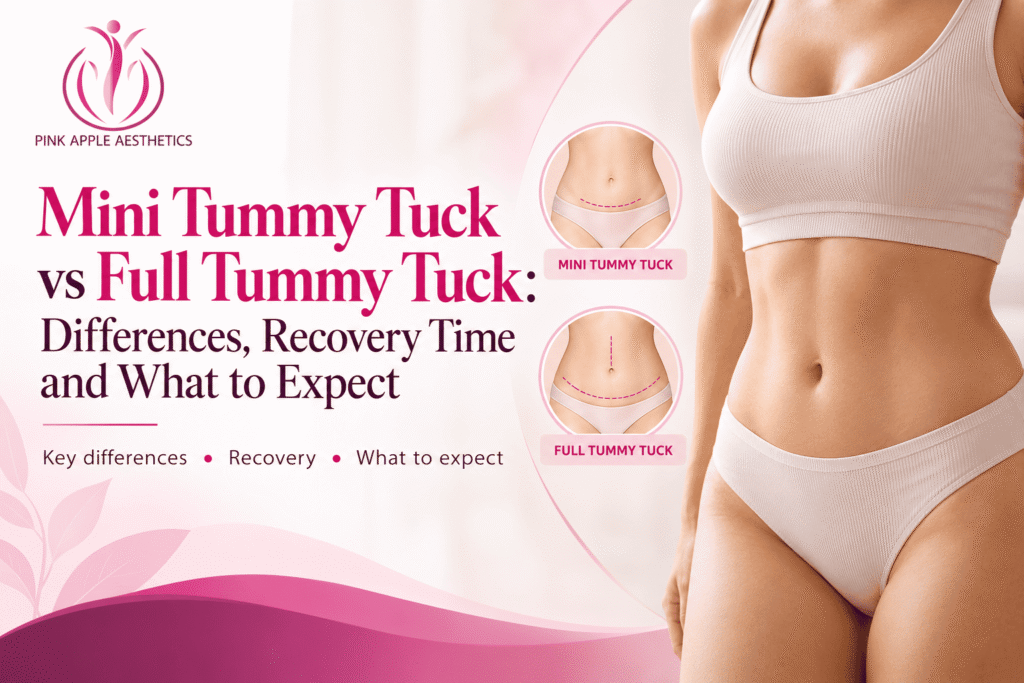
A mini tummy tuck generally involves a shorter lower-abdominal scar, while a full tummy tuck typically involves a longer incision. A full tummy tuck may also involve a scar around the belly button.
Scar length, placement and appearance vary between individuals. Scars usually change in colour and texture as they mature, and the final appearance cannot be guaranteed.
Your surgeon may recommend specific wound-care and scar-management measures once healing permits. Avoid applying unapproved products to healing incisions.
What Factors Affect Tummy Tuck Recovery?
Several factors can influence recovery after either procedure:
- Extent of surgery: More extensive correction may require additional healing time.
- Muscle repair: Abdominal muscle tightening can affect discomfort and activity restrictions.
- General health: Existing health conditions may influence surgical risk and healing.
- Smoking: Smoking and nicotine exposure can impair wound healing.
- Nutrition: Adequate nutrition supports the body’s healing processes.
- Postoperative care: Following activity restrictions and attending follow-up appointments are important.
- Additional procedures: Combining a tummy tuck with liposuction or other surgery may change the recovery plan.
Discuss your medical history, medications, smoking status and recovery support with your surgical team before proceeding.
Can a Tummy Tuck Be Combined With Liposuction?
In selected patients, a tummy tuck may be combined with liposuction to address excess skin and localised fat.
These procedures serve different purposes. A tummy tuck primarily removes excess skin and may tighten the abdominal wall, while liposuction removes localised fat deposits.
Combining procedures is not suitable for everyone. The surgeon must assess the patient’s anatomy, overall health, surgical risks and the extent of the proposed operation.
Read our related guide on [Tummy Tuck vs Liposuction: Which Procedure Is Right for You?] to understand the differences in greater detail.
How Do You Choose Between a Mini and Full Tummy Tuck?
The choice should be based on a clinical assessment rather than price, incision length or recovery expectations alone.
A qualified plastic surgeon may assess:
- Where excess skin is located.
- The degree of skin laxity.
- Whether abdominal muscle separation is present.
- The amount and distribution of abdominal fat.
- Medical history and previous abdominal surgery.
- Weight stability and future pregnancy plans.
- Personal goals and willingness to accept scars and recovery restrictions.
A mini tummy tuck may be appropriate for limited lower-abdominal concerns, whereas a full tummy tuck may be more suitable when changes extend across a larger area.
Frequently Asked Questions
1. Is a mini tummy tuck better than a full tummy tuck?
Neither is universally better. A mini tummy tuck may suit individuals with limited excess skin below the belly button, while a full tummy tuck may be appropriate for more extensive abdominal skin laxity. A plastic surgeon can recommend an option based on an examination.
2. How long does mini tummy tuck recovery take?
Initial recovery may take several weeks, but the timeline varies with the extent of surgery and individual healing. Exercise and heavy lifting may remain restricted beyond the initial recovery period.
3. How long does full tummy tuck recovery take?
Many patients need several weeks before resuming a broader range of everyday activities. Complete healing, swelling resolution and scar maturation take longer. Follow your surgeon’s individual recovery plan.
4. Does a mini tummy tuck leave a scar?
Yes. A mini tummy tuck generally leaves a lower-abdominal scar. Although it is often shorter than the scar from a full tummy tuck, the length and appearance vary.
5. Can a mini tummy tuck tighten abdominal muscles?
Limited muscle tightening may be possible in selected cases, but a mini tummy tuck does not routinely address extensive muscle separation. The appropriate technique depends on the location and severity of the problem.
6. Can I exercise after tummy tuck surgery?
Walking is usually encouraged early as directed by the surgical team. Strenuous exercise, abdominal workouts and heavy lifting must wait until the surgeon confirms that they are safe.
7. Is a tummy tuck suitable after pregnancy?
It may be an option for selected individuals who have completed their desired pregnancies and reached a relatively stable weight. The timing should be discussed with a qualified plastic surgeon.
8. Does a tummy tuck help with weight loss?
No. A tummy tuck is intended primarily for abdominal contouring and removal of excess skin, not as a substitute for weight management or obesity treatment.
9. When will I see the final results?
Some contour changes may be visible early, but swelling can persist for months. Final results depend on healing, scar maturation, the procedure performed and changes in body weight.
10. Where can I consult a plastic surgeon for tummy tuck surgery in Bangalore?
You can contact Pink Apple Aesthetics in Bangalore to enquire about a consultation with the clinic’s plastic surgery team. An in-person assessment is necessary to determine suitability, discuss risks and understand the expected results.
Conclusion
Mini and full tummy tuck procedures address different degrees of abdominal skin laxity and contour concerns. A mini tummy tuck may be appropriate for selected patients with limited lower-abdominal excess skin, while a full tummy tuck may address more extensive skin changes and may include abdominal muscle repair.
Recovery time, scars and outcomes vary according to the surgical plan and individual healing. The best way to determine which procedure is suitable is to consult a qualified plastic surgeon who can assess your anatomy, health and goals.
Considering tummy tuck surgery in Bangalore? Contact Pink Apple Aesthetics to enquire about a consultation and discuss your treatment options, recovery expectations and potential risks.
Medical disclaimer: This article is for educational purposes only and does not replace an individual consultation with a qualified plastic surgeon.


