
By Dr. Pinky Devi Ayyappan, Plastic Surgeon | Pink Apple Aesthetics, Bangalore
If you’re considering breast reduction surgery, you may already have a target in mind: “I want to go from a D cup to a B cup,” or “I want to reduce my breasts by two sizes.”
It’s natural to think about breast reduction this way. However, bra size alone cannot tell a surgeon how much your breasts should be reduced or what your final breast size will be.
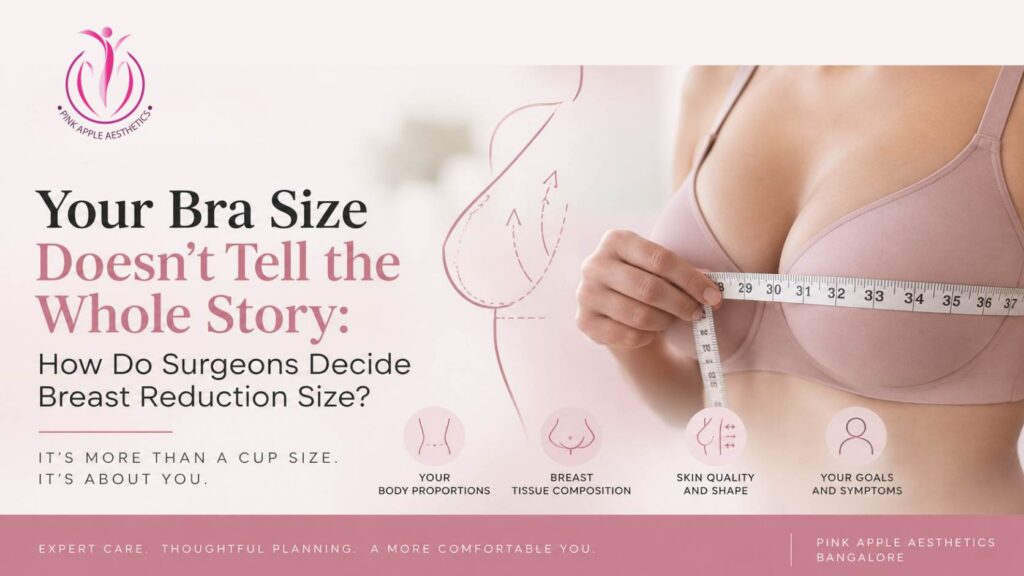
Breast reduction is an individualized surgical procedure. Surgeons consider your breast anatomy, body proportions, tissue composition, skin quality, nipple position, symptoms and personal goals before developing a surgical plan.
So, how is breast reduction size actually decided?
Let’s look at the clinical factors that matter.
Why Isn’t Bra Size Enough to Plan Breast Reduction?
Bra sizes can be useful for describing how a patient currently experiences their breast size, but they aren’t a precise measurement of breast volume.
Different brands can have different sizing systems, and the same cup size can look very different on two people.
For example, two women may both wear a 34D bra, but their actual breast volume and shape may be quite different.
One may have:
- A wider breast base
- More glandular tissue
- More upper-pole fullness
- Greater breast projection
- More stretched skin
The other may have a different combination of these characteristics.
Therefore, a surgeon doesn’t simply use a bra label to decide the amount of reduction required.
What Does a Surgeon Look At When Deciding Breast Reduction Size?
During consultation, several factors are considered together.
1. Your Existing Breast Volume
The surgeon first assesses the overall size and volume of the breasts.
This involves looking at more than just cup size.
The assessment may include:
- Breast width
- Breast height
- Projection
- Overall shape
- Tissue distribution
- Position of the breast fold
These measurements help the surgeon understand the starting anatomy.
2. Your Body Proportions
A breast size that looks proportionate on one person may look very different on another.
The surgeon considers your:
- Height
- Chest width
- Shoulder width
- Torso proportions
- Overall body frame
This is one reason why there isn’t a universal “ideal” breast size for every woman.
The objective is generally to create breasts that are appropriately proportioned to the individual’s body rather than simply achieving a particular cup letter.
3. Breast Tissue Composition
Breasts aren’t made up of only one type of tissue.
They contain varying amounts of:
- Fat
- Glandular tissue
- Connective tissue
The proportions differ between individuals.
This can influence how the breast feels, looks and responds to reduction surgery.
A surgeon therefore needs to assess the actual tissue characteristics rather than relying solely on the patient’s bra size.
4. Excess Skin and Skin Quality
Large or heavy breasts can stretch the surrounding skin over time.
If the breast is significantly reduced, simply removing internal tissue isn’t enough.
The surgeon may also need to reshape the breast and remove excess skin.
Skin elasticity is therefore an important consideration when planning the final breast shape.
5. Breast Sagging or Ptosis
Breast reduction frequently involves addressing some degree of breast ptosis, or drooping.
The surgeon evaluates:
- Nipple position
- Breast fold position
- Amount of drooping
- Skin envelope
- Overall breast shape
The goal isn’t simply to make the breasts smaller. They also need to be reshaped and repositioned.
6. Nipple and Areola Position
The position of the nipple and areola is an important part of breast reduction planning.
Depending on the degree of reduction and breast shape, the surgeon may need to reposition the nipple and areola as part of the procedure.
The surgical plan needs to take this into account while preserving appropriate tissue and blood supply.
7. Breast Asymmetry
Perfect breast symmetry is uncommon.
One breast may naturally be:
- Larger
- Smaller
- Higher
- Lower
- Different in shape
During breast reduction, the surgeon may account for these differences when determining how much tissue to remove from each side.
This means the amount removed from the two breasts does not necessarily have to be identical.
8. Your Symptoms and Reasons for Surgery
The reason you’re considering breast reduction also matters.
Some women seek surgery because of:
- Neck discomfort
- Back discomfort
- Shoulder discomfort
- Bra-strap pressure
- Skin irritation beneath the breasts
- Difficulty exercising
- Difficulty finding suitable clothing
- Physical discomfort associated with breast weight
Your symptoms and functional concerns form part of the overall consultation.
9. Your Personal Goals
Clinical measurements are only part of the conversation.
You should also explain what you want from surgery.
For example, you might want:
“I want my breasts to be noticeably smaller but still have a fuller shape.”
Another patient might prefer:
“I want significant reduction because the weight of my breasts interferes with exercise.”
These are different goals and may result in different surgical plans.
Can You Choose Your Final Cup Size?
You can certainly discuss your preferred cup size with your surgeon.
However, an exact postoperative cup size cannot always be guaranteed.
There are several reasons.
Bra sizes aren’t standardized
A 34C from one brand may fit differently from a 34C from another.
Breast shape matters
Two breasts with the same volume can have different shapes and therefore fit bras differently.
Healing changes the appearance
Immediately after surgery, swelling can affect breast size and shape.
As healing progresses, the breasts settle and the final appearance becomes clearer.
For these reasons, surgeons generally focus on proportion, volume and shape rather than promising an exact cup size.
What Does “Proportionate” Mean in Breast Reduction?
Proportion doesn’t mean that everyone should have the same breast size.
It means considering the relationship between the breasts and the rest of the body.
For example, a surgeon may consider whether the planned breast size is appropriate for the patient’s:
- Chest width
- Shoulder width
- Height
- Body frame
- Existing breast shape
This individualized approach can be more meaningful than simply targeting a particular cup letter.
Is Removing More Tissue Always Better?
No.
Breast reduction isn’t a competition to remove the largest possible amount of tissue.
The surgeon needs to balance:
Reduction + Shape + Proportion + Safety
Removing too much tissue can affect the ability to maintain an appropriate breast shape and may have implications for nipple and tissue blood supply.
The objective is therefore to determine an appropriate reduction for that individual patient.
How Is the Final Surgical Plan Created?
A breast reduction consultation typically involves several stages.
1. Understanding Your Concerns
The surgeon discusses why you’re considering surgery and what you want to change.
2. Physical Examination
Your breast size, shape, symmetry, skin quality and nipple position are assessed.
3. Measurements
Relevant breast and body measurements help the surgeon understand your anatomy.
4. Discussing Your Desired Outcome
You can explain how much reduction you’re hoping for and what type of shape you prefer.
5. Selecting the Surgical Technique
The appropriate technique depends on your anatomy, degree of reduction, skin quality and other clinical factors.
6. Creating an Individual Surgical Plan
The surgeon combines these factors to determine how the breast will be reduced and reshaped.
What If I Want a Very Significant Reduction?
This should be discussed openly during consultation.
A significant reduction may involve more extensive tissue and skin removal and may require a different surgical approach from a smaller reduction.
The surgeon will consider whether the desired size is achievable while maintaining an appropriate shape and preserving the health of the remaining breast tissue.
The important question isn’t simply:
“How small can I make my breasts?”
It is:
“What reduction can safely create a proportionate result that meets my goals?”
Why Two Patients With the Same Bra Size May Need Different Surgery
Consider two hypothetical patients who both wear a 36DD bra.
Patient A
- Wider chest
- More fatty breast tissue
- Moderate skin excess
- Mild breast drooping
Patient B
- Narrower chest
- More glandular tissue
- Greater skin stretching
- More significant breast drooping
Although their bra size is the same, their anatomy is different.
Their surgical plans—and potentially the amount of tissue removed—may therefore be different.
This illustrates why breast reduction size cannot be determined from bra size alone.
What Should You Bring to Your Consultation?
It can be helpful to think about what you want to achieve rather than arriving with only a cup-size target.
You can discuss:
- How much smaller you’d like to be
- Problems you’re experiencing because of breast size
- Clothing or exercise difficulties
- Whether you prefer a fuller or more reduced appearance
- Concerns about scars
- Your expectations regarding recovery
If you have photographs showing a general shape you like, you can also discuss them with your surgeon. However, photographs cannot guarantee that the same result can be reproduced because every patient’s anatomy is different.
Frequently Asked Questions
Can a surgeon guarantee a specific cup size after breast reduction?
Not reliably. Cup sizes vary between brands, and postoperative swelling and individual healing can affect the final breast shape and size.
Does a larger bra size always mean more tissue will be removed?
No. Bra size does not directly measure breast volume or tissue composition.
Can I choose how much smaller I want my breasts to be?
You can discuss your preferred outcome with your surgeon. The surgeon then determines what reduction is appropriate based on your anatomy and safety considerations.
Will both breasts have exactly the same amount of tissue removed?
Not necessarily. If there is natural asymmetry, different amounts may be removed to improve overall balance.
Is breast reduction only about removing tissue?
No. Breast reduction usually involves removing excess tissue and skin while reshaping and repositioning the remaining breast.
The Bottom Line
Your bra size is only one small part of the breast reduction conversation.
A surgeon doesn’t decide your final breast size by simply converting a D cup into a C or a B cup.
Instead, the decision considers your breast volume, tissue composition, body proportions, skin quality, breast shape, degree of drooping, nipple position, asymmetry, symptoms and personal goals.
The aim is to create a breast size and shape that is appropriate for your individual anatomy and expectations, while keeping surgical safety at the forefront.
If you’re considering breast reduction surgery in Bangalore, a consultation with a qualified plastic surgeon can help you understand what breast reduction size may be realistically achievable for you.
Breast Reduction at Pink Apple Aesthetics
At Pink Apple Aesthetics in Bangalore, breast reduction surgery is planned individually rather than based solely on bra size. Dr. Pinky Devi Ayyappan, Plastic Surgeon, evaluates the patient’s anatomy, concerns and desired outcome before developing an appropriate surgical plan.


