
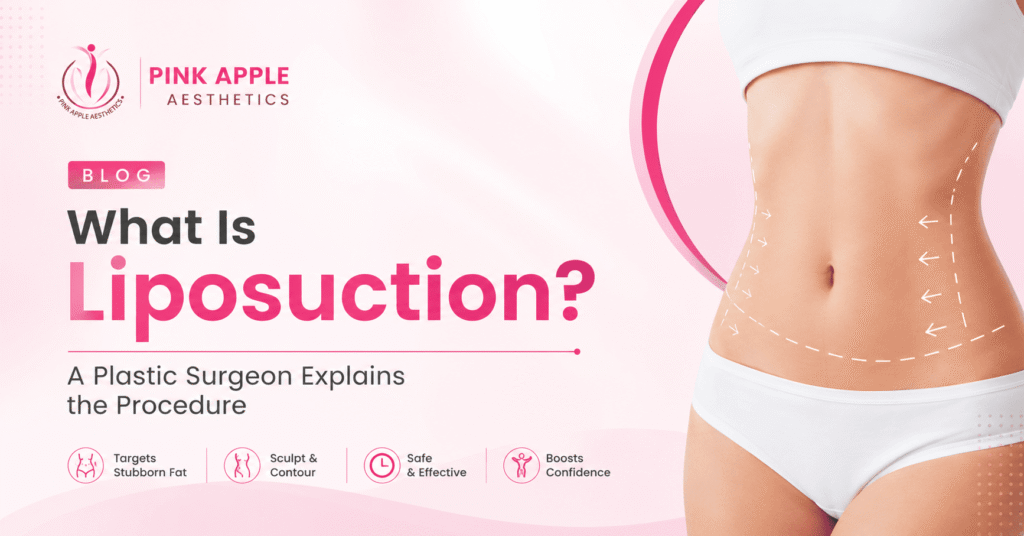
What is liposuction, how does liposuction work, and what should you expect from the procedure? A plastic surgeon explains the process, suitable candidates, recovery, results, and important considerations.
Liposuction is one of the most widely known body-contouring procedures in plastic surgery, but it is also one of the most misunderstood. Many people assume liposuction is simply a way to lose weight or remove fat permanently from any part of the body. In reality, liposuction is a surgical procedure designed to remove localized deposits of fat and improve body contours.
The procedure can be used to treat areas such as the abdomen, waist, thighs, arms, back, hips, and under the chin, depending on the patient’s anatomy, goals, and overall health.
At Pink Apple Aesthetics, the decision to undergo liposuction begins with an individual assessment rather than a one-size-fits-all approach. A plastic surgeon evaluates the distribution of fat, skin quality, body proportions, medical history, and the patient’s expectations before recommending whether liposuction is appropriate.
What Is Liposuction?
Liposuction is a surgical body-contouring procedure that removes excess or localized fat deposits from specific areas of the body.
During the procedure, a plastic surgeon uses a thin tube called a cannula to loosen and remove fat through small incisions. The technique and equipment used can vary depending on the treatment area, the amount of fat being removed, the patient’s anatomy, and the surgeon’s approach.
Unlike weight-loss surgery, liposuction is not primarily intended to treat obesity. Its purpose is to reshape specific areas of the body that may have disproportionate or resistant fat deposits.
For example, a person may maintain a relatively healthy weight but still have persistent fat around the abdomen or waist that does not respond significantly to diet and exercise. In appropriately selected patients, liposuction may help improve the contour of these areas.
How Does Liposuction Work?
The basic principle behind liposuction is straightforward: localized fat cells are physically removed from the selected treatment area.
However, the procedure involves much more than simply “sucking out fat.”
1. Consultation and assessment
The process begins with a consultation with a qualified plastic surgeon.
During the assessment, the surgeon may evaluate:
- The location and distribution of excess fat
- Skin elasticity
- Overall body proportions
- Previous surgeries or medical conditions
- Medications and relevant medical history
- Weight stability
- The patient’s expectations and aesthetic goals
This assessment helps determine whether liposuction is appropriate and which areas may benefit from treatment.
2. Treatment planning
The surgeon identifies the areas to be treated and plans the procedure according to the patient’s anatomy.
In some patients, the goal may be subtle contour refinement. In others, multiple areas may require treatment to create better overall body proportions.
The amount of fat that can safely be removed is not determined solely by what a patient wants removed. Patient safety, surgical conditions, and the individual’s overall health are important factors in determining the appropriate treatment plan.
3. Anaesthesia
Depending on the extent and location of the procedure, liposuction may be performed using different forms of anaesthesia.
The appropriate option is determined by the surgeon and anaesthesia team based on factors such as the treatment area, expected duration of surgery, and the patient’s medical condition.
4. Small incisions are made
Liposuction generally requires small incisions in or near the treatment area.
These incisions provide access for the cannula while allowing the surgeon to work beneath the skin.
5. Fat is loosened and removed
A cannula is inserted through the incision and moved carefully through the fatty layer.
The surgeon uses controlled movements to remove targeted fat while considering the surrounding tissues and the desired contour.
Modern liposuction techniques may use different methods to facilitate fat removal, but the fundamental objective remains the same: controlled removal of unwanted localized fat to improve body contour.
6. Incisions are managed after surgery
After the desired contour has been achieved, the surgical team manages the small incision sites according to the procedure and the surgeon’s technique.
Compression garments may be recommended during recovery to support the treated areas and help manage postoperative swelling.
What Areas Can Be Treated With Liposuction?
Liposuction can potentially be performed on several areas of the body.
Common treatment areas include:
- Abdomen
- Waist and flanks
- Hips
- Thighs
- Arms
- Back
- Chest in selected patients
- Under the chin
- Other localized areas of excess fat
The suitability of each area depends on individual anatomy, skin quality, fat distribution, and the patient’s overall goals.
It is also important to understand that not every area of fullness is caused by excess fat. Loose skin, muscle structure, abdominal wall changes, or other factors can influence the appearance of a body area.
This is one reason a surgical consultation is important before deciding on liposuction.
Is Liposuction a Weight-Loss Procedure?
No. Liposuction is primarily a body-contouring procedure, not a weight-loss treatment.
This distinction is important.
Liposuction removes localized fat deposits, but it is not designed to replace a healthy diet, regular physical activity, or medically supervised weight management.
A person who is significantly overweight may not achieve the result they expect from liposuction alone. In some situations, achieving a stable weight first may be recommended.
The best candidates are generally people who are relatively healthy, have localized areas of excess fat, have realistic expectations, and understand what liposuction can and cannot accomplish.
Who May Be a Candidate for Liposuction?
There is no single body type that automatically makes someone suitable for liposuction.
A plastic surgeon may consider liposuction for someone who:
- Has localized deposits of excess fat
- Is relatively close to their stable or healthy weight
- Has reasonable skin elasticity
- Is medically suitable for surgery
- Has realistic expectations
- Understands the limitations of the procedure
- Is seeking improvement in body contour rather than significant weight reduction
The final decision should always be made after an individual medical assessment.
What Is the Difference Between Liposuction and Fat Loss Through Exercise?
Diet and exercise reduce body fat throughout the body. Liposuction, on the other hand, allows a surgeon to target specific areas of localized fat.
For example, someone may lose weight through diet and exercise but continue to have a disproportionate amount of fat around the waist or lower abdomen.
Liposuction can specifically target such areas.
However, this does not mean liposuction replaces exercise or healthy eating. Maintaining a stable weight after surgery is important for preserving the overall contour achieved.
Does Liposuction Remove Fat Cells Permanently?
Liposuction physically removes fat cells from the treated area. However, this does not mean a person can never gain fat again.
The remaining fat cells can enlarge if a person gains significant weight.
For this reason, patients should continue healthy lifestyle habits after surgery.
The goal of liposuction is to improve body contour—not to make future weight gain impossible.
What Happens During Liposuction Recovery?
Recovery varies depending on the treatment area, extent of surgery, technique used, and individual healing.
It is common to experience:
- Swelling
- Bruising
- Tenderness
- Temporary numbness or altered sensation
- Tightness in the treated area
Compression garments may be recommended during the early recovery period.
Patients are usually given specific instructions regarding wound care, activity, bathing, exercise, medications, and follow-up appointments.
The visible result does not appear immediately because postoperative swelling can temporarily obscure the new contour.
When will you see the final result?
The body gradually settles as swelling decreases and the tissues heal.
Some improvement may become visible relatively early, but final results can take time to develop. The exact timeline varies from patient to patient.
Is Liposuction Safe?
Liposuction is a surgical procedure, and like any surgery, it carries potential risks.
Possible complications can include:
- Infection
- Bleeding
- Fluid accumulation
- Changes in sensation
- Contour irregularities
- Asymmetry
- Skin or tissue problems
- Anaesthesia-related complications
- Blood clots and other uncommon but potentially serious complications
The risk profile depends on factors such as the patient’s health, the extent of surgery, the treatment area, and the surgical setting.
Choosing an appropriately qualified plastic surgeon and undergoing surgery in an appropriate medical facility are important parts of safe surgical care.
Can Liposuction Be Combined With Other Procedures?
In selected patients, liposuction may be performed alongside another procedure.
For example, patients undergoing abdominal contouring may sometimes require consideration of both excess fat and excess skin. In such cases, liposuction and tummy tuck surgery address different problems.
Liposuction primarily targets localized fat, while a tummy tuck focuses on excess abdominal skin and, when appropriate, abdominal wall concerns.
Similarly, liposuction may form part of a broader Mommy Makeover plan in carefully selected patients.
Whether procedures should be combined depends on the patient’s health, anatomy, surgical goals, and overall safety considerations.
What Liposuction Cannot Do
Understanding the limitations of liposuction is just as important as understanding its benefits.
Liposuction cannot:
- Replace weight-loss treatment
- Treat obesity by itself
- Guarantee perfectly flat or symmetrical results
- Remove all body fat
- Prevent future weight gain
- Completely eliminate cellulite
- Correct significant loose skin on its own
If excess skin is a major concern, another procedure may be more appropriate.
A plastic surgeon can help determine whether liposuction alone is sufficient or whether another approach should be considered.
What Should You Ask a Plastic Surgeon Before Liposuction?
Before deciding on surgery, patients should feel comfortable asking questions such as:
- Am I a suitable candidate for liposuction?
- Which areas would benefit most from treatment?
- What type of liposuction technique do you recommend and why?
- What result can I realistically expect?
- How long should I plan for recovery?
- What are the potential risks in my specific case?
- Will I need another procedure to address loose skin?
- Where will the surgery be performed?
- What follow-up care will I need?
- What happens if I gain weight after surgery?
A good consultation should be a two-way discussion. The goal is not simply to determine whether surgery can be performed, but whether it is the right procedure for that particular patient.
Frequently Asked Questions About Liposuction
What exactly does liposuction do?
Liposuction removes localized deposits of fat from selected areas of the body using a cannula inserted through small incisions. It is primarily intended to improve body contour rather than cause major weight loss.
Is liposuction painful?
Liposuction is performed under anaesthesia, so significant pain is not expected during the procedure itself. Some soreness, tenderness, tightness, and discomfort can occur during recovery and are managed according to the surgeon’s postoperative instructions.
How long does liposuction surgery take?
The duration varies according to the number of areas being treated, the amount of fat being removed, the technique used, and other individual factors. Your plastic surgeon can provide a more accurate estimate during consultation.
Will I lose weight after liposuction?
Some reduction in body weight can occur because fat is removed, but weight loss is not the primary purpose of liposuction. The main goal is improvement in body contour.
Does liposuction permanently remove fat?
Fat cells removed during liposuction do not grow back in the same way, but remaining fat cells can enlarge with significant weight gain. Maintaining a stable weight is therefore important.
Can liposuction remove belly fat?
Liposuction can remove localized subcutaneous fat from the abdomen in suitable patients. However, it does not remove visceral fat located around the internal organs and does not correct every cause of abdominal fullness.
How soon can I return to normal activities after liposuction?
Recovery varies depending on the extent of surgery and the individual. Your surgeon will provide personalized guidance on returning to work, exercise, and other activities.
Is liposuction suitable for everyone?
No. Suitability depends on factors including health, weight stability, skin quality, fat distribution, expectations, and the specific area being considered for treatment.
The Bottom Line
Liposuction is a surgical body-contouring procedure designed to remove localized fat and improve the shape and proportion of selected areas of the body.
It is not a substitute for weight-loss treatment, exercise, or healthy lifestyle habits. The best results come from appropriate patient selection, realistic expectations, careful surgical planning, and proper postoperative care.
If you are considering liposuction, the most important first step is not choosing a technique based on an advertisement or social media trend. It is having a detailed consultation with a qualified plastic surgeon who can assess your anatomy and explain which approach, if any, is appropriate for you.
At Pink Apple Aesthetics, liposuction treatment planning is individualized based on the patient’s body contour, fat distribution, skin quality, health, and aesthetic goals.


