
Breast augmentation is one of the most personalized cosmetic procedures, and one of the most important decisions isn’t just the implant size or brand—it’s where the implant is placed.
Modern plastic surgeons increasingly recommend Dual Plane Breast Augmentation because it combines the advantages of placing the implant beneath the chest muscle while allowing the lower part of the implant to shape the breast naturally.
This technique has become one of the most widely used approaches for women seeking natural-looking breasts, especially those with minimal existing breast tissue or mild breast drooping (ptosis).
In this guide, we’ll explain what the Dual Plane Technique is, why many surgeons prefer it, who is an ideal candidate, its benefits, possible risks, recovery timeline, and frequently asked questions.
What Is Dual Plane Breast Augmentation?
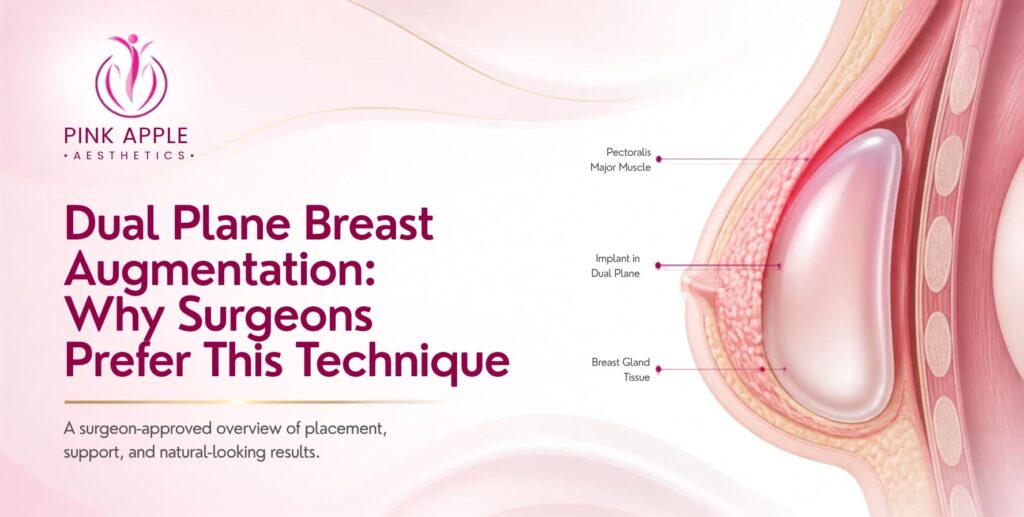
Dual Plane Breast Augmentation is a surgical technique where the breast implant is positioned partially beneath the pectoralis major muscle (upper portion) and partially beneath the natural breast tissue (lower portion).
Unlike traditional implant placement methods, the dual plane approach allows the upper part of the implant to benefit from muscle coverage while enabling the lower breast to drape naturally over the implant.
Simply put:
- Upper implant → Covered by muscle
- Lower implant → Covered by breast tissue
This creates a more natural transition between the chest wall and the breast.
Understanding Breast Implant Placement
There are three primary implant placement options during breast augmentation:
| Implant Placement | Position | Best For |
|---|---|---|
| Over the Muscle (Subglandular) | Above chest muscle | Women with adequate breast tissue |
| Under the Muscle (Submuscular) | Entirely beneath muscle | Lean women needing extra implant coverage |
| Dual Plane Technique | Upper implant under muscle, lower implant under breast tissue | Most women seeking natural-looking results |
Today, the Dual Plane Technique is one of the most commonly performed methods because it balances aesthetics with long-term stability.
Why Do Plastic Surgeons Prefer the Dual Plane Technique?
Many experienced plastic surgeons prefer this technique because it addresses several challenges encountered with other implant placement methods.
1. More Natural-Looking Results
The muscle softens the upper edge of the implant, reducing visible implant outlines and creating a gentle slope.
This is especially beneficial for women with thinner breast tissue.
2. Better Implant Coverage
When implants are placed partially beneath the muscle, they receive additional soft tissue coverage.
This can help:
- Reduce visible implant edges
- Minimize rippling in suitable candidates
- Improve upper pole contour
3. Improved Lower Breast Shape
The lower portion of the implant sits beneath the breast tissue rather than being tightly compressed by muscle.
This allows:
- Better lower pole expansion
- Improved breast projection
- More natural breast movement
4. Suitable for Mild Breast Sagging
Women with mild ptosis (Grade I or selected Grade II) may achieve an improved breast shape with the dual plane technique, depending on their anatomy.
However, women with significant sagging may still require a breast lift in addition to augmentation.
5. Lower Risk of Visible Implant Edges
Patients with very little natural breast tissue often worry that implants may look artificial.
Dual plane placement offers additional upper pole coverage, helping create a smoother contour.
How Is Dual Plane Breast Augmentation Performed?
The surgery is typically performed under general anesthesia.
The procedure generally involves:
- Making a carefully planned incision (often in the inframammary fold).
- Creating a pocket beneath the upper chest muscle.
- Releasing selected lower muscle attachments to create the dual plane pocket.
- Positioning the implant precisely.
- Checking symmetry and implant position.
- Closing the incision with layered sutures.
The operation generally takes between 1.5 to 3 hours, depending on the surgical plan.
Who Is an Ideal Candidate?
Dual Plane Breast Augmentation is commonly recommended for women who:
- Have naturally small breasts.
- Have limited breast tissue.
- Want a natural appearance.
- Desire improved upper breast fullness.
- Have mild breast sagging.
- Want long-term aesthetic outcomes.
- Maintain a stable weight.
- Are in good overall health.
A consultation with a qualified plastic surgeon is essential to determine the most appropriate implant placement.
Benefits of Dual Plane Breast Augmentation
Natural Breast Contour
The transition from chest to breast appears smoother compared to some other placement methods.
Enhanced Implant Camouflage
The chest muscle provides additional coverage over the upper implant.
Improved Cleavage
When combined with the correct implant dimensions and surgical planning, the technique can help achieve balanced cleavage while maintaining natural proportions.
Better Long-Term Aesthetics
Dual plane placement allows the breast tissue to drape naturally over the implant, supporting a more balanced appearance over time.
Versatility
The technique is suitable for a wide range of body types and breast anatomies.
Are There Any Risks?
Like any surgical procedure, Dual Plane Breast Augmentation carries potential risks.
These may include:
- Bleeding
- Infection
- Capsular contracture
- Implant displacement
- Temporary changes in nipple sensation
- Implant rupture (rare)
- Fluid collection (seroma)
- Need for revision surgery
Choosing an experienced board-certified plastic surgeon and following post-operative instructions can help reduce these risks.
Recovery After Dual Plane Breast Augmentation
Recovery varies between individuals, but a typical timeline is:
First Week
- Mild swelling
- Tightness in the chest
- Light walking encouraged
- Prescription medications for discomfort
Weeks 2–3
- Improved comfort
- Return to desk-based work for many patients
- Reduced swelling
Weeks 4–6
- Gradual return to exercise after surgeon approval
- Implant settling begins
- Improved breast shape
Three to Six Months
- Swelling largely resolves
- Implants continue to soften and settle
- Final results become more apparent
Does Dual Plane Breast Augmentation Hurt More?
Some women experience increased chest tightness in the first few days because part of the implant sits beneath the chest muscle.
However, modern pain management strategies—including long-acting local anesthetics and enhanced recovery protocols—help keep discomfort manageable for most patients.
Most patients report that discomfort improves significantly within the first week.
Does the Implant Move When Flexing the Chest?
Because the implant is partially beneath the muscle, some women may notice slight movement during intense chest muscle contraction, a phenomenon known as animation deformity.
The degree varies and is often minimal in everyday activities. Your surgeon can discuss whether this is relevant based on your anatomy and lifestyle.
How Does Dual Plane Compare With Other Implant Placements?
| Feature | Over Muscle | Under Muscle | Dual Plane |
|---|---|---|---|
| Natural Appearance | Moderate | Good | Excellent |
| Implant Coverage | Less | Excellent | Excellent |
| Recovery | Faster | Moderate | Moderate |
| Upper Pole Softness | Moderate | Good | Excellent |
| Suitable for Thin Patients | Less ideal | Good | Excellent |
| Mild Breast Sagging | Limited improvement | Limited | Better suited |
Does Everyone Need the Dual Plane Technique?
No.
While Dual Plane Breast Augmentation is commonly recommended, it is not the best option for every patient.
The ideal implant placement depends on:
- Chest anatomy
- Skin elasticity
- Existing breast tissue
- Implant size
- Implant profile
- Lifestyle
- Athletic activity
- Cosmetic goals
Your surgeon will recommend the most appropriate approach after a detailed evaluation.
Frequently Asked Questions (FAQs)
What is Dual Plane Breast Augmentation?
Dual Plane Breast Augmentation is a surgical technique where the upper portion of the breast implant is placed beneath the chest muscle while the lower portion sits beneath the natural breast tissue, creating a more natural contour.
Why do surgeons prefer the dual plane technique?
Many surgeons prefer this method because it combines the benefits of muscle coverage with improved lower breast shaping, often resulting in a natural-looking outcome.
Is Dual Plane Breast Augmentation better than under-the-muscle implants?
Dual plane is a variation of under-the-muscle placement. It provides muscle coverage while allowing the lower breast to expand more naturally.
Who is the best candidate for Dual Plane Breast Augmentation?
Women with smaller breasts, thinner breast tissue, or mild breast sagging often benefit from this approach. Suitability depends on individual anatomy.
Does Dual Plane Breast Augmentation reduce capsular contracture?
Some studies suggest that implants with muscle coverage may have a lower rate of capsular contracture compared with implants placed entirely above the muscle. Multiple factors influence this risk.
How long does recovery take?
Most patients return to light daily activities within one to two weeks. Full recovery and final implant settling typically take several months.
Can Dual Plane Breast Augmentation correct sagging breasts?
It may improve the appearance of mild sagging. Moderate to severe breast ptosis often requires a breast lift in addition to augmentation.
Will the implants look natural?
When implant size, profile, and placement are chosen appropriately, dual plane augmentation can provide a smooth upper contour and natural-looking results.
Can I breastfeed after Dual Plane Breast Augmentation
Many women are able to breastfeed after breast augmentation, although the ability to breastfeed depends on surgical technique and individual factors.
How long do implants last?
Modern breast implants are designed for long-term use but are not lifetime devices. Regular follow-up with your plastic surgeon is recommended, and replacement is only needed if complications or changes occur.
Expert Perspective
At Pink Apple Aesthetics, breast augmentation is planned using a patient-specific approach rather than a one-size-fits-all technique. Implant placement is determined after assessing chest dimensions, breast tissue thickness, skin quality, lifestyle, and aesthetic goals.
The Dual Plane Technique is frequently recommended because it offers an excellent balance of implant support, natural contour, and long-term aesthetic outcomes for many women. However, the final recommendation is always individualized to ensure the safest and most satisfying result.
Related Articles
Continue exploring our Breast Augmentation Knowledge Hub:
- Breast Augmentation Service Page
- Breast Implant Recovery Week by Week
- Best Breast Implant Profile for Indian Women
- Motiva vs Mentor Breast Implants
- Breast Implant Sizes Explained
- Silicone vs Saline Breast Implants
Ready to Learn Which Implant Placement Is Right for You?
The ideal breast augmentation technique depends on your anatomy, lifestyle, and cosmetic goals—not on trends or one-size-fits-all recommendations.
Book a consultation at Pink Apple Aesthetics to receive a personalized assessment, discuss implant placement options, and create a treatment plan tailored to achieve balanced, natural-looking results.


