
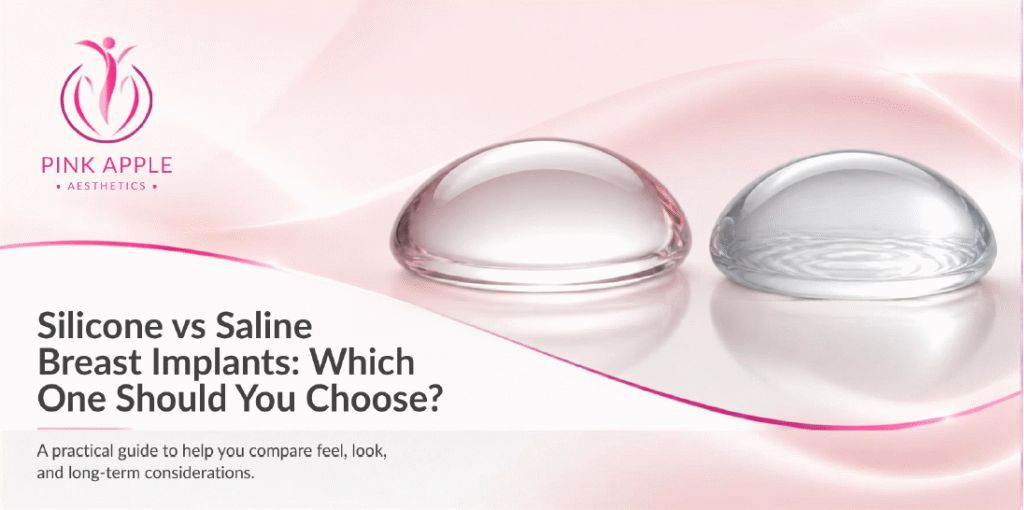
One of the most important decisions you’ll make before breast augmentation isn’t just choosing the implant size or profile—it’s selecting the implant material.
The two main breast implant types available worldwide are silicone breast implants and saline breast implants. Both have been used successfully for many years, but they differ in feel, appearance, incision size, rupture detection, and suitability for different patients.
Many women ask:
- Are silicone implants safer than saline?
- Do silicone implants feel more natural?
- Which implant lasts longer?
- What do plastic surgeons recommend today?
The answer depends on your anatomy, lifestyle, cosmetic goals, and your surgeon’s recommendations not simply on which implant is more popular.
This guide compares Silicone vs Saline Implants to help you make an informed decision during your breast augmentation consultation.
What Are Breast Implants?
Breast implants are medical devices used to enhance breast size, improve breast shape, or restore breast volume after pregnancy, weight loss, or mastectomy.
Modern implants consist of:
- An outer silicone shell
- A filling material inside
The filling determines whether the implant is classified as silicone or saline.
What Are Silicone Breast Implants?
Silicone breast implants are filled with a cohesive silicone gel designed to closely resemble the feel of natural breast tissue.
Modern silicone implants use highly cohesive gel that helps maintain shape even if the implant shell is damaged.
They are the most commonly chosen implant type for cosmetic breast augmentation worldwide.
What Are Saline Breast Implants?
Saline breast implants have a silicone outer shell but are filled with sterile saltwater (saline) after placement.
Because they are inserted empty and filled during surgery, they may require a slightly smaller incision than pre-filled silicone implants.
If a saline implant ruptures, the saline solution is safely absorbed by the body, and the breast typically deflates noticeably.
Silicone vs Saline Implants: Quick Comparison
| Feature | Silicone Breast Implants | Saline Breast Implants |
|---|---|---|
| Filling | Cohesive silicone gel | Sterile saline solution |
| Feel | Soft and natural | Slightly firmer |
| Appearance | Natural contour | May show more rippling in some patients |
| Incision | Slightly larger | Often smaller |
| Rupture Detection | May require imaging if silent rupture is suspected | Usually obvious due to deflation |
| Rippling | Lower likelihood in suitable candidates | More likely in women with thin tissue |
| Popularity | Most commonly selected | Less common for cosmetic augmentation |
Which Feels More Natural?
One of the biggest differences between the two implant types is how they feel.
Silicone Breast Implants
Silicone gel has a consistency that closely resembles natural breast tissue.
Women often choose silicone implants because they provide:
- Softer feel
- Natural movement
- Smooth contour
- Less visible implant edges
Saline Breast Implants
Saline implants can also produce good cosmetic outcomes but may feel slightly firmer, particularly in women with minimal natural breast tissue.
The perceived feel varies depending on:
- Implant placement
- Implant size
- Existing breast tissue
- Chest anatomy
Which Looks More Natural?
For many patients, silicone implants create a more natural appearance, especially in:
- Slim women
- Women with limited breast tissue
- Women seeking subtle enhancement
The cohesive gel allows the implant to maintain a smooth contour while reducing visible wrinkling in suitable candidates.
Saline implants can also provide attractive results, particularly in women with more natural breast tissue.
Safety: Are Silicone Implants Safe?
Modern silicone breast implants have undergone extensive clinical evaluation and continue to be widely used worldwide.
Current evidence supports their safety when implanted by qualified plastic surgeons and monitored appropriately.
Like all breast implants, silicone implants are not lifetime devices and require regular follow-up.
Potential complications—such as capsular contracture, rupture, or implant displacement—can occur with both silicone and saline implants.
What Happens If an Implant Ruptures?
Silicone Implant Rupture
A rupture may not be immediately noticeable because the cohesive gel often remains within the implant shell or surrounding scar tissue. This is sometimes called a silent rupture.
Your plastic surgeon may recommend imaging studies if a rupture is suspected.
Saline Implant Rupture
If a saline implant ruptures:
- The implant loses volume.
- The breast typically deflates over hours or days.
- The saline is naturally absorbed by the body.
Although rupture is easier to recognize, surgery is still required to replace the implant if desired.
Which Implant Lasts Longer?
Both silicone and saline implants are designed for long-term use.
However:
- Neither implant should be considered a lifetime device.
- Replacement is not routinely required after a fixed number of years.
- Implants are generally replaced only if complications arise or cosmetic preferences change.
Regular follow-up appointments help ensure implant health over time.
Which Implant Has Less Rippling?
Rippling refers to visible or palpable folds in the implant.
In general:
- Silicone implants are less likely to show rippling.
- Saline implants may have a higher likelihood of visible rippling in women with thin breast tissue.
Proper implant selection and placement can reduce this risk.
Which Implant Requires a Smaller Incision?
Because saline implants are filled after insertion, they can often be placed through a slightly smaller incision.
Silicone implants are pre-filled, so the incision may need to be marginally larger.
Your surgeon will choose the incision based on implant type, anatomy, and surgical goals.
Which Implant Do Plastic Surgeons Commonly Recommend?
Many plastic surgeons prefer silicone breast implants for cosmetic breast augmentation because they:
- Feel more natural.
- Provide smooth breast contours.
- Offer a wide range of implant sizes and profiles.
- Have high patient satisfaction.
However, saline implants remain an appropriate choice for selected patients based on individual preferences and clinical considerations.
How Do You Choose the Best Breast Implant Material?
There is no single implant material that is right for everyone.
Your surgeon will evaluate:
- Chest width
- Existing breast tissue
- Skin elasticity
- Desired breast size
- Lifestyle
- Implant placement
- Aesthetic goals
The final recommendation should be individualized after a detailed consultation.
Common Myths About Silicone and Saline Implants
Myth 1: Silicone implants are unsafe.
Fact: Modern silicone implants have undergone extensive testing and are widely used around the world when used according to approved indications.
Myth 2: Saline implants always look artificial.
Fact: When selected appropriately, saline implants can achieve attractive, natural-looking outcomes in many patients.
Myth 3: Silicone implants never rupture.
Fact: Both silicone and saline implants can rupture, although rupture rates are generally low with modern implants.
Myth 4: Bigger implants are always better.
Fact: Implant material is only one factor. Implant size, profile, placement, and surgical planning all influence the final result.
Silicone vs Saline: Which Implant Is Right for You?

You may prefer silicone implants if you:
- Want the softest, most natural feel.
- Have a lean body frame.
- Desire subtle breast enhancement.
- Have limited natural breast tissue.
You may consider saline implants if you:
- Prefer a smaller incision.
- Want immediate visual detection if rupture occurs.
- Have sufficient natural breast tissue to cover the implant.
The best choice depends on your anatomy and goals rather than a universal recommendation.
Frequently Asked Questions (FAQs)
Which is better: silicone or saline breast implants?
Neither is universally better. Silicone implants are often chosen for their natural feel, while saline implants may appeal to patients who prefer easier rupture detection or a smaller incision.
Do silicone implants feel more natural?
Yes. Many patients and surgeons find that silicone implants more closely resemble the feel of natural breast tissue.
Are saline implants safer than silicone implants?
Both implant types have established safety profiles when used appropriately. They differ mainly in filling material and how rupture presents, rather than overall safety.
Which implants last longer?
Both silicone and saline implants are designed for long-term use. Replacement is generally only needed if complications develop or personal preferences change.
Can silicone implants rupture without symptoms?
Yes. A silicone implant rupture may be “silent,” meaning it may not cause obvious changes. Imaging may be recommended if rupture is suspected.
Are saline implants more likely to ripple?
In women with thinner breast tissue, saline implants may be more prone to visible rippling compared with silicone implants.
Which implant is more popular in India?
Silicone breast implants are commonly selected for cosmetic breast augmentation in India due to their natural feel and appearance.
Can I breastfeed after getting silicone or saline implants?
Many women can breastfeed after breast augmentation, although outcomes depend on surgical technique and individual anatomy.
Which implant is better for a natural look?
For many women, silicone implants provide a softer feel and smoother contour, making them a popular choice for natural-looking results.
Expert Perspective
At Pink Apple Aesthetics, choosing between silicone and saline implants is never based on trends alone. Every patient undergoes a comprehensive assessment that includes chest dimensions, breast tissue thickness, skin quality, lifestyle, and aesthetic goals.
For most cosmetic breast augmentation procedures, modern silicone breast implants are often recommended because of their natural feel and appearance. However, saline implants remain a valuable option for selected patients, and the final decision is made collaboratively after discussing the benefits, limitations, and expected outcomes of each implant type.
Related Articles
Explore more from our Breast Augmentation Knowledge Hub:
- Breast Augmentation in Bangalore
- Motiva vs Mentor Breast Implants
- Breast Implant Sizes Explained
- Best Breast Implant Profile for Indian Women
- Dual Plane Breast Augmentation
- Breast Implant Recovery Week by Week
Ready to Choose the Right Breast Implant?
Selecting the ideal implant involves more than deciding between silicone and saline. It requires understanding how implant material, size, profile, and placement work together to achieve safe, balanced, and natural-looking results.
Book a consultation at Pink Apple Aesthetics to discuss your options with an experienced plastic surgeon and receive a personalized treatment plan based on your anatomy and aesthetic goals.


