
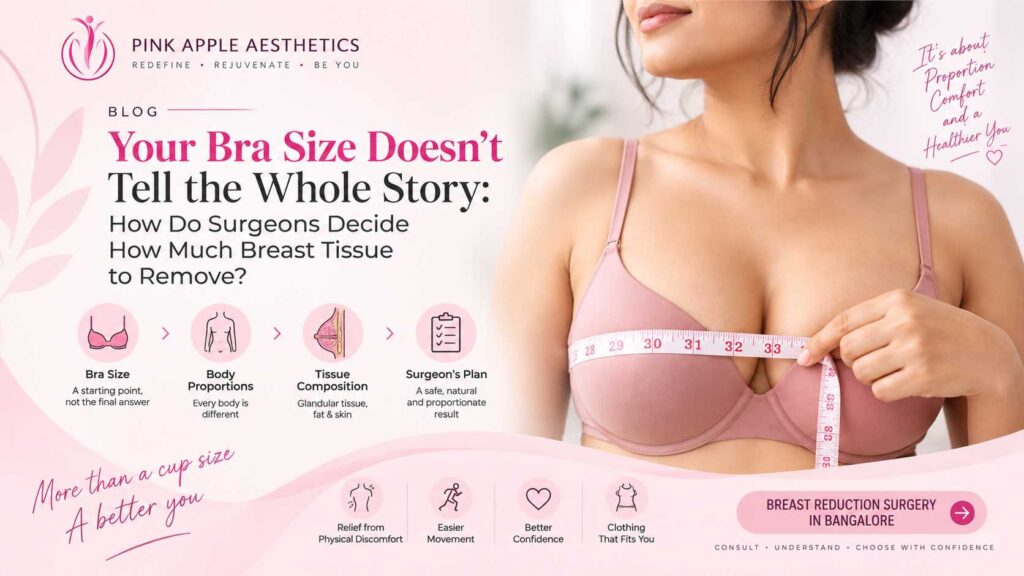
“I’m currently a 38F. Can I become a 38C after breast reduction?”
This is one of the most understandable questions a woman can ask during a breast reduction consultation.
But there is an important misconception behind it:
Breast reduction surgery is not planned by simply choosing a smaller bra cup size.
A surgeon has to consider much more than the number printed on your bra label. Breast volume, body proportions, breast shape, skin quality, nipple position, tissue composition, symptoms, desired outcome and—most importantly—what can be safely removed while maintaining an appropriate breast shape and blood supply all influence the surgical plan.
So if you are considering breast reduction surgery in Bangalore, the better question may not be:
“What cup size will I become?”
It may be:
“How much reduction is appropriate and safe for my body?”
Let’s look at how surgeons approach that decision.
Quick Answer
How do surgeons decide how much breast tissue to remove?
There is no universal number of grams or a fixed cup-size formula that applies to every woman.
During a breast reduction consultation, the surgeon considers:
- Your current breast size and volume
- Your body proportions
- Breast width and shape
- Degree of breast sagging
- Skin quality and excess skin
- Nipple and areola position
- Breast tissue composition
- Your symptoms and reasons for surgery
- Your desired degree of reduction
- Breast symmetry
- The surgical technique being considered
- The need to maintain adequate blood supply to the nipple and remaining breast tissue
The objective is to create a smaller, proportionate and appropriately shaped breast while maintaining safety, rather than simply removing the largest possible amount of tissue.
Why Your Bra Size Isn’t a Surgical Measurement
Bra sizing can be useful for describing how a woman experiences her current breast size, but it isn’t a precise measurement of breast volume.
For example, two women may both wear a 36F but have very different:
- Breast widths
- Breast shapes
- Projection
- Tissue composition
- Skin excess
- Chest dimensions
- Body proportions
Even bra sizing itself varies between manufacturers and styles.
That means a surgeon cannot reliably say:
“You are an F cup, so we need to remove exactly X grams to make you a C cup.”
In fact, the American Society of Plastic Surgeons notes that an exact postoperative cup size cannot be predicted when planning breast reduction.
Think of it this way:
Bra size ≠ breast volume
And:
Breast volume ≠ the amount of tissue that can safely be removed
That distinction is one of the most important things to understand before breast reduction surgery.
What Does a Surgeon Actually Look At?
During a consultation, breast reduction planning is much more individualized than simply looking at your bra label.
1. Your Current Breast Volume
The starting point matters.
Someone with very large breasts may require a substantially greater reduction than someone whose breasts are moderately enlarged.
But the surgeon isn’t simply trying to remove a predetermined percentage.
The amount removed depends on the overall surgical plan.
2. Your Body Proportions
This is one of the reasons two women with the same bra size may have completely different surgical plans.
A surgeon considers the breast in relation to the:
- Chest
- Shoulders
- Waist
- Hips
- Overall body frame
The goal is generally proportion, rather than achieving a particular letter on a bra tag.
A smaller breast isn’t necessarily a better result if it doesn’t suit the patient’s anatomy.
3. Breast Shape and Width
Breasts aren’t simply measured by volume.
A surgeon also considers:
Width
How wide is the breast across the chest?
Projection
How far does the breast extend forward?
Lower-pole fullness
How much tissue is concentrated in the lower portion?
Upper-pole fullness
How much volume is present in the upper breast?
Sagging
How far has the breast descended?
These characteristics influence how the remaining tissue can be reshaped after reduction.
4. Skin Quality and Excess Skin
Breast reduction isn’t simply a “remove tissue and close the skin” procedure.
When breast volume is reduced, the remaining breast tissue and skin need to be reshaped.
The surgeon must consider:
- How much excess skin is present
- Skin elasticity
- Degree of breast sagging
- Breast envelope
- Expected final shape
Breast reduction generally involves removing excess tissue and skin and reshaping the remaining breast tissue.
5. Nipple and Areola Position
The nipple doesn’t simply stay in exactly the same position after a significant breast reduction.
As the breast is reshaped and lifted, the nipple-areola complex may need to be repositioned.
The surgeon therefore considers:
- Current nipple position
- Breast ptosis or sagging
- Desired breast shape
- Amount of reduction
- Technique required to maintain appropriate blood supply
Mayo Clinic explains that breast reduction commonly involves removing excess breast tissue, fat and skin while reshaping the breast and repositioning the nipple and areola.
6. What Is Actually Inside the Breast?
Not every breast has the same tissue composition.
Breast volume can include different proportions of:
- Glandular tissue
- Fat
- Connective tissue
This matters because a gram is a measurement of weight, not volume.
Two women may have a similar breast volume but different tissue composition and therefore different weights.
An ASPS surgeon explanation also highlights that tissue density can influence the weight of tissue removed for a given volume.
This is why:
“How many grams will you remove?”
doesn’t tell the entire story.
The surgeon has to think about volume, shape, proportion and safety together.
7. Your Symptoms Matter Too
Breast reduction isn’t necessarily about appearance alone.
Women may consider surgery because large or heavy breasts are associated with:
- Neck discomfort
- Shoulder discomfort
- Back pain
- Bra-strap grooves
- Skin irritation beneath the breasts
- Difficulty exercising
- Difficulty finding comfortable clothing
- Other physical limitations
These symptoms are important during the consultation because they help the surgeon understand why you are considering reduction.
8. Your Desired Result Matters
A consultation should be a conversation—not just an examination.
You may want:
“I don’t want extremely small breasts. I want them smaller, lifted and proportionate.”
Another woman may say:
“My breasts are affecting my exercise and I want a significant reduction.”
Someone else may prioritise:
“I want to maintain as much fullness as possible while reducing the weight.”
These are different goals.
The surgeon has to balance your expectations with what is anatomically and surgically appropriate.
The Most Important Factor: Safety
This is where “remove as much as possible” becomes the wrong approach.
During breast reduction, the surgeon must preserve an appropriate blood supply to the nipple-areola complex and the remaining breast tissue.
Removing excessive tissue or compromising the structures that maintain blood supply can increase the risk of complications.
ASPS specifically notes that the amount of tissue removed is influenced by the need to maintain adequate blood supply to the nipple.
So the goal isn’t:
❌ Maximum tissue removal
The goal is:
Appropriate reduction + good shape + proportion + safety
Is There a Minimum Number of Grams That Must Be Removed?
This is a particularly confusing topic because you may find numbers online such as:
200 g | 300 g | 500 g | 700 g
But these numbers should not be interpreted as universal medical targets.
Some historical insurance policies have used minimum resection weights as part of their coverage criteria, and these requirements can vary by insurer and location. ASPS has also highlighted that resection-weight requirements do not necessarily correspond to symptom relief.
In other words:
The amount of tissue that needs to be removed for an insurance policy is not the same thing as the medically ideal amount of tissue for every patient.
For an individual patient, the surgical plan should be based on anatomy, symptoms, goals and safety.
Can 500 Grams of Tissue Mean a Full Cup-Size Reduction?
Not reliably.
You may find online estimates suggesting that a certain number of grams corresponds to a particular cup-size reduction.
These should be treated cautiously.
Why?
Because:
Cup size isn’t a standardized volume measurement.
And breast tissue varies in density and distribution.
ASPS notes that although some estimates have been suggested between grams removed and cup-size changes, a patient’s exact postoperative cup size cannot be predicted.
What If I Want to Go From an F Cup to a C Cup?
This is where an in-person consultation becomes particularly important.
Instead of promising:
“Yes, you’ll definitely be a C cup.”
a responsible surgeon should discuss:
- How much reduction appears realistic
- What breast shape may be achievable
- How much tissue may need to be removed
- Where the scars are likely to be
- How the nipple will be positioned
- What limitations exist because of your anatomy
- What risks are involved
The final breast size cannot be guaranteed with complete precision.
Why Surgeons Don’t Use a “Breast Reduction Calculator”
You may find online calculators asking:
Current cup size → Desired cup size → Estimated grams
These can be interesting for general education, but they cannot replace surgical assessment.
A meaningful surgical plan requires examination and measurements.
Mayo Clinic notes that during preparation, a plastic surgeon may examine and measure the breasts, discuss desired size and appearance, and assess medical history and risks.
Your body isn’t a spreadsheet.
Two patients with the same:
Height + weight + bra size
may still require different surgical plans.
What Happens During a Breast Reduction Consultation?
A good consultation should answer much more than:
“How many grams will be removed?”
Step 1 — Understand your concerns
The surgeon asks why you want the reduction.
Step 2 — Medical history
Previous breast procedures, medications, health conditions and other relevant factors are reviewed.
Step 3 — Breast examination
Breast size, shape, symmetry, skin quality and nipple position are assessed.
Step 4 — Measurements
The surgeon evaluates proportions and dimensions that help with surgical planning.
Step 5 — Discuss your desired outcome
You can explain how much smaller you would like to be and what you want the final shape to look like.
Step 6 — Discuss technique
The appropriate surgical approach depends on your anatomy and the amount of reduction required.
Step 7 — Discuss scars and risks
You should understand where scars may be and what complications are possible.
Step 8 — Create an individualised plan
Only after considering all of these factors can the surgeon estimate the appropriate amount of tissue removal.
A Simple Example
Imagine two women who both wear a 36F.
Patient A
- Smaller frame
- High breast projection
- Significant lower-pole fullness
- Good skin elasticity
- Moderate sagging
Patient B
- Wider chest
- More fatty breast composition
- Significant skin excess
- More pronounced sagging
- Different nipple position
They have the same bra size.
But their surgical plans may be completely different.
This is why:
Bra size is a starting point—not a surgical blueprint.
What Does “Proportion” Mean in Breast Reduction?
Proportion means the surgeon isn’t looking at the breasts in isolation.
Imagine reducing the breast dramatically but leaving a breast shape that doesn’t suit the patient’s chest width or body frame.
The breast may be smaller—but the overall result may not look balanced.
A well-planned reduction considers:
Breast size
↓
Breast shape
↓
Chest dimensions
↓
Body proportions
↓
Nipple position
↓
Skin envelope
↓
Patient’s goals
↓
Final surgical plan
Recent ASPS educational material similarly emphasises discussing the magnitude of change and proportionality rather than relying solely on cup-size expectations.
What Happens to the Removed Breast Tissue?
The tissue removed during breast reduction is generally sent for appropriate pathological examination according to the surgeon’s practice and clinical circumstances.
This is another reason the removed tissue shouldn’t be thought of simply as a number on a weighing scale.
The procedure is surgery involving actual breast tissue, and the surgeon should explain what happens to the tissue as part of the consent process.
Will Removing More Tissue Always Give a Better Result?
No.
A larger reduction isn’t automatically a better reduction.
The surgeon has to balance:
Desired reduction
How much smaller you want to be.
Breast shape
How the remaining tissue can be reshaped.
Proportion
How the result fits your body.
Nipple position
Where the nipple needs to sit after reshaping.
Skin
How much skin needs to be removed.
Blood supply
How the nipple and remaining tissues can remain adequately perfused.
Healing
How your body is likely to heal.
The goal is an individualised and safe result, not simply the largest possible reduction.
Does Breast Reduction Affect Breastfeeding?
It can.
Depending on the surgical technique and individual anatomy, breast reduction may affect the ability to produce a full milk supply.
If future pregnancy or breastfeeding is important to you, discuss this before surgery, not after.
Mayo Clinic and the NHS both identify possible breastfeeding difficulties as an important consideration of breast reduction surgery.
Does Breast Reduction Always Give the Same Result?
No.
Breast reduction results vary between patients.
Differences can occur because of:
- Starting breast size
- Breast shape
- Tissue composition
- Skin quality
- Age
- Weight changes
- Healing
- Surgical technique
- Individual anatomy
Even when two patients undergo similar procedures, their results can look different.
This is why before-and-after photographs are useful for understanding possible outcomes, but should not be treated as guarantees.
What About Breast Reduction Cost in Bangalore?
The cost of breast reduction depends on the surgical plan and individual requirements.
At Pink Apple Aesthetics, Bangalore, the indicative price for breast reduction surgery is:
₹1,00,000 – ₹1,50,000*
Terms and conditions apply.
The final cost should be discussed during consultation because the surgical plan, facility requirements and individual patient factors can vary.
If you’re researching the procedure, you can read the main Breast Reduction Surgery in Bangalore service page for more information about the treatment and consultation.
Real Breast Reduction Results at Pink Apple Aesthetics
Look at the Change—Not Just the Cup Size
One of the best ways to understand breast reduction is to look beyond the bra label.
The objective can include:
Less volume + improved proportion + reshaping + lifting + improved comfort
Pink Apple Aesthetics can showcase authentic patient before-and-after photographs here.
6-Month Result
[INSERT AUTHENTIC 6-MONTH BEFORE/AFTER IMAGE]
3-Month Result
[INSERT AUTHENTIC 3-MONTH BEFORE/AFTER IMAGE]
10-Week Result
[INSERT AUTHENTIC 10-WEEK BEFORE/AFTER IMAGE]
Important: Individual results vary. Before-and-after photographs represent individual patients and do not guarantee a particular outcome.
Why this section works well
Rather than asking the reader to imagine what “smaller” means, authentic results help them understand how surgeons can change volume, shape and proportion together.
7 Questions to Ask Your Surgeon About Tissue Removal
Before your breast reduction, consider asking:
1.How much reduction is realistic for my anatomy?
2.Can you explain why you recommend this amount of tissue removal?
3. What breast shape do you expect after the reduction?
4. Where will my scars be?
5. How will my nipple position change?
6. Could the procedure affect nipple sensation or breastfeeding?
7. What postoperative breast size or proportions should I realistically expect?
A good consultation should allow enough time for these questions and for the surgeon to explain the reasoning behind the proposed surgical plan.
Frequently Asked Questions
How many grams are removed during breast reduction?
There is no standard amount that applies to every patient. The amount depends on breast size, anatomy, desired reduction, tissue composition, surgical technique and safety considerations.
Does removing 500 grams mean one cup size smaller?
Not necessarily. There is no reliable universal conversion between grams of tissue removed and bra cup size.
Can I choose my exact cup size after breast reduction?
You can communicate your preferred size and desired degree of reduction, but an exact postoperative cup size cannot be guaranteed.
Does a larger bra size mean more tissue will be removed?
Not necessarily. Bra size doesn’t precisely measure breast volume, and two women with the same bra size may have different anatomy and tissue composition.
Does the surgeon weigh the removed breast tissue?
The amount of tissue removed can be measured by weight, but the weight alone doesn’t describe the quality of the surgical result.
Is breast reduction the same as a breast lift?
No. Breast reduction removes breast volume as well as reshaping and lifting the breasts. A breast lift primarily addresses sagging and reshapes the breast without necessarily removing a significant amount of volume.
Can breast reduction relieve back and shoulder discomfort?
It may help when breast size contributes to symptoms such as neck, shoulder or back discomfort. However, other causes of pain should also be considered.
Can I have breast reduction if I plan to become pregnant?
Possibly, but pregnancy can change breast size and shape, and breast reduction can affect breastfeeding. Discuss your pregnancy plans with your plastic surgeon before deciding on surgery.
The Takeaway: Think Beyond the Bra Cup
If you remember just one thing from this article, let it be this:
Breast reduction isn’t about turning one bra size into another. It’s about creating an appropriate, proportionate and safely reduced breast for your individual anatomy.
Your bra size is useful information—but it is only one piece of the puzzle.
The surgeon also considers:
Volume
- Shape
- Body proportions
- Skin
- Nipple position
- Tissue composition
- Symptoms
- Your goals
- Safety
= Individualised breast reduction plan
If you are considering breast reduction surgery in Bangalore, a personal consultation is the best way to understand how much reduction may be appropriate for your anatomy and goals.
Explore Breast Reduction Surgery in Bangalore
Pink Apple Aesthetics
Indicative price: ₹1,00,000–₹1,50,000*
Terms and conditions apply.
Learn More About Breast Reduction Surgery in Bangalore →
Medical Disclaimer
This article is intended for general educational purposes and does not replace an individual medical consultation. Breast reduction is a surgical procedure with potential risks and complications. The appropriate amount of tissue removal, surgical technique, expected result and suitability for surgery vary between individuals. A qualified plastic surgeon should assess your anatomy, medical history and goals before treatment.


