
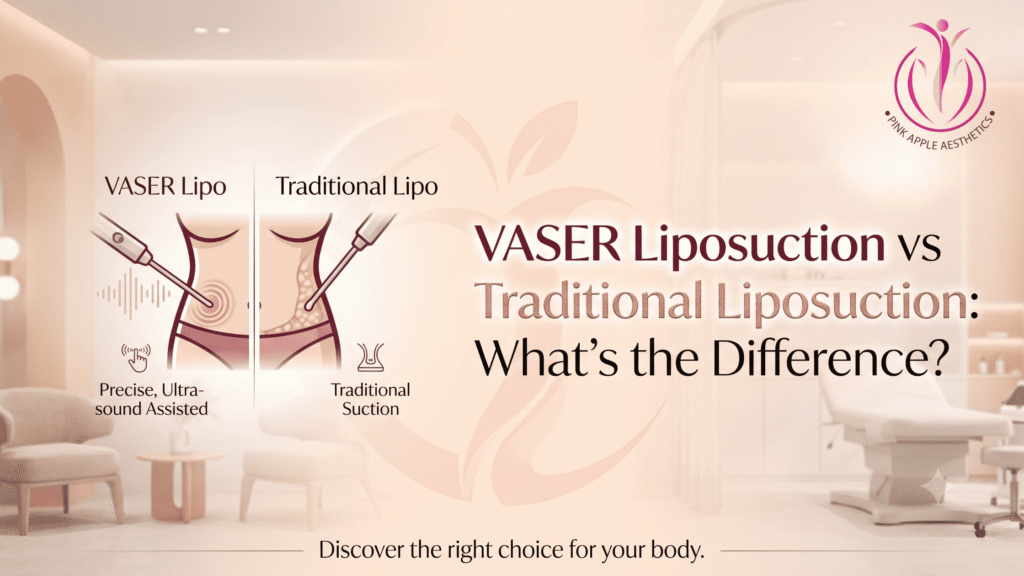
Liposuction is a surgical body-contouring procedure used to remove selected deposits of subcutaneous fat. Over the years, different technologies have been developed to assist surgeons with fat removal, including VASER liposuction, which uses ultrasound energy.
This can make choosing between VASER and traditional liposuction confusing. Is VASER actually better? Does it provide more skin tightening? Is recovery easier? And which technique is appropriate for a particular patient?
The answer is that there is no single liposuction technique that is best for everyone. The appropriate approach depends on factors such as the treatment area, amount and distribution of fat, skin quality, overall health, surgical goals and the surgeon’s experience.
This guide explains the key differences between VASER and traditional liposuction so patients can have a more informed discussion with a qualified plastic surgeon.
What Is Traditional Liposuction?
Traditional liposuction, sometimes called suction-assisted liposuction (SAL), removes unwanted subcutaneous fat using a cannula connected to a suction system.
The surgeon moves the cannula through the fatty layer in controlled passes to remove targeted fat and improve body contours.
Traditional liposuction can be used to treat areas such as:
- Abdomen
- Flanks or love handles
- Thighs
- Upper arms
- Back
- Hips
- Other areas with localized subcutaneous fat
The objective is body contouring rather than significant weight loss.
What Is VASER Liposuction?
VASER stands for Vibration Amplification of Sound Energy at Resonance.
VASER liposuction uses ultrasound energy to assist with the separation of fat cells before they are removed through suction.
The ultrasound energy is delivered through a specialised probe placed within the treatment area.
The technique is intended to allow the surgeon to selectively work with fatty tissue while aiming to preserve surrounding structures.
VASER is therefore not a completely different concept from liposuction. It is an energy-assisted liposuction technique used to facilitate fat removal.
VASER Liposuction vs Traditional Liposuction: Key Differences
| Feature | VASER Liposuction | Traditional Liposuction |
|---|---|---|
| Main technology | Uses ultrasound energy to assist fat removal | Uses mechanical cannula movement and suction |
| Fat removal | Fat is emulsified or disrupted with ultrasound before suction | Fat is removed primarily through cannula movement and suction |
| Treatment approach | Energy-assisted | Suction-assisted |
| Suitability | Depends on anatomy and treatment goals | Widely applicable to many body-contouring procedures |
| Skin considerations | Skin quality remains important | Skin quality remains important |
| Anaesthesia | Depends on extent of surgery | Depends on extent of surgery |
| Recovery | Varies according to treatment extent | Varies according to treatment extent |
| Results | Depends on patient, technique and surgeon | Depends on patient, technique and surgeon |
The technology is only one component of the overall procedure. Patient selection and surgical technique remain critical.
How Does VASER Liposuction Work?
Preoperative Assessment
The surgeon first assesses the areas of localized fat and determines whether liposuction is appropriate.
This may involve evaluating:
- Fat distribution
- Skin elasticity
- Body proportions
- Overall health
- Previous procedures
- Medications
- Treatment goals
Tumescent Infiltration
A fluid solution may be introduced into the treatment area before fat removal.
The exact solution and technique depend on the surgical plan.
Ultrasound Energy
A specialised VASER probe is used to deliver ultrasound energy to the fatty tissue.
The energy helps disrupt the fat before it is removed.
Suction-Assisted Fat Removal
Once the treatment area has been prepared, the surgeon uses a cannula to remove the targeted fat.
The surgeon carefully controls the amount and location of fat removal to create a balanced contour.
How Does Traditional Liposuction Work?
Traditional liposuction also begins with assessment and surgical planning.
After appropriate preparation and infiltration, a cannula is inserted through small incisions.
The surgeon moves the cannula through the fat layer using controlled movements while suction removes the targeted fat.
The emphasis is on creating a smooth and proportionate contour.
Traditional liposuction does not require ultrasound energy to remove the fat.
Is VASER Liposuction More Effective Than Traditional Liposuction?
Not necessarily.
VASER can be useful in selected patients and treatment situations, but it should not automatically be considered superior to traditional liposuction.
The outcome depends on several factors, including:
- Patient anatomy
- Fat distribution
- Skin quality
- Treatment area
- Amount of fat
- Surgical technique
- Surgeon experience
- Postoperative healing
A highly experienced surgeon using an appropriate technique may achieve excellent contouring with traditional liposuction.
Likewise, VASER may be appropriate for selected patients when ultrasound-assisted fat removal offers advantages for the planned procedure.
Does VASER Liposuction Provide Better Skin Tightening?
VASER is sometimes marketed as providing significant skin tightening.
However, patients should be cautious about interpreting this as a guarantee.
VASER may produce some degree of tissue contraction in selected circumstances, but it is not a substitute for surgery designed to remove significant excess skin.
If substantial skin laxity is present, liposuction alone may not provide the desired result.
The surgeon should assess skin elasticity before recommending any fat-removal technique.
Is VASER Better for Muscle Definition?
VASER is sometimes used as part of procedures designed to create more defined body contours.
In carefully selected patients, surgeons may use advanced liposuction techniques to emphasise existing anatomical contours.
However, this does not mean VASER creates muscle or replaces strength training.
The visible result depends on:
- Existing muscle anatomy
- Body-fat distribution
- Skin quality
- Surgical planning
- Individual healing
Patients should have realistic expectations about what surgical contouring can achieve.
Which Areas Can Be Treated?
Both VASER and traditional liposuction can potentially be used for several areas of the body.
Depending on the patient and surgeon’s assessment, these may include:
- Abdomen
- Flanks
- Thighs
- Arms
- Back
- Hips
- Chest in selected cases
- Other areas with localized fat
The appropriate technique depends on the specific treatment area.
A technique suitable for one region may not necessarily be the best option for another.
VASER vs Traditional Liposuction: Which Has Less Recovery Time?
It is difficult to say that one technique always provides a shorter recovery.
Recovery depends on:
- Number of areas treated
- Amount of fat removed
- Surgical technique
- Anaesthesia
- Individual healing
- Overall health
Both procedures can cause temporary swelling, bruising, tenderness and altered sensation.
Your surgeon should provide recovery guidance based on the specific procedure being planned.
What Is Recovery Like After Liposuction?
Regardless of the technology used, liposuction is surgery and requires a recovery period.
Common temporary effects include:
- Swelling
- Bruising
- Tenderness
- Tightness
- Temporary numbness or altered sensation
- Fluid drainage from small access sites
A compression garment may be recommended.
Returning to Normal Activities
Some daily activities may be resumed relatively early, but the timing varies.
Strenuous exercise and heavy lifting should be avoided until your surgeon confirms that it is safe.
The final contour develops gradually as swelling decreases and tissues heal.
Are the Risks Different?
Both techniques carry potential surgical risks.
Possible complications include:
- Infection
- Bleeding
- Fluid accumulation
- Changes in sensation
- Contour irregularities
- Asymmetry
- Skin irregularities
- Scarring
- Anaesthesia-related complications
- Blood clots
- Other uncommon but serious complications
VASER also involves the use of ultrasound energy, which introduces technology-specific considerations.
The actual risk depends on the individual, procedure, treatment area, surgeon and clinical setting.
A qualified plastic surgeon should discuss the risks specific to the planned treatment.
Who Is a Good Candidate for VASER or Traditional Liposuction?
Candidates for either technique may have localized deposits of subcutaneous fat that remain despite healthy lifestyle habits.
Potential candidates generally have:
Stable Weight
Liposuction is not intended to replace weight-loss treatment.
Localized Fat
The procedure is most useful for specific areas of persistent fat rather than generalized obesity.
Reasonable Skin Elasticity
The skin needs to adapt to the reduced volume after fat removal.
Realistic Expectations
Patients should understand that liposuction improves contour but does not guarantee a particular body shape.
Suitable General Health
The surgeon will assess medical history, medications and other factors that may affect surgical safety.
When Might Liposuction Not Be Appropriate?
Liposuction may not be the right choice if the primary concern is:
- Significant overall weight excess
- Major loose skin
- Unrealistic expectations
- Certain uncontrolled medical conditions
- A body contour problem that cannot be adequately addressed through fat removal alone
In these circumstances, another treatment or a different sequence of care may be more appropriate.
How Should You Choose Between VASER and Traditional Liposuction?
Instead of choosing based solely on the name of the technology, consider asking your surgeon why a particular technique is appropriate for your anatomy.
A good consultation should cover:
- Your specific treatment area
- Amount and distribution of fat
- Skin quality
- Expected improvement
- Proposed technique
- Anaesthesia
- Recovery
- Potential complications
- Alternative treatments
The surgeon’s experience with the selected technique is also an important consideration.
VASER Liposuction in Bangalore
If you are considering VASER liposuction in Bangalore, consult a qualified plastic surgeon who can assess whether VASER, traditional liposuction or another approach is appropriate for you.
Avoid choosing a procedure based solely on promotional claims such as “scarless,” “risk-free,” “permanent weight loss” or guaranteed results.
During consultation, ask the surgeon to explain:
- Why the technique is being recommended
- What areas will be treated
- What results are realistically achievable
- How recovery will be managed
- What risks apply to your case
Questions to Ask Your Plastic Surgeon
Why are you recommending VASER instead of traditional liposuction?
The answer should be based on your anatomy and treatment goals rather than simply the availability of a particular device.
What results can I realistically expect?
A surgeon should explain potential improvement without promising a guaranteed outcome.
Do I have enough skin elasticity for liposuction?
Skin quality can significantly influence the final contour.
Would traditional liposuction be equally suitable?
Understanding the alternatives can help you make an informed decision.
What will recovery look like?
Ask about compression garments, activity restrictions, follow-up and expected swelling.
What are the risks in my case?
Your surgeon should discuss risks based on your health and the specific procedure.
Frequently Asked Questions
Is VASER liposuction better than traditional liposuction?
Not necessarily. VASER may be beneficial for selected patients, but the appropriate technique depends on anatomy, treatment goals, skin quality, fat distribution and surgeon expertise.
Is VASER liposuction safer?
Both procedures have potential risks. Safety depends on appropriate patient selection, surgical technique, equipment, monitoring and postoperative care.
Does VASER remove more fat than traditional liposuction?
The amount of fat that can be safely removed depends on the patient and the planned procedure. More aggressive fat removal is not automatically better or safer.
Does VASER permanently remove fat?
The fat cells removed during liposuction are permanently removed from the treated area. However, remaining fat cells can enlarge with significant weight gain.
Does VASER liposuction tighten loose skin?
VASER may produce some tissue contraction in selected cases, but it does not reliably correct significant excess skin. Patients with substantial skin laxity may require a different procedure.
Is VASER liposuction a weight-loss treatment?
No. VASER liposuction is a body-contouring procedure designed to treat localized fat, not significant overall weight loss.
How long does recovery take after VASER liposuction?
Recovery varies according to the extent of treatment and individual healing. Swelling, bruising and tenderness can persist while the tissues recover, and the final contour develops gradually.
The Bottom Line
VASER and traditional liposuction both aim to remove localized subcutaneous fat and improve body contour, but they use different methods to assist fat removal.
VASER uses ultrasound energy before suction-assisted fat removal, while traditional liposuction relies primarily on cannula movement and suction.
Neither technique is universally better. The right choice depends on your anatomy, skin quality, fat distribution, treatment goals, health and the surgeon’s expertise.
If you are considering VASER liposuction in Bangalore, an individual consultation with a qualified plastic surgeon can help you understand whether VASER, traditional liposuction or another treatment is most appropriate for you.


