
Stubborn belly fat is one of the most common concerns men bring up in our clinic. You’ve tried the gym, cut the carbs, maybe even given up beer for months — and yet that layer around the midsection just won’t budge. If this sounds familiar, you’ve probably wondered whether liposuction for men’s belly fat actually works, or whether it’s just a marketing promise.
As practising plastic surgeons who perform body contouring procedures regularly, we want to give you a straight, medically grounded answer: yes, liposuction does work on men’s belly fat — but only for the right candidate, done for the right reasons, with realistic expectations. This guide walks you through how it works, who it’s for, what recovery looks like, and what to consider before booking a consultation for male liposuction in Bangalore.
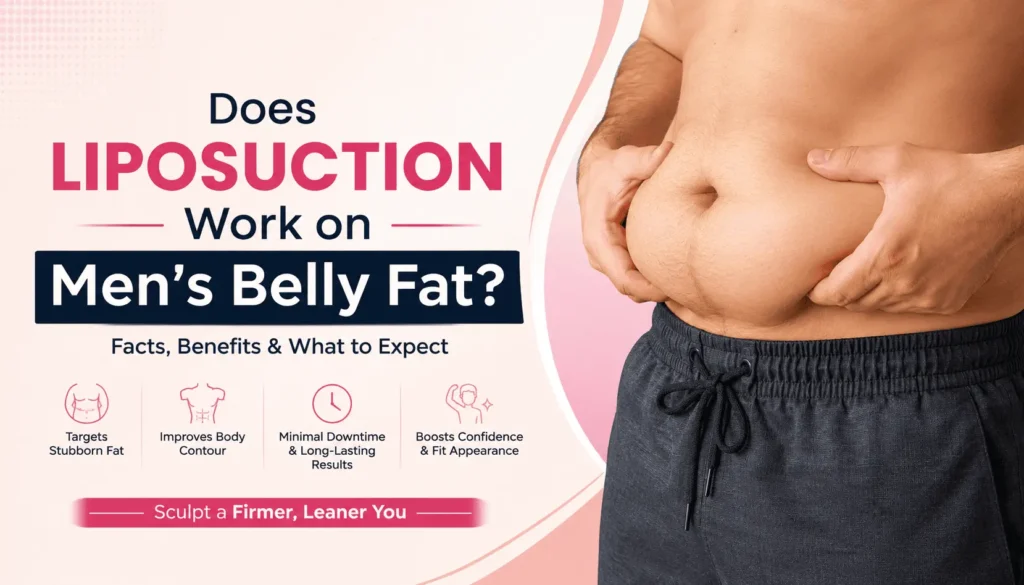
Why Men’s Belly Fat Behaves Differently
Men typically store fat differently than women. Male abdominal fat tends to accumulate both under the skin (subcutaneous fat) and deeper around the organs (visceral fat). This is important because liposuction only removes subcutaneous fat — the layer you can pinch. Visceral fat, the kind linked to metabolic risk, sits inside the abdominal cavity and cannot be removed with liposuction. No surgeon, however skilled, can suction fat from around your liver or intestines.
This is precisely why liposuction is not a treatment for obesity or a substitute for weight loss. It is a body contouring procedure designed to reshape stubborn, diet-and-exercise-resistant subcutaneous fat once you’re already close to a healthy weight.
So, Does Liposuction Actually Work for Belly Fat in Men?
For the right candidate, yes — and the results are usually visible immediately, improving further over the following months as swelling resolves. Liposuction physically removes fat cells from the treated area using a thin cannula connected to gentle suction. Because mature fat cells don’t regenerate once removed, the contour change in the treated zone tends to be long-lasting, provided your weight stays relatively stable afterward.
Where men often see the best results is in areas that respond poorly to diet and exercise: the lower abdomen, love handles (flanks), and the area around the belly button. Many men opt for abdominal liposuction combined with flank liposuction — sometimes called Lipo 360 — for a more complete, evenly contoured midsection rather than treating the front of the belly in isolation.
That said, liposuction will not:
- Fix loose or sagging skin (a separate concern called laxity, which may need a tummy tuck instead)
- Remove visceral fat or improve metabolic health markers
- Give you visible abs if you don’t already have reasonably developed underlying muscle
- Work well if you’re significantly overweight, rather than dealing with localized fat pockets
Who Is a Good Candidate?
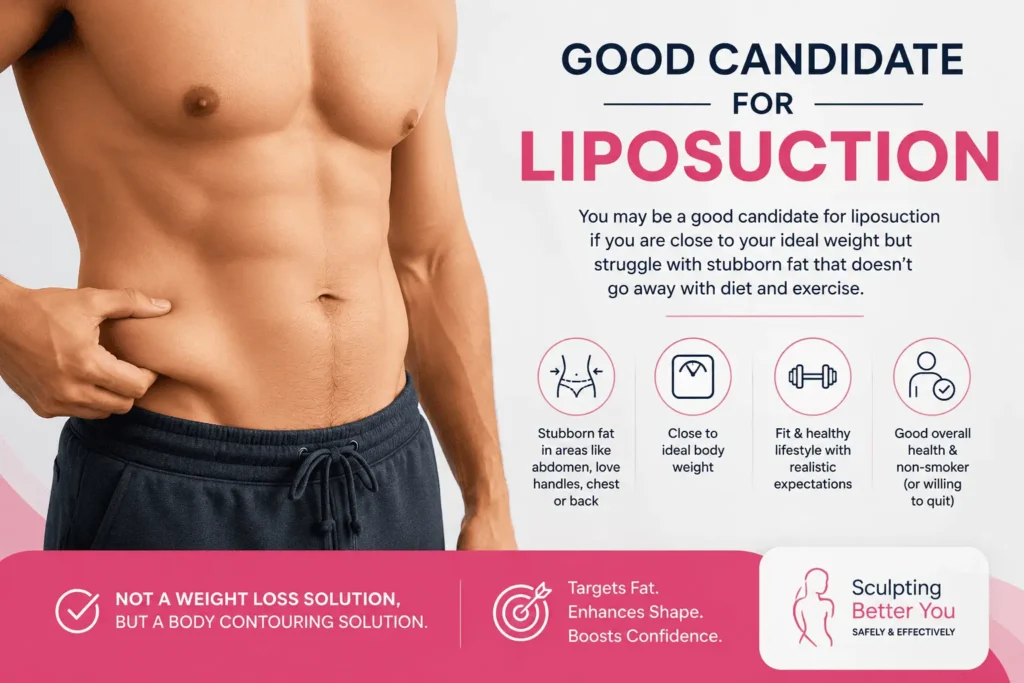
Based on what we assess in consultations at Pink Apple Aesthetics, good candidates for liposuction for men’s belly fat generally:
- Are at or close to a stable, healthy body weight (usually within a reasonable BMI range)
- Have firm, elastic skin with good tone
- Have localized fat deposits that haven’t responded to sustained diet and exercise
- Are non-smokers, or willing to stop smoking well before and after surgery
- Have realistic expectations about contouring rather than dramatic weight loss
- Are in good general health, without uncontrolled diabetes, heart disease, or clotting disorders
If you’re carrying a significant amount of overall body fat, your surgeon may recommend supervised weight loss first. Liposuction on a body that isn’t close to its target weight tends to give underwhelming, uneven results and carries higher surgical risk.
What the Procedure Actually Involves
Modern stomach fat removal surgery is typically performed as tumescent liposuction, sometimes assisted by technologies like VASER (ultrasound-assisted) or power-assisted liposuction, depending on fat consistency and the surgeon’s assessment. In broad terms:
- A tumescent fluid (mixing saline, a local anesthetic, and a vessel-constricting agent) is infused into the fat layer to reduce bleeding and bruising.
- A thin cannula is inserted through small incisions to break up and suction out fat.
- Depending on the extent of treatment, the procedure is done under local anesthesia with sedation, or general anesthesia.
- Compression garments are applied immediately afterward to control swelling and help the skin adapt to the new contour.
Most abdominal liposuction procedures take between one and three hours, depending on the areas treated.
Recovery: What to Realistically Expect
Recovery is one of the most searched — and most misunderstood — parts of this procedure. Here’s a realistic week-by-week picture for abdominal or Lipo 360 procedures:
- First 3–5 days: Swelling, bruising, and soreness are at their peak. Most men take about a week off work, especially for desk jobs.
- 1–2 weeks: Discomfort eases significantly. Compression garments are worn continuously, as advised by your surgeon.
- 2–4 weeks: Light activity and walking resume; strenuous exercise and heavy lifting are still restricted.
- 4–6 weeks: Most swelling has subsided; you can usually return to full workouts with your surgeon’s clearance.
- 3–6 months: Final contour becomes visible as residual swelling fully resolves.
Pain is generally described as manageable soreness and tightness rather than sharp pain, and is controlled with prescribed medication in the initial days. It’s worth noting that recovery experience varies from person to person, and your surgeon will give you a personalized timeline based on the extent of your procedure.
Can Liposuction Fail?
Liposuction can underdeliver or lead to complications when candidacy, technique, or aftercare aren’t right. Common reasons results disappoint include:
- Unrealistic candidacy (too much visceral fat, poor skin tone, or significant excess weight)
- Uneven fat removal, leading to contour irregularities
- Not following post-op garment and activity instructions
- Significant weight regain after the procedure
- Choosing an inexperienced or unqualified operator
Choosing a board-certified plastic surgeon with specific experience in male body contouring — and having an honest, detailed consultation beforehand — is the single biggest factor in avoiding a disappointing outcome. Ask to see before-and-after cases of male patients specifically, since male and female abdominal contouring differ in technique and goals.
Why Location and Surgeon Choice Matter
If you’re researching liposuction clinic in Bangalore options, look beyond price. Verify the surgeon’s qualifications (MCh or equivalent plastic surgery training, registration with the Medical Council), the facility’s accreditation, and whether they offer a proper in-person consultation and assessment rather than a same-day sales pitch. Bangalore has a growing number of accredited cosmetic surgery centers, including Pink Apple Aesthetics, where consultations typically include a physical assessment of fat distribution, skin quality, and a candid discussion of what liposuction can and cannot achieve for your body.
Cost Considerations in India
Liposuction cost for men in India varies based on the number of areas treated, the technique used (standard tumescent vs. VASER), anesthesia type, surgeon experience, and hospital facility charges. Abdominal-only procedures cost less than a full Lipo 360 combining the abdomen, flanks, and sometimes the back. During your consultation, ask for a detailed, itemized quote rather than a flat number, so you understand exactly what’s included — surgeon’s fee, anesthesia, facility charges, garments, and follow-up visits.
Final Thoughts
Liposuction genuinely works for stubborn, diet-resistant belly fat in men who are already close to their ideal weight and have good skin elasticity — but it is a contouring tool, not a weight-loss or health intervention. The best results come from realistic expectations, an honest assessment of your candidacy, and a qualified plastic surgeon who understands male body contouring specifically.
If you’re considering male liposuction in Bangalore, the right first step is a proper consultation — not a quick quote over the phone. At Pink Apple Aesthetics, our approach starts with understanding your body, your goals, and whether liposuction is truly the right solution for you.
Frequently Asked Questions
Is male liposuction worth it?
For men with stubborn, localized fat that hasn’t responded to diet and exercise, and who have good skin elasticity, liposuction is often worth it — it delivers visible, long-lasting contour improvement. It’s not “worth it” as a weight-loss shortcut for men who are significantly overweight; in that case, addressing overall weight first usually gives better, safer results.
How painful is Lipo 360 recovery?
Most men describe Lipo 360 recovery as soreness, tightness, and swelling rather than sharp pain, especially in the first 3–5 days. Prescribed pain medication and compression garments help manage discomfort. Since Lipo 360 covers more surface area than single-zone liposuction, expect a slightly longer initial recovery window — typically 1–2 weeks before returning to normal daily activity.
Can liposuction fail?
Yes, results can disappoint if candidacy wasn’t ideal to begin with, technique was inconsistent, aftercare instructions weren’t followed, or significant weight is regained post-surgery. Choosing an experienced, board-certified plastic surgeon and following pre- and post-operative guidance significantly reduces this risk.
What is the best age for men to do liposuction?
There’s no single “best age” — candidacy depends more on skin elasticity, overall health, and stable weight than age itself. That said, younger and middle-aged men (typically 20s to 50s) often see the most predictable results because skin tends to retract better onto the new contour. Older men can still be excellent candidates if skin quality and health are good; this is best assessed individually during a consultation.


